Stock Analysis · Nordic Semiconductor ASA (NDCVF)
Overview
Nordic Semiconductor ASA is a fabless semiconductor company focused on low-power wireless chips and related software. In simple terms, it designs the components that let devices connect wirelessly while using very little battery power. Its products are used in areas such as smart home devices, wearables, healthcare equipment, industrial sensors, asset tracking, and other Internet of Things applications.
The company’s business is centered on short-range and cellular connectivity. Nordic is especially well known for Bluetooth Low Energy chips, a category used in devices that need to stay connected for long periods without frequent charging. It also sells products for cellular IoT, Wi‑Fi, power management, cloud services, development tools, and software that make those chips easier for customers to integrate into finished products.
Based on company reporting, revenue is primarily generated from semiconductor product sales, with the following structure being the most useful practical breakdown:
- Bluetooth Low Energy and other short-range wireless solutions: approximately 65% to 75% of revenue. This includes the company’s core nRF wireless systems-on-chip used in consumer, medical, and industrial IoT products.
- Cellular IoT solutions: approximately 15% to 25% of revenue. These products are aimed at devices that need wide-area connectivity, such as trackers, smart meters, and remote monitoring equipment.
- Wi‑Fi, power management, software, and other products/services: approximately 5% to 10% of revenue. This includes newer adjacent offerings designed to expand Nordic’s share of each customer design.
That mix matters because it shows a company still anchored in one strong franchise, but increasingly trying to become a broader connectivity platform rather than a single-product chip vendor.
The multi-year operating picture also shows a business that remained heavily committed to research and development even during the downturn. Revenue fell sharply in 2023 and 2024 after a very strong 2022, but spending on product development stayed high, which helps explain why profit became volatile.
Key Figures
| Metric | Value | Sector ⓘ |
|---|---|---|
| Date | Sep 12, 2026 | |
| Context | ||
| Sector | Technology | |
| Industry | Semiconductors | |
| Market Cap ⓘ | $3.69B | |
| Beta ⓘ | 0.98 | |
Value (Cheapness) | ||
| P/E Ratio ⓘ | 116.62 | 29.51 |
| FCF Yield ⓘ | -0.27% | 4.25% |
| EBIT / EV ⓘ | 0.93% | 2.85% |
| PEG ⓘ | 0.78 | |
Growth (Business expansion) | ||
| Revenue Growth ⓘ | 33.20% | 15.40% |
| RPS Growth (5Y CAGR) ⓘ | 1.80% | 8.56% |
| EPS Growth (5Y CAGR) ⓘ | -35.95% | -11.88% |
| Margin Growth (5Y Trend) ⓘ | -10.52% | 0.46% |
| FCF Growth (5Y CAGR) ⓘ | 1.19% | 9.80% |
Quality (Business durability) | ||
| ROIC (Latest) ⓘ | N/A | 9.44% |
| ROIC (5Y Median) ⓘ | 4.31% | 8.30% |
| Net Debt / EBIT (Latest) ⓘ | -3.54 | 0.54 |
| Net Debt / EBIT (5Y Median) ⓘ | -4.55 | 0.44 |
| Operating Margin (Latest) ⓘ | 4.30% | 9.58% |
| Operating Margin (5Y Median) ⓘ | 3.58% | 8.25% |
| Debt to Equity (Latest) ⓘ | 22.98% | 33.33% |
| Profit Margin (Latest) ⓘ | 4.24% | 7.14% |
| Free Cash Flow (Latest) ⓘ | -$9.87M | |
Momentum (Price trend) | ||
| 3Y Return ⓘ | +72.78% | +45.48% |
| 12M Return (excl. last month) ⓘ | +33.56% | +23.48% |
| 6M Return ⓘ | +23.33% | +20.93% |
| Price vs. 200-Day MA ⓘ | +12.38% | +7.43% |
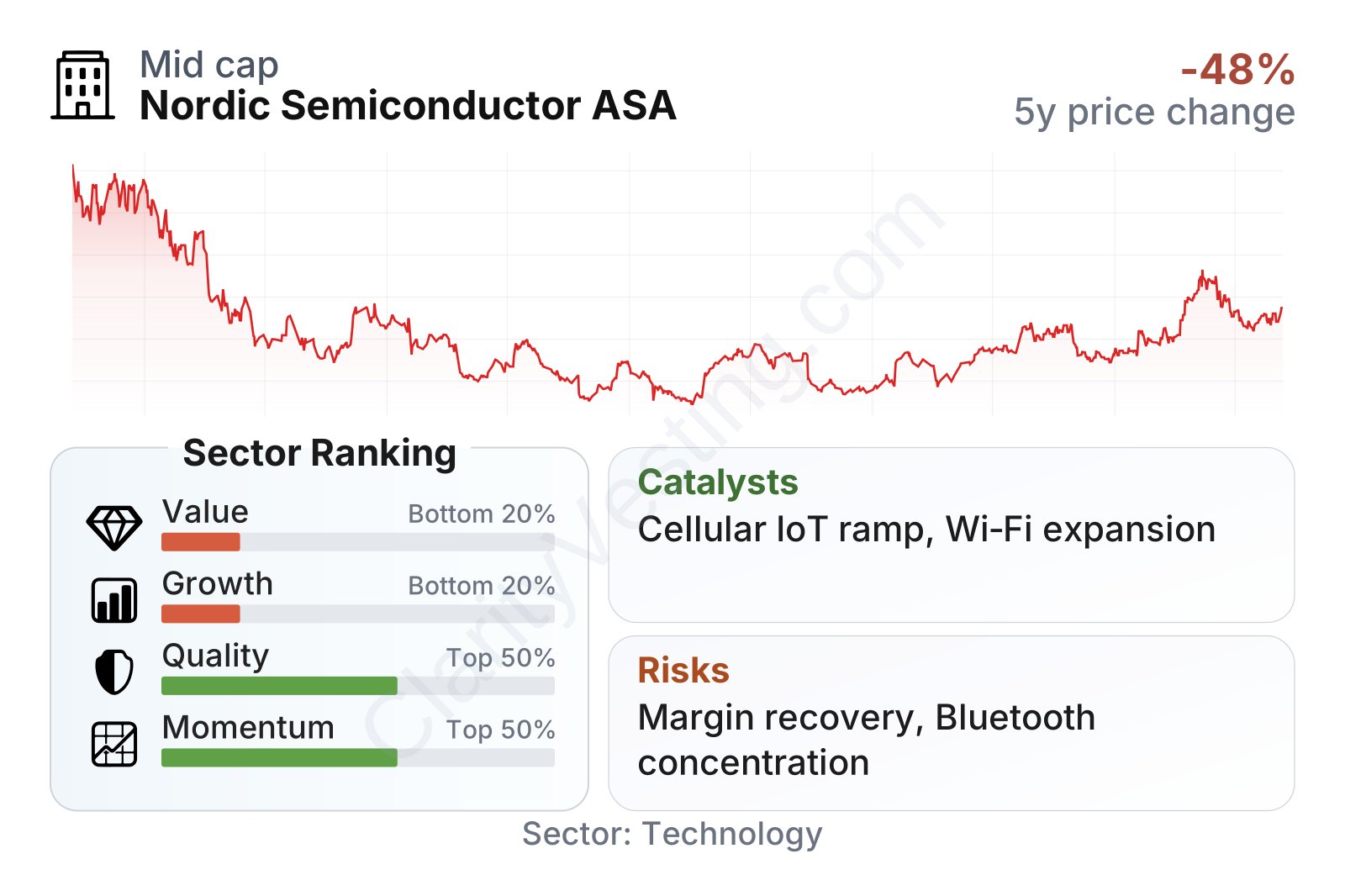
Nordic is a mid-sized semiconductor company with a market value in the low single-digit billions of dollars and a share price that has been highly cyclical over the past few years. The metrics table points to a mixed profile. Balance sheet quality looks healthier than many semiconductor peers, helped by low leverage and net cash. However, profitability remains below the sector median, and valuation multiples are elevated relative to current earnings and cash generation. Recent revenue growth has improved, but the longer five-year trend still reflects the deep inventory correction that hit the business after its 2022 peak.
Growth
Nordic operates in an attractive long-term market. Low-power connected devices are expected to keep expanding across consumer electronics, healthcare, logistics, industrial automation, and smart infrastructure. Even when the chip cycle turns weak, the underlying direction remains favorable because more devices are being designed to sense, communicate, and run on batteries for long periods.
Its strategy is logical for that environment. Rather than competing across the entire semiconductor industry, Nordic focuses on low-power wireless connectivity where it already has strong engineering credibility. The company has been widening its platform from Bluetooth into cellular IoT, Wi‑Fi, power management, and software tools. That can increase revenue per customer design and make Nordic harder to replace once a customer has built a product around its ecosystem.
The recent revenue trend suggests the business is in recovery mode after a sharp correction. Growth turned deeply negative during the inventory downturn, then rebounded strongly as customer stock levels normalized. The latest year-over-year pace remains above the semiconductor sector median, which is encouraging, but the five-year growth record is still weaker than many peers because the company lost momentum for several quarters before the rebound took hold.
Cash generation tells a similar story. Free cash flow moved from clearly positive to negative during the downturn, then recovered, although the latest trailing level is still modest for a company of this size. That means the business is improving, but not yet consistently producing the level of cash that would make the growth profile look fully mature.
Several catalysts could matter over the next few years. Nordic has been pushing further into cellular IoT, an area that could become more meaningful if large fleets of trackers, smart meters, and industrial monitoring devices scale up. The company has also expanded its product offering with Wi‑Fi and power management solutions, which could deepen customer relationships and improve content per device. In addition, as inventories across the electronics supply chain continue to normalize, demand can recover faster than earnings because fixed operating costs were maintained during the weak period.
Recent company communications have also highlighted continued design wins and a broader product roadmap. For a semiconductor company, these wins do not convert into revenue immediately, but they can support future growth because chips are often selected early in a product’s development cycle and then remain embedded for years.
Risks
This article is for informational purposes only and does not constitute financial advice. Some content is AI-generated. See Disclaimer