Stock Analysis · NICE Ltd (NCSYF)
Overview
NICE Ltd is an enterprise software company focused on customer experience, contact centers, compliance, financial crime prevention, and public safety. In simple terms, it sells software that helps large organizations manage customer interactions, automate service workflows, analyze conversations and data, monitor compliance, and detect fraud. The company has increasingly shifted toward cloud-based subscriptions, which makes its business more recurring and generally easier to scale than traditional one-time software licenses.
NICE reports its business in two main segments. Based on recent annual reporting, revenue is primarily split as follows:
- Cloud segment: about 67% of revenue. This includes CXone and other cloud platforms used for contact center operations, customer engagement, workforce optimization, analytics, and AI-driven automation.
- Non-cloud segment: about 33% of revenue. This includes on-premise customer engagement software, compliance solutions, financial crime and fraud prevention products, and public safety and justice-related software and services.
Within the overall mix, the largest underlying engine is customer experience software, especially cloud contact center tools. A smaller but still meaningful contribution comes from compliance, fraud prevention, and public sector software. The business model is attractive because a large portion of revenue comes from subscriptions, support, and long-term customer relationships rather than one-off transactions.
Over the last several years, the company has expanded revenue steadily while improving profitability. Revenue rose from roughly $2.0 billion in 2021 to about $3.2 billion in 2025, while operating income and net income grew faster than sales. That points to improving scale and a stronger software mix.
The revenue base has been expanding while gross profit has grown even faster in absolute dollars, and operating income has widened materially over time. That combination suggests the business has been shifting toward higher-value software and cloud revenue rather than simply growing through heavier spending.
Key Figures
| Metric | Value | Sector ⓘ |
|---|---|---|
| Date | Jul 27, 2026 | |
| Context | ||
| Sector | Technology | |
| Industry | Software - Application | |
| Market Cap ⓘ | $5.61B | |
| Beta ⓘ | 0.00 | |
Value (Cheapness) | ||
| P/E Ratio ⓘ | 11.38 | 31.75 |
| FCF Yield ⓘ | 10.17% | 4.26% |
| EBIT / EV ⓘ | 13.23% | 2.64% |
| PEG ⓘ | 0.58 | |
Growth (Business expansion) | ||
| Revenue Growth ⓘ | 9.80% | 13.85% |
| RPS Growth (5Y CAGR) ⓘ | 13.96% | 8.57% |
| EPS Growth (5Y CAGR) ⓘ | -48.04% | -20.46% |
| Margin Growth (5Y Trend) ⓘ | 9.64% | 0.44% |
| FCF Growth (5Y CAGR) ⓘ | 16.48% | 9.80% |
Quality (Business durability) | ||
| ROIC (Latest) ⓘ | 12.83% | 8.56% |
| ROIC (5Y Median) ⓘ | 8.84% | 8.12% |
| Net Debt / EBIT (Latest) ⓘ | -0.28 | 0.40 |
| Net Debt / EBIT (5Y Median) ⓘ | 0.59 | 0.44 |
| Operating Margin (Latest) ⓘ | 21.24% | 9.58% |
| Operating Margin (5Y Median) ⓘ | 19.41% | 8.25% |
| Debt to Equity (Latest) ⓘ | 2.34% | 33.82% |
| Profit Margin (Latest) ⓘ | 17.57% | 6.94% |
| Free Cash Flow (Latest) ⓘ | $570.12M | |
Momentum (Price trend) | ||
| 3Y Return ⓘ | -50.79% | +34.90% |
| 12M Return (excl. last month) ⓘ | -49.75% | +23.26% |
| 6M Return ⓘ | -11.97% | +4.78% |
| Price vs. 200-Day MA ⓘ | -7.33% | +4.98% |
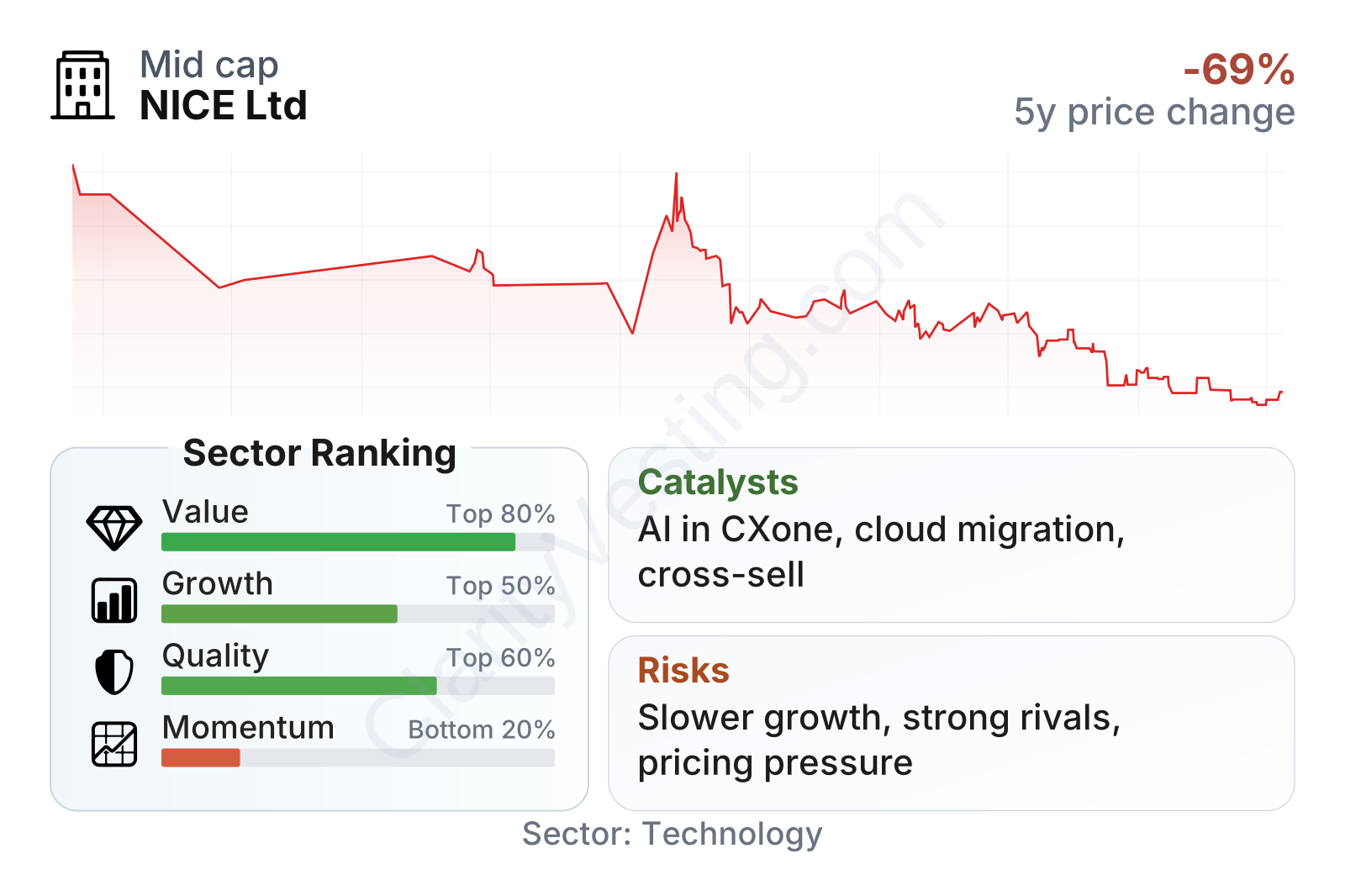
NICE is a mid-sized software company by market value, but its profitability and cash generation look stronger than many peers. The value metrics stand out: the earnings multiple is far below the sector median, while free cash flow yield and earnings relative to enterprise value are well above typical software levels. Quality is also solid, with operating margin around 21%, profit margin near 18%, and returns on invested capital ahead of the sector median. Growth is more mixed: recent revenue growth is close to 9% year over year, which is below many faster-growing software names, but five-year revenue per share and free cash flow growth remain healthy. The weak point is momentum, as the stock has fallen sharply over the past one- and three-year periods.
Growth
NICE operates in a sector with durable long-term demand. Companies continue to invest in cloud contact centers, AI-assisted customer service, workflow automation, compliance tools, and fraud prevention. These are not niche needs. They are tied to labor efficiency, customer retention, regulatory pressure, and risk control, which makes the addressable market broad and resilient.
The company’s strategy appears coherent. NICE has spent years moving customers from on-premise products to cloud subscriptions while adding more analytics, automation, and AI functions around the core contact center platform. That matters because cloud software tends to create recurring revenue, lower churn when deeply integrated, and stronger cross-selling opportunities over time.
Recent growth is no longer at the rapid pace seen earlier in the cloud software cycle, but it has remained positive and fairly consistent, mostly in the mid- to low-teens range before settling closer to high single digits more recently. That pattern suggests the business is maturing rather than stalling. For a company already generating substantial profits, moderate growth can still be meaningful if margins keep improving.
Free cash flow has increased significantly over the last five years, even with some pullback from a peak level. That is an important signal for long-term analysis because it shows NICE is not relying only on accounting earnings. The company is converting a meaningful portion of revenue into real cash, which can support product investment, acquisitions, and balance sheet strength.
A major catalyst is the broader adoption of AI in customer service. NICE has been embedding AI capabilities into CXone, including self-service, agent assistance, workflow automation, and analytics. If enterprises continue to replace older contact center systems with cloud platforms that use AI to reduce costs and improve service quality, NICE is positioned to benefit. Another growth lever is cross-selling: large customers that start with contact center tools can later add workforce management, analytics, compliance, or fraud solutions.
Recent company communications have also highlighted continued cloud momentum and AI-related product development. That does not guarantee acceleration, but it supports the idea that NICE is aligned with current enterprise software spending priorities rather than being tied to a fading technology stack.
Risks
This article is for informational purposes only and does not constitute financial advice. Some content is AI-generated. See Disclaimer