Stock Analysis · Buckle Inc (BKE)
Overview
Buckle Inc. is a specialty apparel retailer focused on denim, casual clothing, footwear, and accessories for young men and women. The company operates under the Buckle brand through a nationwide store base and an e-commerce platform. Its assortment includes both private-label merchandise and well-known third-party brands, with denim remaining the centerpiece of the business. The model is relatively straightforward: Buckle sells fashion products at full price more often than many peers, relies heavily on in-store service and styling, and supports that with online ordering and fulfillment.
Revenue comes primarily from merchandise sales to retail customers. Based on company disclosures, the business is overwhelmingly tied to direct product sales rather than services or licensing. The most useful breakdown available is by merchandise category and channel.
- Denims: typically the largest category, often around 40% to 45% of net sales. This includes jeans and related bottoms, which are central to Buckle’s brand identity.
- Tops: generally around 25% to 30% of sales. This includes shirts, knits, fleece, outerwear, and fashion tops.
- Accessories: usually around 10% to 15% of sales. This category includes jewelry, belts, bags, sunglasses, fragrance, and similar items.
- Footwear: generally around 8% to 12% of sales.
- Sportswear/Fashion bottoms/Other apparel categories: the remainder, often in the single-digit to low-teens percentage range depending on the year and company classification.
- Online sales: digital revenue is meaningful but still smaller than store revenue, typically representing a low-teens percentage of total net sales in recent years.
- Physical stores: the large majority of revenue, generally accounting for well above 80% of sales.
Buckle’s economics stand out for an apparel retailer. Over the last several years, the company has converted a large share of revenue into operating income and net income, helped by disciplined inventory management and strong gross margins. Revenue and profit have come off their peak levels, but the overall earnings structure remains stronger than is typical in the sector.
The business mix has been fairly stable, and the main visible shift recently is that sales and profits recovered in the latest fiscal year after a softer period in 2024 and 2025. Even with that recovery, Buckle remains a concentrated retail model built around fashion apparel, especially denim, rather than a diversified consumer platform.
Key Figures
| Metric | Value | Sector ⓘ |
|---|---|---|
| Date | Sep 12, 2026 | |
| Context | ||
| Sector | Consumer Cyclical | |
| Industry | Apparel Retail | |
| Market Cap ⓘ | $2.08B | |
| Beta ⓘ | 1.02 | |
Value (Cheapness) | ||
| P/E Ratio ⓘ | 9.39 | 17.10 |
| FCF Yield ⓘ | 9.22% | 8.53% |
| EBIT / EV ⓘ | 11.55% | 6.46% |
| PEG ⓘ | 3.32 | |
Growth (Business expansion) | ||
| Revenue Growth ⓘ | 4.60% | 5.75% |
| RPS Growth (5Y CAGR) ⓘ | -0.59% | 9.14% |
| EPS Growth (5Y CAGR) ⓘ | -26.00% | -18.21% |
| Margin Growth (5Y Trend) ⓘ | -4.64% | -0.23% |
| FCF Growth (5Y CAGR) ⓘ | -8.43% | 4.91% |
Quality (Business durability) | ||
| ROIC (Latest) ⓘ | 47.36% | 12.61% |
| ROIC (5Y Median) ⓘ | 55.71% | 10.72% |
| Net Debt / EBIT (Latest) ⓘ | 0.50 | 2.10 |
| Net Debt / EBIT (5Y Median) ⓘ | 0.16 | 2.32 |
| Operating Margin (Latest) ⓘ | 22.18% | 9.25% |
| Operating Margin (5Y Median) ⓘ | 22.93% | 9.64% |
| Debt to Equity (Latest) ⓘ | 86.18% | 75.78% |
| Profit Margin (Latest) ⓘ | 16.62% | 5.33% |
| Free Cash Flow (Latest) ⓘ | $191.32M | |
Momentum (Price trend) | ||
| 3Y Return ⓘ | +55.58% | +14.53% |
| 12M Return (excl. last month) ⓘ | -11.49% | +3.08% |
| 6M Return ⓘ | -18.46% | +0.55% |
| Price vs. 200-Day MA ⓘ | -15.90% | -0.54% |
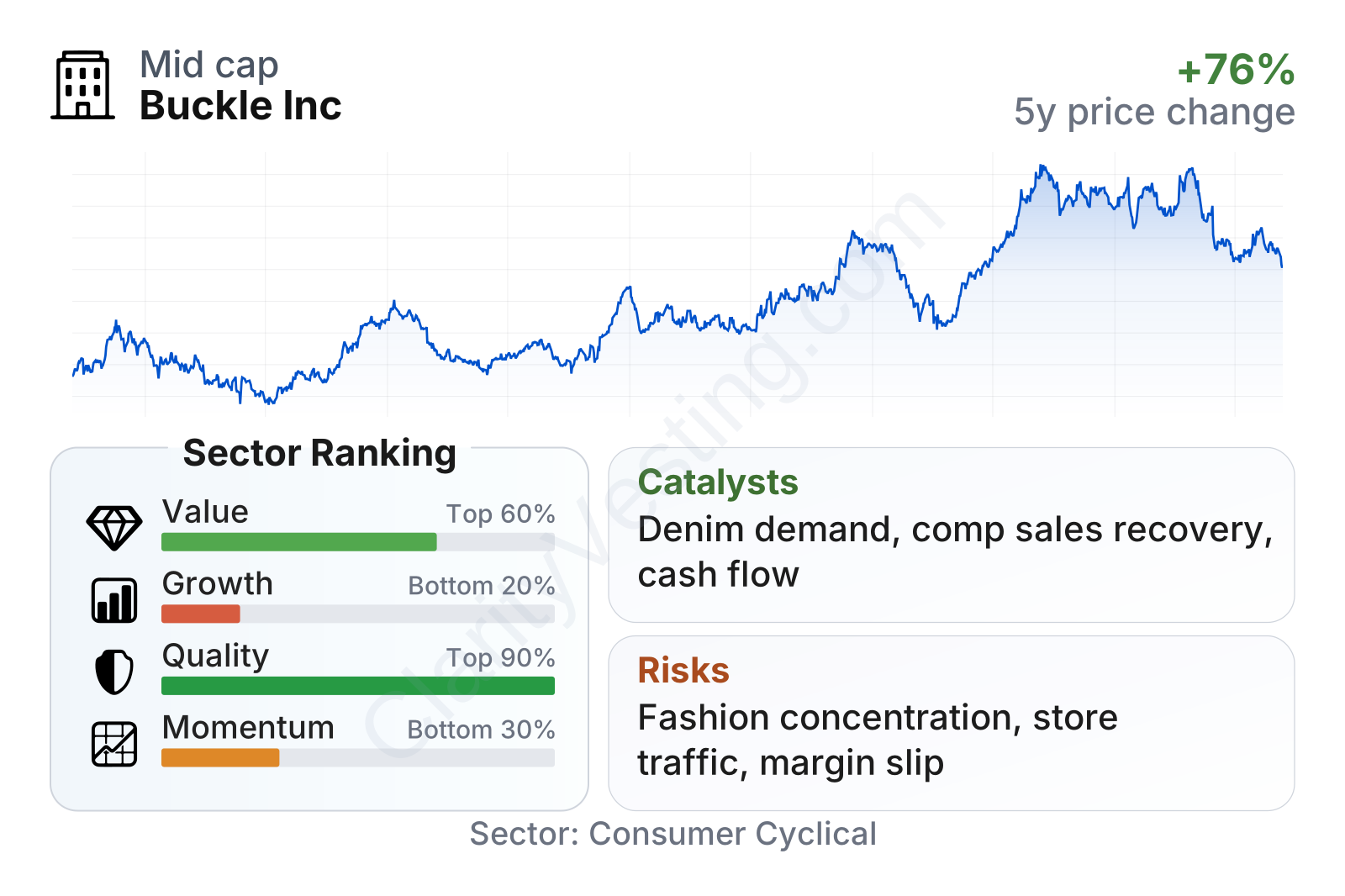
Buckle is a mid-sized public retailer with a market value a little above $2 billion and share-price volatility close to the broader market. The most notable feature in the metrics table is the contrast between very strong quality and weak growth. Profitability is far ahead of the sector median, with operating margin around 22%, profit margin around 17%, and return on invested capital far above most apparel retailers. Cash generation is also solid, with trailing free cash flow around $221 million.
At the same time, Buckle ranks poorly on growth. Recent year-over-year revenue growth is positive at roughly 5%, but the longer-term record is less impressive, with five-year revenue per share and free cash flow trends under pressure and earnings growth trailing the sector. That combination helps explain why the stock trades on a lower earnings multiple than many peers despite unusually strong margins.
Growth
The apparel retail sector is mature, competitive, and not a structural high-growth market. Long-term expansion usually comes from brand strength, inventory discipline, digital execution, store productivity, and market-share gains rather than from rapid industry growth. In that environment, Buckle’s strategy is sensible but narrow. It emphasizes a focused customer demographic, a denim-led assortment, personalized store service, and a mix of private-label and branded merchandise. That can work well when fashion trends align with its core categories, but it does not create the same number of growth avenues as larger competitors with broader international reach, multiple banners, or more advanced digital ecosystems.
Recent revenue trends are better than the longer-term picture. After a stretch of negative year-over-year comparisons, Buckle returned to positive sales growth through fiscal 2026, generally in the mid-single-digit range. That matters because it suggests the business is still capable of stabilizing demand and regaining momentum when assortments and consumer trends improve. Still, the wider five-year record shows a company that has been more resilient than expansive.
Free cash flow has remained healthy and relatively steady, staying around the low $200 million range in recent years. That is important for a retailer because it gives the company flexibility to fund store updates, support e-commerce, carry inventory conservatively, and continue returning capital to shareholders without relying heavily on outside financing. Buckle has historically paid regular dividends and, at times, special dividends, which reflects the cash-producing nature of the business, though those distributions do not themselves create growth.
The most credible catalyst is not a breakthrough new market but continued execution in categories where Buckle already has traction. If denim demand remains healthy, if private-label products continue to support gross margin, and if digital sales keep complementing the store base rather than replacing it, the company can continue producing respectable results. A smaller but still relevant opportunity comes from operating efficiency: because Buckle already runs with high margins, even modest sales gains can translate into meaningful profit support.
Recent company updates in 2026 point more toward steady operating progress than a major transformation. Comparable-store sales and monthly sales releases remain worth watching because they can quickly show whether demand is holding up. For Buckle, near-term opportunity is tied much more to merchandise execution and consumer traffic than to acquisitions, international expansion, or major strategic reinvention.
Risks
This article is for informational purposes only and does not constitute financial advice. Some content is AI-generated. See Disclaimer


