Stock Analysis · nCino Inc (NCNO)
Overview
nCino is a cloud software company focused on banks, credit unions, mortgage lenders, and other financial institutions. Its main product is the nCino Bank Operating System, a platform that helps customers manage lending, onboarding, account opening, compliance, and workflow automation in one place. In simple terms, nCino sells software that helps financial institutions replace slow manual processes, paper-based steps, and disconnected legacy systems.
The company makes most of its money from recurring software subscriptions, with the rest coming from professional services such as implementation, consulting, and training. Based on recent annual reporting, revenue is split approximately as follows:
- Subscription revenue: about 84% of total revenue. This includes access to the core cloud platform and related software modules.
- Professional services: about 16% of total revenue. This mainly covers deployment, configuration, advisory work, and customer support tied to new rollouts or expansions.
Geographically, nCino still depends heavily on the United States, but it also has a growing international presence, especially in markets where banks are modernizing their digital systems. The business model is attractive because subscription revenue tends to be recurring, more predictable, and usually carries better margins than services. That said, professional services remain important because they help customers adopt the platform and can support later subscription expansion.
Over the last several years, the company has expanded from commercial lending into adjacent products such as consumer banking, mortgage technology, small business tools, and artificial intelligence-enabled capabilities. This broadens nCino’s addressable market and gives it more ways to deepen relationships with existing customers instead of depending only on winning brand-new clients.
The financial flow also shows a useful trend: revenue and gross profit have risen steadily over five years, while operating losses narrowed and recently turned into positive operating income. Research and development remains a large expense, which fits a software company still investing in product depth, but the overall direction suggests improving scale.
Key Figures
| Metric | Value | Sector ⓘ |
|---|---|---|
| Date | Sep 12, 2026 | |
| Context | ||
| Sector | Technology | |
| Industry | Software - Application | |
| Market Cap ⓘ | $2.27B | |
| Beta ⓘ | 0.69 | |
Value (Cheapness) | ||
| P/E Ratio ⓘ | 69.13 | 29.51 |
| FCF Yield ⓘ | 5.83% | 4.25% |
| EBIT / EV ⓘ | 1.24% | 2.85% |
| PEG ⓘ | N/A | |
Growth (Business expansion) | ||
| Revenue Growth ⓘ | 8.20% | 15.40% |
| RPS Growth (5Y CAGR) ⓘ | 16.42% | 8.56% |
| EPS Growth (5Y CAGR) ⓘ | N/A | -11.88% |
| Margin Growth (5Y Trend) ⓘ | N/A | 0.46% |
| FCF Growth (5Y CAGR) ⓘ | N/A | 9.80% |
Quality (Business durability) | ||
| ROIC (Latest) ⓘ | 6.52% | 9.44% |
| ROIC (5Y Median) ⓘ | -2.80% | 8.30% |
| Net Debt / EBIT (Latest) ⓘ | 7.39 | 0.54 |
| Net Debt / EBIT (5Y Median) ⓘ | N/A | 0.44 |
| Operating Margin (Latest) ⓘ | 4.97% | 9.58% |
| Operating Margin (5Y Median) ⓘ | -7.93% | 8.25% |
| Debt to Equity (Latest) ⓘ | 36.42% | 33.33% |
| Profit Margin (Latest) ⓘ | 5.40% | 7.14% |
| Free Cash Flow (Latest) ⓘ | $132.17M | |
Momentum (Price trend) | ||
| 3Y Return ⓘ | -31.63% | +45.48% |
| 12M Return (excl. last month) ⓘ | -28.08% | +23.48% |
| 6M Return ⓘ | +39.62% | +20.93% |
| Price vs. 200-Day MA ⓘ | +11.45% | +7.43% |
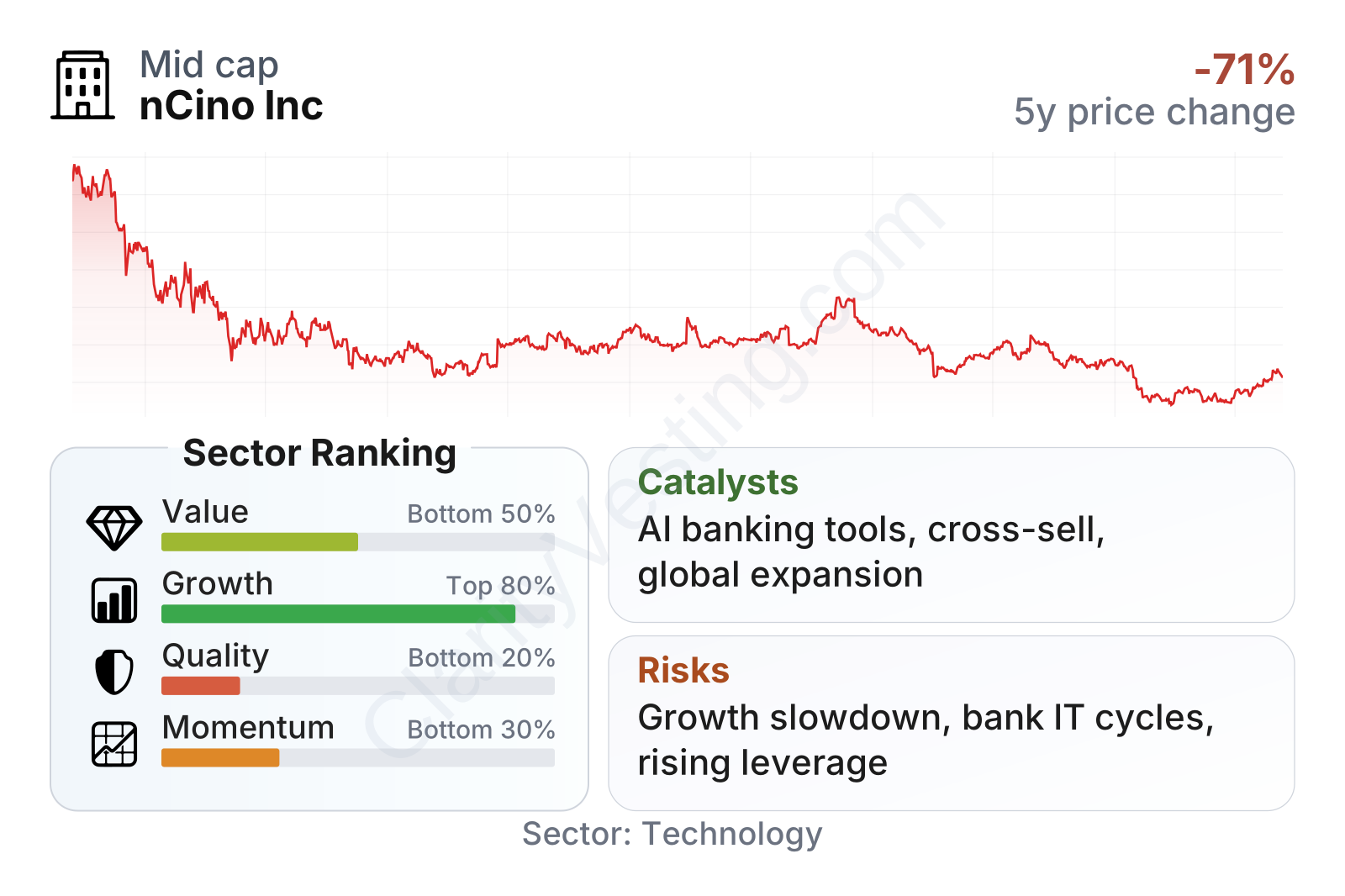
nCino is a mid-sized software company with a market value in the low single-digit billions of dollars and a relatively low beta, which means its share price has historically moved less violently than many technology names. The factor summary is mixed. Growth remains stronger than a large part of the software sector over a five-year view, but quality metrics are still below sector norms because profitability and returns on invested capital have only recently moved into healthier territory. Value metrics also look weak at first glance because the earnings multiple remains elevated, even after a major stock-price decline from earlier highs.
The stock history highlights how much sentiment has changed. Shares traded above $60 in 2021 and fell to the mid-teens by mid-2026. That large reset means the market is no longer pricing nCino like a high-growth software favorite. Even so, recent momentum has improved compared with the last six months, suggesting that the market has started to react more positively to the company’s shift toward profitability and cash generation.
Growth
nCino operates in a sector with a credible long-term growth backdrop. Banks and other lenders still run many core processes on older systems, spreadsheets, email chains, and fragmented software. Digital transformation in financial services is not a short fad; it is tied to cost reduction, regulatory pressure, customer experience, and the need to process loans and account openings faster. That gives nCino exposure to a market where modernization demand can continue for years.
The company’s strategy also makes sense. Rather than selling a single narrow tool, nCino is trying to become a broader operating platform for financial institutions. That matters because platform vendors can benefit from cross-selling: once a bank uses the system for commercial lending, it may later add consumer, small business, onboarding, analytics, or mortgage capabilities. This can increase revenue per customer without requiring the same effort as landing a new institution from scratch.
Growth has clearly cooled from the unusually fast pace seen a few years ago. Revenue expansion was above 40% to 50% during an earlier phase, then slowed into the low-teens and recently into a high-single-digit to low-double-digit range. That is a meaningful deceleration, and recent annual growth of about 8% sits below the broader software sector median. Still, the longer view is more favorable: five-year revenue-per-share growth remains well ahead of the sector median, which suggests the company has built real scale even as its pace has normalized.
Cash generation is one of the most encouraging developments. Free cash flow was negative a few years ago, then turned positive and climbed to more than $80 million on a trailing basis in the most recent period shown, while the latest quality snapshot indicates trailing free cash flow around $132 million. For a software company coming out of an investment-heavy stage, this shift matters because it shows the business is no longer relying only on revenue growth to support the equity case; it is also beginning to convert that growth into real cash.
A notable catalyst is the company’s ongoing focus on AI and automation for banks. nCino has been integrating more intelligence-driven features into its platform, including tools intended to improve decision speed, workflow efficiency, and customer interaction. Another catalyst is international expansion, especially where banks are still early in core process digitization. In addition, any improvement in banking technology spending or stabilization in mortgage and lending activity could help demand, since nCino’s products are closely tied to loan origination and account-opening activity.
Risks
This article is for informational purposes only and does not constitute financial advice. Some content is AI-generated. See Disclaimer


