Stock Analysis · MaxLinear Inc (MXL)
Overview
MaxLinear is a semiconductor company that designs chips and software used to move, process, and connect data. Its products are found in broadband access equipment, wired and wireless infrastructure, and data center or industrial networking systems. In simple terms, the company sells the components that help internet service providers, equipment makers, and enterprise customers move large amounts of data more efficiently.
The business is fabless, which means MaxLinear designs chips but relies on outside manufacturing partners to produce them. That model can reduce the need for heavy factory investment, but it also means results depend on product design strength, customer demand, and execution across the supply chain.
Based on recent company disclosures, revenue is mainly organized around communications and connectivity chips rather than consumer electronics. MaxLinear has historically had meaningful exposure to broadband access and infrastructure markets, with additional contributions from connectivity, industrial, and data center-related products. Public filings do not always break revenue into a very detailed percentage mix each quarter, but the company’s end-market exposure can be summarized as follows.
- Broadband access and connectivity: likely the largest revenue source. This includes chips for cable, fiber, satellite, gateways, Wi-Fi access platforms, and other equipment used by broadband operators and device makers.
- Wireless and wired infrastructure: a major revenue source. This includes radio, backhaul, and network infrastructure semiconductors used in telecom and communications equipment.
- Industrial, multi-market, and data center interconnect: a smaller but strategically important source. This includes high-speed connectivity, signal processing, and power-management-related products for enterprise and industrial applications.
The broad pattern over the last several years has been a sharp cycle: revenue climbed strongly into 2022, then fell heavily in 2023 and 2024 as customer inventory corrections and weaker demand hurt sales, before beginning to recover in 2025 and 2026. Costs have also remained high because the company continues to spend heavily on research and development, which is essential in semiconductors but has weighed on profitability during the downturn.
The financial flow highlights how quickly the cycle turned. Revenue and gross profit peaked in 2022, then contracted sharply in 2023 and especially 2024, while operating expenses stayed relatively elevated. That gap pushed the company from healthy operating profit into sizable operating losses, showing that MaxLinear’s recovery depends not only on sales growth but also on restoring scale.
Key Figures
| Metric | Value | Sector ⓘ |
|---|---|---|
| Date | Sep 12, 2026 | |
| Context | ||
| Sector | Technology | |
| Industry | Semiconductors | |
| Market Cap ⓘ | $6.76B | |
| Beta ⓘ | 3.94 | |
Value (Cheapness) | ||
| P/E Ratio ⓘ | N/A | 29.51 |
| FCF Yield ⓘ | 0.05% | 4.25% |
| EBIT / EV ⓘ | -1.20% | 2.85% |
| PEG ⓘ | 0.39 | |
Growth (Business expansion) | ||
| Revenue Growth ⓘ | 55.20% | 15.40% |
| RPS Growth (5Y CAGR) ⓘ | -16.67% | 8.56% |
| EPS Growth (5Y CAGR) ⓘ | -50.97% | -11.88% |
| Margin Growth (5Y Trend) ⓘ | N/A | 0.46% |
| FCF Growth (5Y CAGR) ⓘ | -50.97% | 9.80% |
Quality (Business durability) | ||
| ROIC (Latest) ⓘ | -10.12% | 9.44% |
| ROIC (5Y Median) ⓘ | -3.71% | 8.30% |
| Net Debt / EBIT (Latest) ⓘ | N/A | 0.54 |
| Net Debt / EBIT (5Y Median) ⓘ | N/A | 0.44 |
| Operating Margin (Latest) ⓘ | -13.40% | 9.58% |
| Operating Margin (5Y Median) ⓘ | -5.51% | 8.25% |
| Debt to Equity (Latest) ⓘ | 28.75% | 33.33% |
| Profit Margin (Latest) ⓘ | -18.24% | 7.14% |
| Free Cash Flow (Latest) ⓘ | $3.31M | |
Momentum (Price trend) | ||
| 3Y Return ⓘ | +228.94% | +45.48% |
| 12M Return (excl. last month) ⓘ | +365.44% | +23.48% |
| 6M Return ⓘ | +351.94% | +20.93% |
| Price vs. 200-Day MA ⓘ | +53.46% | +7.43% |
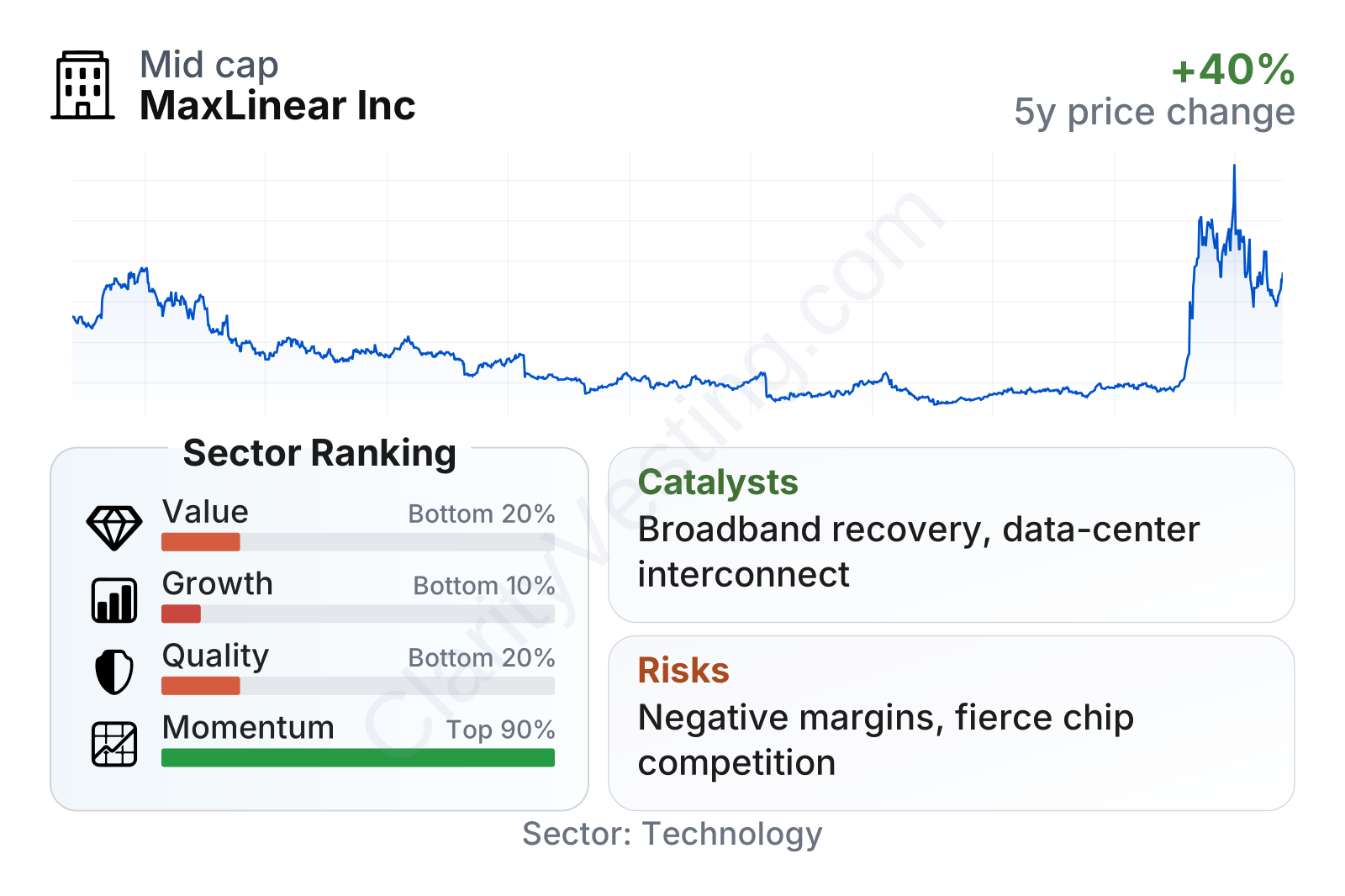
MaxLinear is a mid-sized semiconductor company with unusually high share-price volatility, reflected in a beta close to 4. The stock’s recent momentum has been very strong, but the underlying fundamental picture is much weaker: value, growth quality, and profitability measures still rank near the lower end of the sector, while balance-sheet leverage looks more controlled than many peers.
Growth
MaxLinear operates in markets that have long-term structural support. Broadband upgrades, fiber deployments, faster home networking, cloud traffic growth, and higher data rates across communications equipment all point to continued demand for advanced connectivity chips. These are attractive areas over a multi-year horizon because networks need regular performance upgrades, not just one-time buildouts.
The company’s strategy also makes sense in principle. It is focused on specialized analog, mixed-signal, radio-frequency, and high-speed interconnect semiconductors rather than commodity chips. That matters because customers in communications infrastructure usually care about performance, power efficiency, and system integration, which can support longer product cycles and deeper customer relationships if execution is strong.
The most visible positive change is that revenue growth has turned sharply upward after a deep downturn. The company moved from steep year-over-year declines in 2023 and 2024 to strong positive growth in 2025 and 2026, with recent growth running far above the sector median. That suggests MaxLinear is benefiting from recovery in customer orders and easier comparisons after a very weak period.
Cash generation is also showing early signs of stabilization, but it remains fragile. Free cash flow was solid in 2022 and 2023, then turned negative during the slump before edging back into positive territory more recently. For long-term analysis, this is encouraging as a direction of travel, but not yet enough to say the business has fully rebuilt a durable cash engine.
Recent company updates have pointed to improving demand across several core product lines, especially where customers are normalizing inventory and restarting network-related spending. If that recovery broadens into a more normal ordering pattern, MaxLinear could benefit from operating leverage because a large part of its cost base is already in place. In semiconductors, that can make the rebound in earnings stronger than the rebound in revenue once utilization and customer mix improve.
Risks
This article is for informational purposes only and does not constitute financial advice. Some content is AI-generated. See Disclaimer


