Stock Analysis · Murphy USA Inc (MUSA)
Overview
Murphy USA Inc. is a gasoline and convenience retail company that operates fuel stations and small-format convenience stores across the United States. Its locations are often positioned near Walmart stores, a model that has historically helped the company capture high traffic from value-focused consumers. The business is built around selling motor fuel at large volumes and using that traffic to drive in-store purchases such as nicotine products, beverages, snacks, and other convenience items.
Revenue is heavily concentrated in fuel, while a much larger share of profit tends to come from merchandise and operating efficiency rather than from wide fuel margins alone. Based on recent annual filings, Murphy USA’s revenue mix is approximately:
- Retail motor fuel sales: about 75% to 85% of total revenue. This includes gasoline and diesel sold through company-operated sites and is the largest contributor by far.
- Merchandise sales: about 10% to 15% of total revenue. This includes tobacco and nicotine products, packaged beverages, candy, salty snacks, beer, general merchandise, and other convenience-store items.
- Wholesale and other revenue: about 3% to 10% of total revenue. This typically includes fuel supply arrangements, rents, and other smaller operating streams.
That mix is important because it shows the company is not simply a pure fuel-price play. Fuel drives visits and revenue scale, but in-store categories and disciplined site economics are central to earnings quality. Over the last several years, sales have moved up and down with fuel prices, yet the company has maintained a strong gross profit base through execution, merchandising, and site productivity.
The business model shows how thin the fuel-retailing model can be at the operating line: a very large revenue base flows through high product costs before reaching a much smaller level of operating income. Even so, Murphy USA has consistently converted that structure into meaningful profits and cash generation, which is one reason the company has remained relevant despite modest retail margins.
Key Figures
| Metric | Value | Sector ⓘ |
|---|---|---|
| Date | Sep 12, 2026 | |
| Context | ||
| Sector | Consumer Cyclical | |
| Industry | Specialty Retail | |
| Market Cap ⓘ | $9.62B | |
| Beta ⓘ | 0.25 | |
Value (Cheapness) | ||
| P/E Ratio ⓘ | 16.08 | 17.10 |
| FCF Yield ⓘ | 5.63% | 8.53% |
| EBIT / EV ⓘ | 6.61% | 6.46% |
| PEG ⓘ | 1.51 | |
Growth (Business expansion) | ||
| Revenue Growth ⓘ | 40.80% | 5.75% |
| RPS Growth (5Y CAGR) ⓘ | 11.06% | 9.14% |
| EPS Growth (5Y CAGR) ⓘ | -11.24% | -18.21% |
| Margin Growth (5Y Trend) ⓘ | 0.23% | -0.23% |
| FCF Growth (5Y CAGR) ⓘ | -5.16% | 4.91% |
Quality (Business durability) | ||
| ROIC (Latest) ⓘ | 21.73% | 12.61% |
| ROIC (5Y Median) ⓘ | 21.72% | 10.72% |
| Net Debt / EBIT (Latest) ⓘ | 3.17 | 2.10 |
| Net Debt / EBIT (5Y Median) ⓘ | 3.10 | 2.32 |
| Operating Margin (Latest) ⓘ | 3.76% | 9.25% |
| Operating Margin (5Y Median) ⓘ | 3.71% | 9.64% |
| Debt to Equity (Latest) ⓘ | 349.50% | 75.78% |
| Profit Margin (Latest) ⓘ | 3.23% | 5.33% |
| Free Cash Flow (Latest) ⓘ | $541.50M | |
Momentum (Price trend) | ||
| 3Y Return ⓘ | +64.84% | +14.53% |
| 12M Return (excl. last month) ⓘ | +40.85% | +3.08% |
| 6M Return ⓘ | +15.24% | +0.55% |
| Price vs. 200-Day MA ⓘ | +5.84% | -0.54% |
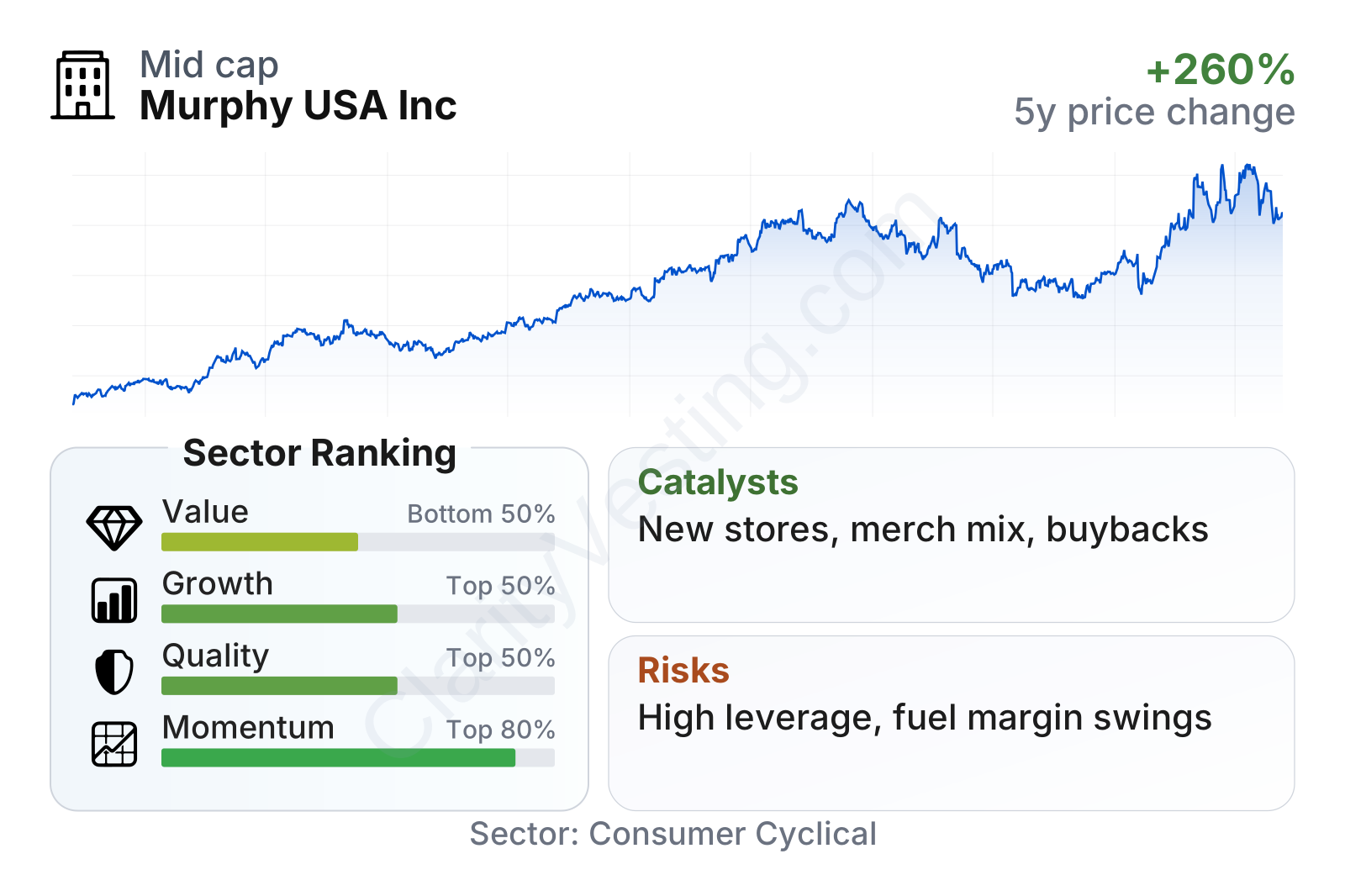
Murphy USA is a mid-sized public company with a market value around $10 billion and an unusually low beta near 0.28, meaning its stock has historically moved less than the broader market. In the factor breakdown, quality and growth rank in the top half of the sector, while momentum is especially strong. Profitability is mixed: return on invested capital is strong at roughly 22%, well above the sector median, but operating and net margins remain low at around 4% and 3%, which is normal for fuel retailing but still below many other consumer businesses. Valuation is not stretched on headline earnings multiples, with the P/E ratio modestly below the sector median, though leverage is clearly higher than typical peers.
Growth
Murphy USA operates in a mature industry rather than a high-growth one. Selling gasoline and convenience goods is not a fast-expanding market in the way software or semiconductors can be, and long-term fuel demand faces gradual pressure from better vehicle efficiency and electric vehicle adoption. However, the company’s niche within that industry still offers room for growth. Its focus on smaller-box stores, low-cost operations, high fuel volumes, and value-oriented customers gives it a strategy that can continue to produce incremental expansion even without a booming sector backdrop.
The core growth logic is straightforward: add stores, improve the merchandise mix, raise margins on higher-value categories, and use scale in fuel procurement and operations. Murphy USA has also invested in new store formats and raze-and-rebuild projects that can lift productivity per site. This matters because convenience retail growth often comes less from flashy innovation and more from squeezing stronger economics out of each location.
Revenue growth has been volatile, which is typical for a company where fuel prices can heavily influence reported sales. After a period of declines, growth turned positive again and recently accelerated sharply, far ahead of the sector median. That rebound is encouraging, but it should be read carefully: for Murphy USA, revenue jumps do not automatically mean structural profit expansion, because fuel prices can inflate sales without creating the same increase in earnings.
Cash generation is a more useful signal here. Free cash flow weakened for several years and then recovered materially, showing that the company still has meaningful ability to turn operations into available cash even after capital spending. That supports continued reinvestment in the store base, shareholder returns, and debt management, although the longer-term free-cash-flow trend has been less smooth than the recent rebound suggests.
A practical catalyst is Murphy USA’s continued emphasis on new stores and larger-format locations with a broader merchandise offering. In a business with tight margins, even small improvements in mix and throughput can have an outsized impact on returns. Another important driver is cigarette and nicotine traffic, which remains a major visit generator in convenience retail, even though it also creates category concentration risk. The company has also highlighted digital and loyalty-related initiatives in recent years as tools to strengthen customer retention and frequency.
Recent company updates have generally pointed to continued network development, capital returns, and ongoing efforts to improve merchandise economics. None of that transforms Murphy USA into a high-growth company, but it does reinforce a credible path to steady expansion within a defensive, everyday-use retail model.
Risks
This article is for informational purposes only and does not constitute financial advice. Some content is AI-generated. See Disclaimer


