Stock Analysis · MACOM Technology Solutions Holdings Inc (MTSI)
Stock Analysis · MACOM Technology Solutions Holdings Inc (MTSI)

Overview

MACOM Technology Solutions Holdings Inc designs and sells analog semiconductor products used in communications infrastructure, data centers, industrial applications, aerospace and defense, and some multi-market electronics uses. In simple terms, the company makes specialized chips and components that help move, convert, amplify, and process signals at very high speeds or high frequencies. These products are important in areas such as fiber-optic networks, wireless systems, satellite communications, radar, and advanced electronics where performance matters more than commodity pricing.

MACOM’s business is built around a broad portfolio of radio frequency, microwave, millimeter-wave, optical, and power semiconductor technologies. The company manufactures some products internally and also relies on external foundries and packaging partners. Its strategy has been to focus on higher-value niches of the chip industry rather than mass-market processors or memory.

Based on company reporting, revenue is mainly organized by end market rather than by a single product line. The mix can shift from quarter to quarter, but recent filings and investor materials point to the following rough structure:

  • Industrial & Defense: roughly the largest segment in recent periods, often around 35% to 40% of revenue. This includes aerospace, defense electronics, radar, test and measurement, and industrial uses.
  • Data Center: approximately 25% to 35%. This includes optical and interconnect products used in high-speed cloud and AI-related infrastructure.
  • Telecom: about 20% to 30%. This market covers wired and wireless communications infrastructure.
  • Multi-Market: generally the smallest part, often around 5% to 10%, including a mix of other commercial applications.

This revenue profile matters for long-term analysis because MACOM is exposed to several structural technology themes at once: rising data traffic, optical networking upgrades, defense electronics demand, and increasing complexity in wireless and high-frequency systems.

The longer-term business flow shows a company that has grown revenue meaningfully over time, while keeping a large gross profit pool. At the same time, operating costs—especially research and development—have also risen materially, which helps explain why revenue growth has not always translated into equally smooth profit growth.

Key Figures

MetricValueSector
DateJul 18, 2026
Context
SectorTechnology
IndustrySemiconductors
Market Cap $21.02B
Beta 1.66
Value
(Cheapness)
P/E Ratio 125.2231.76
FCF Yield 0.73%4.18%
EBIT / EV 1.03%2.56%
PEG 2.05
Growth
(Business expansion)
Revenue Growth 22.50%13.50%
RPS Growth (5Y CAGR) 11.00%8.57%
EPS Growth (5Y CAGR) -13.75%-21.87%
Margin Growth (5Y Trend) -12.90%0.41%
FCF Growth (5Y CAGR) 4.10%9.76%
Quality
(Business durability)
ROIC (Latest) 10.12%8.54%
ROIC (5Y Median) 8.03%8.12%
Net Debt / EBIT (Latest) 1.310.38
Net Debt / EBIT (5Y Median) 2.990.38
Operating Margin (Latest) 19.82%9.58%
Operating Margin (5Y Median) 13.25%8.25%
Debt to Equity (Latest) 26.61%33.52%
Profit Margin (Latest) 16.46%6.96%
Free Cash Flow (Latest) $152.49M
Momentum
(Price trend)
3Y Return +308.12%+30.91%
12M Return (excl. last month) +180.84%+28.90%
6M Return +22.12%+5.38%
Price vs. 200-Day MA +11.09%+7.61%
Better than sector median
Slightly worse than sector median
More than 20% worse than sector median

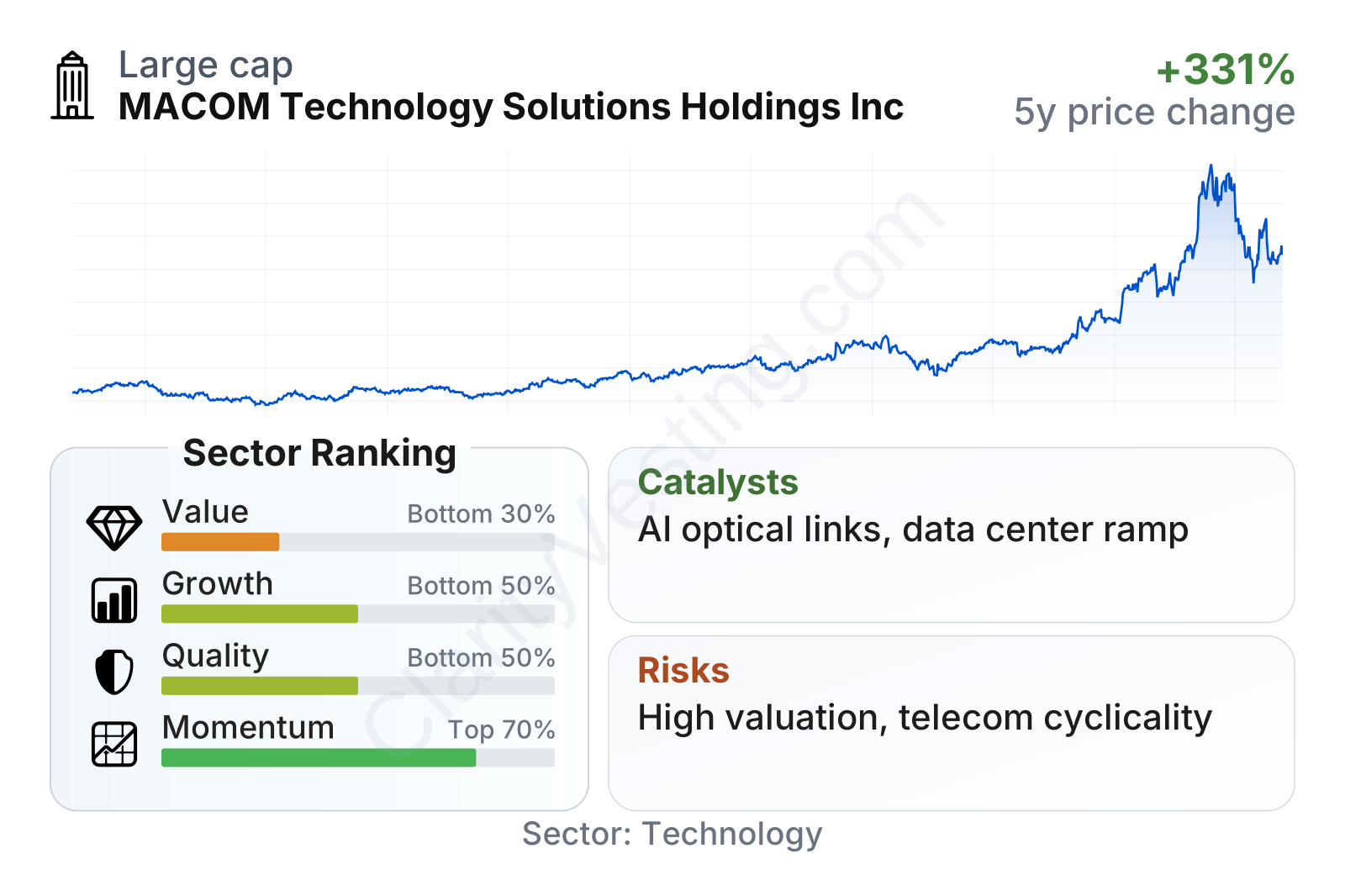
MACOM currently stands out as a large semiconductor company by market value, but the profile is mixed. Recent growth has been stronger than the typical company in the sector, and profitability on an operating basis is also above the sector median. However, the stock’s valuation is far richer than most peers, while free cash flow yield and earnings-based value measures look weak relative to the broader semiconductor group. Price momentum has been exceptionally strong, which shows the market has become much more optimistic about the company’s future than it was a few years ago.

Growth

MACOM operates in areas of the semiconductor market that still have favorable long-term demand drivers. Optical connectivity for data centers is one of the clearest examples. As AI workloads expand, data centers need faster and denser interconnects, and that supports demand for high-speed analog and optical semiconductor content. Telecom infrastructure is a more cyclical market, but long-term network upgrades continue to require increasingly sophisticated signal-handling components. Industrial and defense also provide a useful layer of demand that can be less directly tied to consumer spending.

The company’s strategy broadly makes sense for future growth because it is focused on specialized categories where technical know-how, qualification cycles, and customer relationships can create stickier demand than in commodity chips. MACOM has also emphasized technologies such as optical components, RF and microwave solutions, and products used in high-performance communications systems. These are not the easiest parts of the chip market to enter quickly, which gives established suppliers some room to defend margins.

Revenue growth has clearly reaccelerated after a softer period in 2023. Recent year-over-year growth has been running well above the sector median, which suggests the company is participating in stronger underlying demand and potentially gaining traction in priority markets such as data center and defense-related applications. The important question for the long term is not whether one or two quarters are strong, but whether MACOM can keep converting design wins into durable revenue streams across multiple years.

Cash generation remains positive, which is an important point in a capital-intensive industry. Free cash flow has been somewhat uneven over the past few years, with a notable step-up followed by some pullback, but it still indicates that the business is capable of funding operations and investment without depending entirely on external financing. For a company spending heavily on product development, sustaining positive cash flow is a constructive sign even if it is not yet exceptional relative to the stock’s market value.

Recent company communications have highlighted opportunities tied to AI-related optical interconnect demand, continued defense and aerospace programs, and high-bandwidth infrastructure. Those are credible growth catalysts because they align with markets where MACOM’s product portfolio is relevant and where customers often prioritize performance and reliability over lowest price. The company has also discussed expanding manufacturing capabilities for certain technologies, which can matter if demand stays elevated and customers seek resilient supply chains.

Risks

MACOM’s main risks start with cyclicality. Even strong semiconductor niches can go through inventory corrections, spending pauses, and project delays. Telecom spending can be inconsistent, and data center demand, while currently attractive, can also shift quickly depending on customer road maps and technology transitions. A company serving infrastructure markets may look more stable than a consumer chipmaker, but it is not immune to abrupt swings in order patterns.

Another risk is execution. MACOM sells technically demanding products where delays in qualification, manufacturing yields, or customer adoption can have outsized effects. The company also appears to be balancing growth investment with margin discipline. Research and development spending has risen significantly over time, which is logical for a specialized semiconductor company, but that spending needs to translate into commercially successful platforms. Recent profitability has recovered from a weak patch, showing improvement, yet the path has not been consistently smooth.

Balance-sheet risk looks more manageable than it used to. Debt relative to equity has fallen sharply from much higher levels a few years ago and is now slightly better than the sector median. That improvement reduces financial strain and gives the company more flexibility. Even so, net debt relative to EBIT remains higher than the sector median, which means leverage still deserves attention if operating earnings were to weaken again.

Profitability has been volatile. The current profit margin is well above the sector median, which is encouraging, but the historical path includes a period of negative net margins before a rebound. That suggests investors are dealing with a business that can generate strong economics in favorable conditions, but not one that has delivered perfectly steady bottom-line performance. This matters because richly valued semiconductor stocks are often punished when margins wobble.

On competitive positioning, MACOM appears stronger in specialized analog, RF, microwave, and optical niches than in broad semiconductor categories. That is a real advantage, but it does not make the company the clear overall leader across all of its markets. Competitors vary by end market and product family, with names such as Broadcom, Coherent, Qorvo, Skyworks, Wolfspeed, and Microchip appearing in adjacent or overlapping areas. Larger companies may have deeper resources, broader product portfolios, or greater scale, while some niche players may be highly focused in particular technologies. MACOM’s position is best described as a capable specialist rather than the dominant force of the entire field.

There is no widely known recent scandal or governance event that appears to overshadow the investment case. The bigger risk is more ordinary but still important: whether elevated market expectations have moved faster than the company’s ability to produce consistently expanding earnings.

Valuation

MACOM’s valuation is demanding. The stock trades at a price-to-earnings multiple far above the sector median, and its free cash flow yield is also much lower than what is typical in the industry. In plain language, the market is placing a very high value on each dollar of current earnings and cash generation. That kind of pricing usually requires confidence that future growth will remain strong and that profitability will continue improving.

The valuation history shows how dramatically sentiment has changed. MACOM once traded at much more modest earnings multiples, but the market now values it at a premium that is difficult to justify on current fundamentals alone. Some of that premium can be explained by exposure to attractive themes such as AI-related optical infrastructure and defense electronics, but the gap versus the broader sector is still large. The PEG ratio suggests the stock is not cheap even after considering growth.

That does not mean the valuation is irrational. The company has above-median revenue growth, strong operating margins, improved balance-sheet trends, and a product set linked to attractive end markets. But the current price appears to assume that these strengths will persist and likely improve further. When a stock is priced this richly, strong business performance may support the valuation, yet any slowdown in growth, margin compression, or delayed customer ramp could make the premium harder to sustain.

Conclusion

MACOM is an appealing semiconductor company in terms of business quality and market exposure, even if the financial profile is not flawless. It operates in specialized parts of the chip market where technical barriers are meaningful, and it is tied to long-term demand drivers such as optical networking, AI infrastructure, and defense electronics. Revenue growth has been strong again, profitability has recovered, and leverage has become more comfortable than it was in earlier years.

The main challenge is that the stock already reflects a lot of optimism. MACOM does not look like a broad-based industry leader with overwhelming scale, and its earnings and cash flow record still shows some volatility. That leaves a contrast at the center of the long-term case: a credible specialist with real strategic relevance, but one trading at a valuation that leaves limited room for disappointment. The company’s business position looks solid and increasingly attractive, while the market’s enthusiasm appears even stronger than the underlying fundamentals.

Sources:

  • U.S. Securities and Exchange Commission (EDGAR) — MACOM Technology Solutions Holdings, Inc. latest Form 10-Q filings in 2026
  • U.S. Securities and Exchange Commission (EDGAR) — MACOM Technology Solutions Holdings, Inc. latest Form 10-K available in 2026 reference set
  • MACOM Investor Relations — Quarterly earnings press releases and shareholder materials published in 2026
  • MACOM Investor Relations — Investor presentation materials describing end markets, strategy, and product portfolio
  • MACOM Technology Solutions Holdings, Inc. — Company website product and market overview pages
  • Wikipedia — MACOM basic company history and corporate background

This article is for informational purposes only and does not constitute financial advice. Some content is AI-generated. See Disclaimer


Sign up for exclusive research and insights.

Unsubscribe anytime.
