Stock Analysis · Match Group Inc (MTCH)
Overview
Match Group is a global online dating company. It owns a portfolio of apps and services designed to help people meet, date, and build relationships. Its best-known brands include Tinder, Hinge, Match, Meetic, OkCupid, Plenty of Fish, and several smaller regional platforms. The company operates across North America, Europe, Asia, and other international markets, giving it a broad footprint in a category that has become a mainstream part of digital consumer behavior.
The business model is mainly based on paid features inside its dating apps. Users can usually join for free, then pay for subscriptions or one-time upgrades that improve visibility, increase the number of interactions, or unlock premium tools. Advertising exists, but it is a relatively small contributor compared with direct user payments.
Based on recent company reporting, revenue is concentrated in a few major brands and product formats.
- Tinder: about 45% to 50% of total revenue. This is the company’s largest brand, built around paid subscriptions and in-app purchases such as boosts, likes, and premium discovery features.
- Hinge: about 15% to 20% of total revenue. Hinge has been one of Match Group’s fastest-growing apps, with monetization coming from subscriptions and premium features.
- Evergreen & Emerging brands: about 30% to 35% of total revenue. This group includes Match, Meetic, OkCupid, Plenty of Fish, Pairs, Azar and other properties, combining more mature brands with newer growth initiatives.
- Advertising and other revenue: a small single-digit percentage of total revenue. This includes ad sales and smaller ancillary items, but it is not the core of the model.
One important characteristic of Match Group is that it runs a multi-brand portfolio rather than relying on a single app alone, even though Tinder remains the biggest profit engine. That structure helps the company reach different age groups, relationship intentions, and geographies, but it also means execution matters brand by brand. The broader financial picture shows a company with high gross margins and strong cash generation, while spending heavily on product development and marketing to keep user engagement healthy.
Over the last several years, revenue has grown from just under $3.0 billion to roughly $3.5 billion, while gross profit has remained very strong. Research and development spending has also moved higher, showing that Match is still reinvesting meaningfully in product quality, safety, and new features rather than simply harvesting its existing user base.
Key Figures
| Metric | Value | Sector ⓘ |
|---|---|---|
| Date | Sep 12, 2026 | |
| Context | ||
| Sector | Communication Services | |
| Industry | Internet Content & Information | |
| Market Cap ⓘ | $9.89B | |
| Beta ⓘ | 1.32 | |
Value (Cheapness) | ||
| P/E Ratio ⓘ | 15.03 | 18.61 |
| FCF Yield ⓘ | 11.54% | 13.68% |
| EBIT / EV ⓘ | 8.18% | 4.54% |
| PEG ⓘ | 0.35 | |
Growth (Business expansion) | ||
| Revenue Growth ⓘ | -1.20% | 5.40% |
| RPS Growth (5Y CAGR) ⓘ | 7.94% | 4.62% |
| EPS Growth (5Y CAGR) ⓘ | -14.40% | -18.01% |
| Margin Growth (5Y Trend) ⓘ | 12.66% | 1.10% |
| FCF Growth (5Y CAGR) ⓘ | 5.30% | 5.88% |
Quality (Business durability) | ||
| ROIC (Latest) ⓘ | 23.08% | 8.38% |
| ROIC (5Y Median) ⓘ | 17.79% | 8.32% |
| Net Debt / EBIT (Latest) ⓘ | 2.89 | 1.99 |
| Net Debt / EBIT (5Y Median) ⓘ | 3.34 | 2.94 |
| Operating Margin (Latest) ⓘ | 29.31% | 14.89% |
| Operating Margin (5Y Median) ⓘ | 24.84% | 12.96% |
| Debt to Equity (Latest) ⓘ | -1498.33% | 59.59% |
| Profit Margin (Latest) ⓘ | 20.17% | 8.77% |
| Free Cash Flow (Latest) ⓘ | $1.14B | |
Momentum (Price trend) | ||
| 3Y Return ⓘ | +1.96% | +46.64% |
| 12M Return (excl. last month) ⓘ | +2.77% | +2.16% |
| 6M Return ⓘ | +42.47% | +5.05% |
| Price vs. 200-Day MA ⓘ | +22.44% | +2.88% |
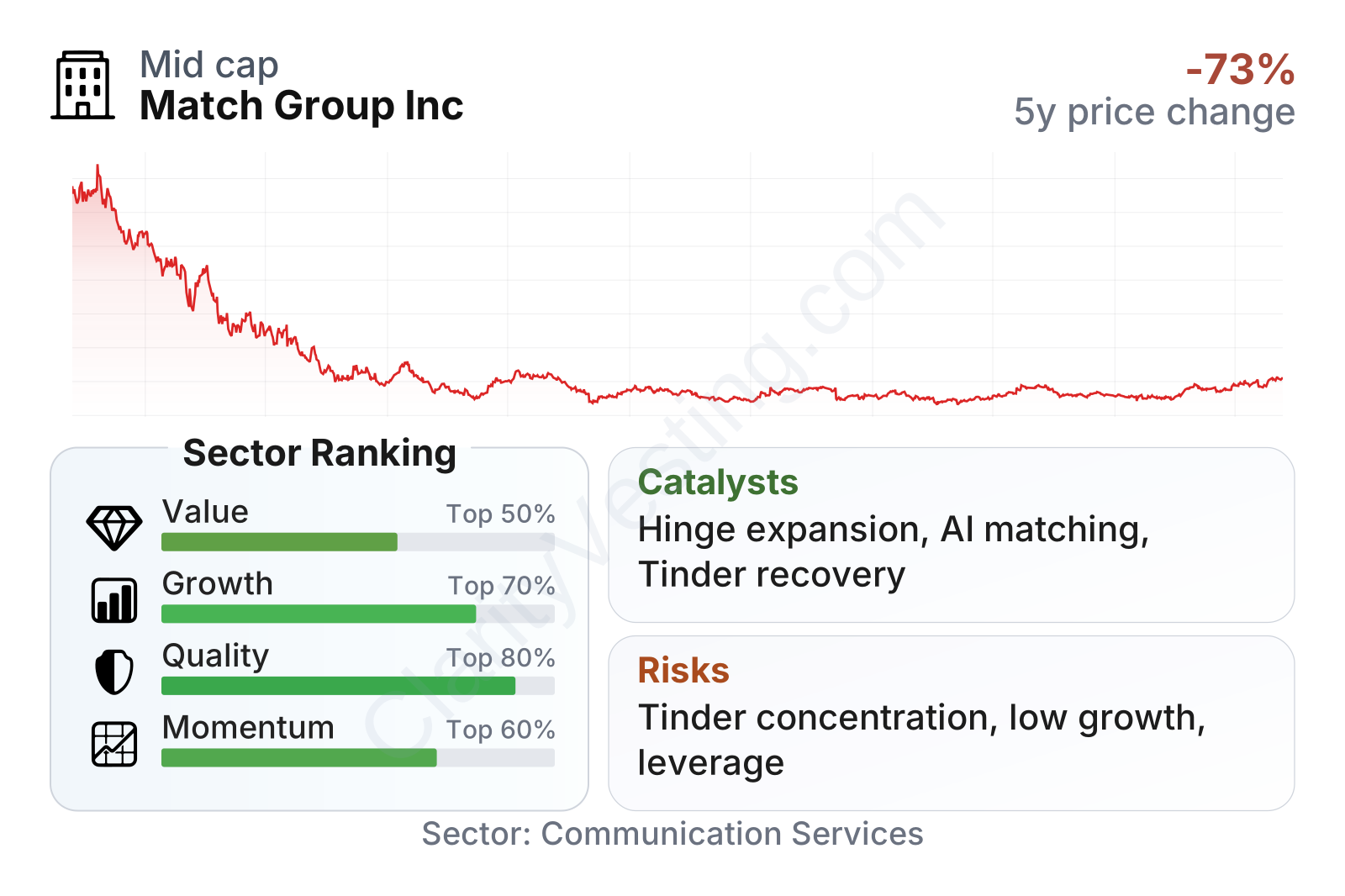
Match Group stands out more for profitability and capital efficiency than for near-term sales growth. Profitability metrics are comfortably above sector medians, with operating margin near 29% and profit margin around 20%, while return on invested capital is also notably strong. On valuation, the earnings multiple sits below the sector median, suggesting the market is not assigning a premium growth profile at the moment. Growth indicators are more mixed: long-term revenue-per-share and free-cash-flow trends are solid, but the most recent year-over-year revenue comparison is slightly negative. Momentum has improved over the last 6 to 12 months, though the stock still sits far below its 2021 peak.
Growth
Online dating remains part of a large and still relevant digital category. The long-term backdrop is supported by smartphone usage, changing social habits, and the normalization of meeting partners online. That said, this is no longer an early-stage market in developed countries. For a company like Match Group, future expansion depends less on basic industry adoption and more on better monetization, stronger user retention, international progress, and taking share through superior products.
Match Group’s strategy for future growth is centered on improving user outcomes, deepening engagement, and making premium features more attractive. Hinge is the clearest growth engine inside the portfolio. Management has highlighted Hinge’s expansion potential both in existing markets and internationally, and the brand still appears to have room to scale relative to Tinder’s mature base. The company has also been working on product improvements at Tinder, where restoring healthier user trends matters more than almost anything else because of the brand’s size.
The recent revenue trend shows a business that has moved out of its strongest post-pandemic growth phase into a flatter period. Growth was very strong in 2021, slowed sharply in 2022, improved through much of 2023 and early 2024, then turned modestly negative again in the latest reading. That pattern suggests Match Group is in a transition phase: still capable of growing, but no longer benefiting from easy expansion across the whole portfolio.
Cash generation remains one of the company’s strongest attributes. Free cash flow has been uneven at times, but the broader direction remains robust, with trailing twelve-month free cash flow back above $1 billion. For a digital platform business, that matters because it provides room for product investment, debt management, and share repurchases without requiring heavy physical capital spending.
A meaningful catalyst is the company’s effort to use artificial intelligence to improve matching, profile recommendations, safety tools, and user personalization. If these features raise engagement or conversion to paid products, the financial impact could be significant because even small gains on a large installed base can meaningfully affect revenue. Another opportunity is international growth for Hinge, which is still much less penetrated globally than Tinder.
Recent company communications have also emphasized sharper execution, disciplined costs, and product upgrades across the portfolio. The opportunity is not simply adding more users; it is improving the quality of interactions so users remain active and see enough value to pay for premium services.
Risks
This article is for informational purposes only and does not constitute financial advice. Some content is AI-generated. See Disclaimer


