Stock Analysis · MicroStrategy Incorporated (MSTR)
Overview
MicroStrategy Incorporated is a software company best known for two very different activities. First, it sells enterprise analytics and business intelligence software that helps organizations organize data, build dashboards, and support decision-making. Second, and now far more important for how the market views the company, it has turned itself into a large corporate holder of Bitcoin. In practice, that means the operating business is still software, but the company’s public identity and stock behavior are heavily tied to its Bitcoin treasury strategy.
The software business generates revenue from licenses, subscription services, product support, and related consulting. Based on recent company filings, the software operation remains the source of recurring business revenue, but it is small relative to the value the market assigns to the company because most of that market value reflects its very large Bitcoin holdings rather than the scale of the software franchise.
Revenue is mainly split across the following categories:
- Product support: approximately 45% to 50% of total revenue. This includes maintenance and support tied to the installed software base and is typically the most stable part of the business.
- Subscription services: approximately 25% to 30%. This includes cloud and subscription-based access to the company’s analytics platform.
- Product licenses: approximately 10% to 15%. This is revenue from software licenses, which can be more variable from quarter to quarter.
- Other services: approximately 10% to 15%. This includes consulting, education, and related professional services.
One important point for long-term analysis is that these percentages describe the operating business only. They do not capture the economic effect of the company’s Bitcoin strategy, which can dominate reported earnings, cash needs, financing activity, and market perception.
The operating business has stayed near the same revenue range for several years, while expenses and non-cash accounting effects tied to Bitcoin have caused very large swings in operating income and net income. In other words, the software business looks relatively steady, but the overall company no longer behaves like a typical software firm.
Key Figures
| Metric | Value | Sector ⓘ |
|---|---|---|
| Date | Sep 12, 2026 | |
| Context | ||
| Sector | Technology | |
| Industry | Software - Application | |
| Market Cap ⓘ | $51.07B | |
| Beta ⓘ | 3.60 | |
Value (Cheapness) | ||
| P/E Ratio ⓘ | N/A | 29.51 |
| FCF Yield ⓘ | -15.81% | 4.25% |
| EBIT / EV ⓘ | -32.11% | 2.85% |
| PEG ⓘ | 2.85 | |
Growth (Business expansion) | ||
| Revenue Growth ⓘ | 6.90% | 15.40% |
| RPS Growth (5Y CAGR) ⓘ | -24.88% | 8.56% |
| EPS Growth (5Y CAGR) ⓘ | N/A | -11.88% |
| Margin Growth (5Y Trend) ⓘ | N/A | 0.46% |
| FCF Growth (5Y CAGR) ⓘ | N/A | 9.80% |
Quality (Business durability) | ||
| ROIC (Latest) ⓘ | -36.31% | 9.44% |
| ROIC (5Y Median) ⓘ | -10.96% | 8.30% |
| Net Debt / EBIT (Latest) ⓘ | N/A | 0.54 |
| Net Debt / EBIT (5Y Median) ⓘ | N/A | 0.44 |
| Operating Margin (Latest) ⓘ | -4499.75% | 9.58% |
| Operating Margin (5Y Median) ⓘ | -254.24% | 8.25% |
| Debt to Equity (Latest) ⓘ | 14.94% | 33.33% |
| Profit Margin (Latest) ⓘ | N/A | 7.14% |
| Free Cash Flow (Latest) ⓘ | -$8.08B | |
Momentum (Price trend) | ||
| 3Y Return ⓘ | +276.61% | +45.48% |
| 12M Return (excl. last month) ⓘ | -75.96% | +23.48% |
| 6M Return ⓘ | -4.64% | +20.93% |
| Price vs. 200-Day MA ⓘ | -5.11% | +7.43% |
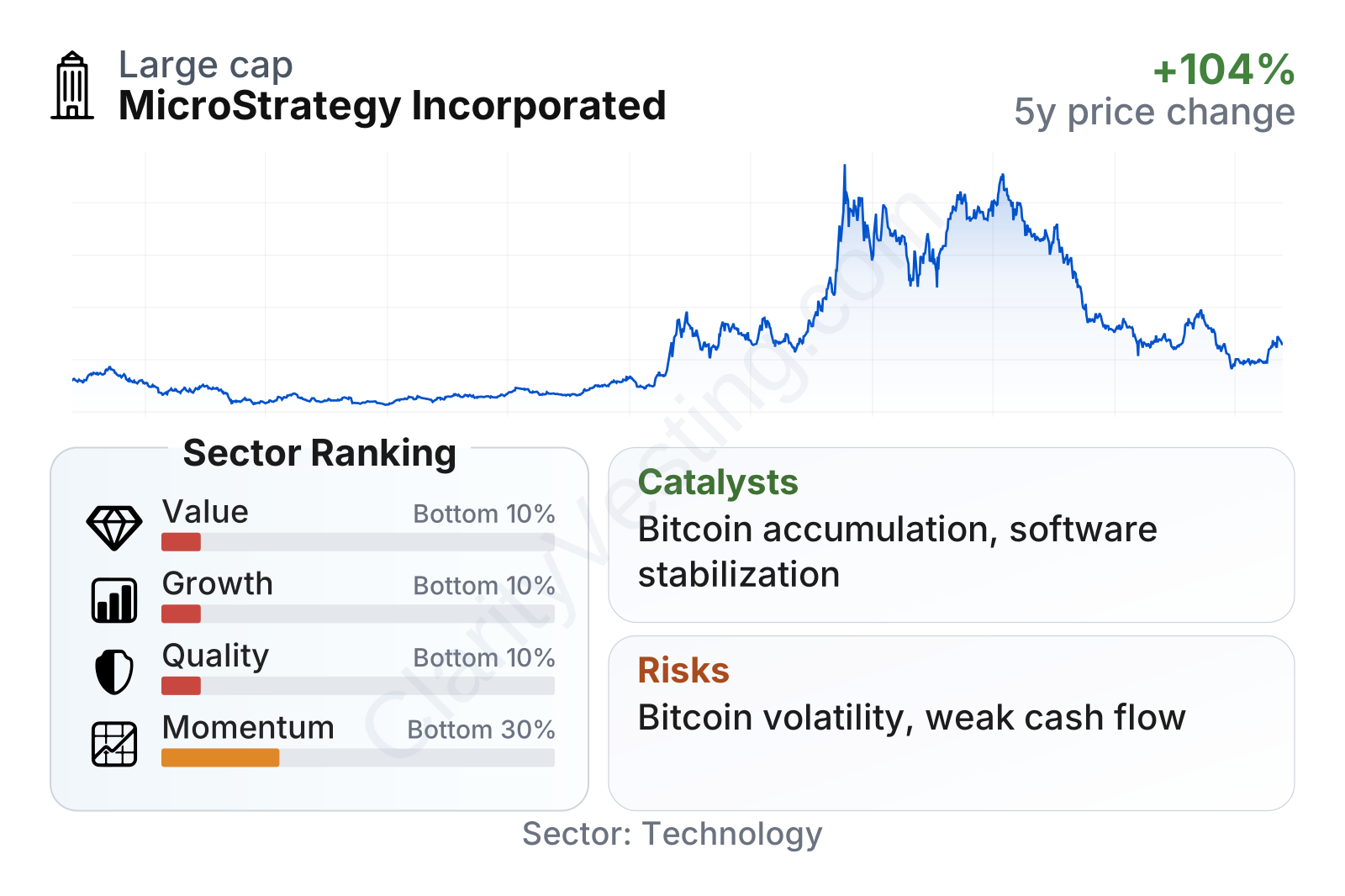
MicroStrategy is a large company by market value, but its trading profile is unusually volatile, with a beta well above most technology names. The factor breakdown is weak on value, quality, growth, and recent momentum relative to the broader software group. That reflects a combination of negative free cash flow, unstable profitability, and a stock price that has moved much more on Bitcoin sentiment than on software fundamentals.
The share price history also shows how dramatically the market’s view has changed. The stock multiplied over the last few years before falling sharply from later peaks, which is consistent with a security driven more by changing expectations around Bitcoin and capital markets access than by steady operating progress.
Growth
MicroStrategy operates in enterprise analytics and cloud software, which is still a relevant sector with long-term demand. Companies continue to spend on data tools, automation, governance, and AI-related workflows. That gives the software segment a reasonable industry backdrop. The challenge is that MicroStrategy has not been growing like a typical software winner. Recent year-over-year revenue growth returned to positive territory, reaching high-single digits to low-teens in the latest quarters, but over a longer period the business has been mostly flat to down.
The recent rebound suggests the operating business is stabilizing, but the growth rate remains below the software sector median. That matters because a company in a growing market usually needs either superior product momentum or a very strong installed base to stand out, and MicroStrategy’s reported numbers do not yet show clear breakout expansion.
The company’s future growth thesis is therefore not centered only on software. It is centered on its strategy of using equity, debt, and internal resources to accumulate more Bitcoin. Management has effectively positioned the company as a listed vehicle that combines a software business with a large and actively expanded Bitcoin reserve. If Bitcoin appreciates over time and capital markets remain open, that strategy can create strong balance-sheet growth and draw continued investor attention.
Free cash flow has been deeply negative, which shows the cost of the treasury strategy. The business is not currently funding that expansion through strong internal cash generation alone. Instead, capital raising and balance-sheet management are central to the model. That can support growth in Bitcoin per share under favorable conditions, but it is very different from the self-financed growth model investors often expect from mature software companies.
A meaningful catalyst is the broader institutional adoption of Bitcoin. As digital assets become more integrated into financial products, custody infrastructure, and corporate treasury discussions, MicroStrategy’s early and highly visible position may keep it relevant. Another catalyst is any improvement in the software segment’s cloud transition, because even modest operating improvement would strengthen the case that the company retains a real underlying business beneath the Bitcoin exposure.
Recent company communications and filings have continued to emphasize capital raising and Bitcoin accumulation as the core strategic focus. That is a significant opportunity if Bitcoin enters another sustained upcycle, since MicroStrategy has built one of the most leveraged public-market exposures to that asset.
Risks
This article is for informational purposes only and does not constitute financial advice. Some content is AI-generated. See Disclaimer


