Stock Analysis · Motorola Solutions Inc (MSI)
Overview
Motorola Solutions is a communications and public safety technology company. Its products are used mainly by government agencies, police departments, fire and emergency services, transportation systems, utilities, schools, hospitals, and large commercial or industrial customers. In simple terms, the company helps critical workers communicate, monitor incidents, and manage emergency response. Its business has gradually expanded from traditional land mobile radio equipment into software, video security, command center tools, and recurring services.
The company reports revenue through two main segments. Based on recent annual reporting, revenue is roughly split as follows:
- Products and Systems Integration: about 67% of revenue. This includes land mobile radio networks and devices, fixed video cameras, in-car video, access control hardware, and large system deployments for public safety and enterprise customers.
- Software and Services: about 33% of revenue. This includes command center software, cloud-based applications, maintenance, managed services, security monitoring, and other recurring support contracts.
Within those categories, the biggest underlying driver remains mission-critical communications, especially radio systems and related devices for public safety agencies. Software and services are smaller in revenue today, but they are strategically important because they tend to be more recurring and can deepen customer relationships over time. Geographically, the company still derives most of its sales from North America, with international markets providing an additional growth lever through government modernization and public safety upgrades.
Motorola Solutions stands out because its offerings are tied to essential operations rather than discretionary spending. Police, fire, ambulance, and emergency coordination systems are difficult to replace and often stay in place for many years, which can create durable customer relationships and a steady stream of upgrades, maintenance, and software additions.
The business mix has become more attractive over time. Revenue has risen from a little above $8 billion in 2021 to nearly $11.7 billion in 2025, while gross profit and operating income have also moved higher. Research and development spending has increased, but not as fast as revenue, which suggests improving scale as the company expands.
Key Figures
| Metric | Value | Sector ⓘ |
|---|---|---|
| Date | Sep 12, 2026 | |
| Context | ||
| Sector | Technology | |
| Industry | Communication Equipment | |
| Market Cap ⓘ | $77.15B | |
| Beta ⓘ | 0.88 | |
Value (Cheapness) | ||
| P/E Ratio ⓘ | 36.50 | 29.51 |
| FCF Yield ⓘ | 3.47% | 4.25% |
| EBIT / EV ⓘ | 3.75% | 2.85% |
| PEG ⓘ | 2.04 | |
Growth (Business expansion) | ||
| Revenue Growth ⓘ | 13.30% | 15.40% |
| RPS Growth (5Y CAGR) ⓘ | 10.23% | 8.56% |
| EPS Growth (5Y CAGR) ⓘ | -9.55% | -11.88% |
| Margin Growth (5Y Trend) ⓘ | 4.69% | 0.46% |
| FCF Growth (5Y CAGR) ⓘ | 12.71% | 9.80% |
Quality (Business durability) | ||
| ROIC (Latest) ⓘ | 21.41% | 9.44% |
| ROIC (5Y Median) ⓘ | 26.88% | 8.30% |
| Net Debt / EBIT (Latest) ⓘ | 2.77 | 0.54 |
| Net Debt / EBIT (5Y Median) ⓘ | 2.41 | 0.44 |
| Operating Margin (Latest) ⓘ | 26.27% | 9.58% |
| Operating Margin (5Y Median) ⓘ | 21.63% | 8.25% |
| Debt to Equity (Latest) ⓘ | 359.99% | 33.33% |
| Profit Margin (Latest) ⓘ | 17.44% | 7.14% |
| Free Cash Flow (Latest) ⓘ | $2.68B | |
Momentum (Price trend) | ||
| 3Y Return ⓘ | +71.22% | +45.48% |
| 12M Return (excl. last month) ⓘ | +0.81% | +23.48% |
| 6M Return ⓘ | +1.33% | +20.93% |
| Price vs. 200-Day MA ⓘ | +10.17% | +7.43% |
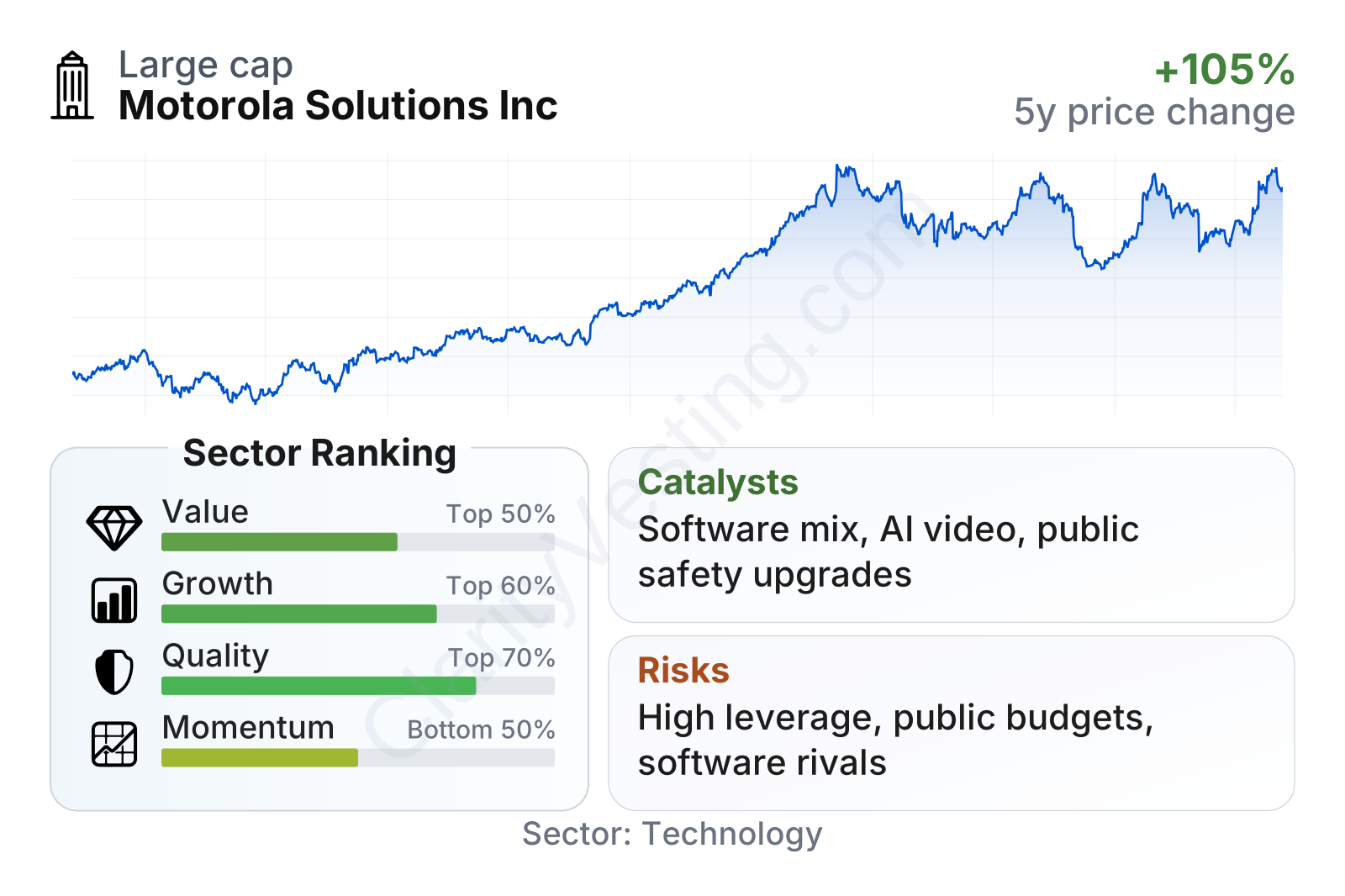
Motorola Solutions ranks well on business quality, with returns on invested capital and operating margins far above the sector median. Growth is solid rather than exceptional, supported by good long-term expansion in revenue per share and free cash flow. The weaker area is recent share price momentum, which has cooled after a strong multi-year run. Valuation sits around the middle of the sector on some measures, but the earnings multiple remains above the sector median, showing that the market still assigns a premium to the company’s business profile.
The stock’s longer-term performance has been strong despite periods of volatility. Its beta below 1 also suggests the shares have generally moved less aggressively than the broader market, which fits a business serving critical infrastructure and government-related customers.
Growth
Motorola Solutions operates in a part of technology that benefits from long-term structural demand. Public safety agencies and critical infrastructure operators increasingly need integrated communications, video, software, analytics, and cloud-connected workflows. This is not the fastest-growing corner of technology, but it is a durable one, supported by modernization cycles, rising security needs, and the increasing importance of real-time coordination.
The company’s strategy makes sense for future growth because it builds around an installed base that is already hard to displace. A customer may begin with radio networks and later add body cameras, fixed video, evidence management, dispatch software, control room systems, AI-assisted analysis, or service contracts. That cross-selling model can increase revenue per customer and make the overall platform more embedded in day-to-day operations.
Revenue growth has not been perfectly smooth, but it has remained consistently positive in recent years and accelerated again in the latest period to the low-teens range. That pattern suggests the company is still finding expansion opportunities even after several years of steady gains.
Cash generation has also improved materially. Trailing free cash flow has climbed from roughly $1.4 billion in early 2022 to around $2.5 billion in early 2026, and the latest table points to more than $3.0 billion on a trailing basis. That matters because free cash flow gives a clearer picture of how much money is left after operating needs and capital spending, and Motorola Solutions converts a meaningful share of its profit into cash.
A current catalyst is the broader move toward integrated public safety ecosystems. Agencies increasingly want fewer disconnected tools and more unified platforms that connect dispatch, field communications, video, records, and incident management. Motorola Solutions has spent years building that wider product set through internal development and acquisitions. Another meaningful catalyst is government and public safety modernization spending, especially where aging communications networks are being replaced or upgraded.
Recent company updates have also highlighted continued demand for software, services, and video-related offerings, which matters because these areas can support higher recurring revenue and improve visibility. In addition, AI-enabled features in video security and command center workflows could create incremental growth if adoption expands from existing customers.
Risks
This article is for informational purposes only and does not constitute financial advice. Some content is AI-generated. See Disclaimer


