Stock Analysis · Madison Square Garden Sports Corp (MSGS)
Overview
Madison Square Garden Sports Corp is a live sports company built around two iconic professional franchises: the New York Knicks of the NBA and the New York Rangers of the NHL. It also controls development league and esports-related assets tied to those teams, but the core economic value comes from owning major league sports franchises in one of the largest media markets in the world.
The business makes money from several recurring sources linked to team operations, fan demand, and media rights. Based on the company’s recent annual reporting, revenue is primarily split across the following categories:
- Ticketing, suites, and sponsorship-related game presentation revenue: about 45% to 50%. This includes regular season and playoff ticket sales, premium seating, hospitality, signage, and corporate partnerships tied to the teams.
- Local media rights and broadcasting revenue: about 25% to 30%. This comes from the right to televise games and related programming in the New York market.
- League distributions and luxury-suite / premium-related shared revenues: about 15% to 20%. This can include NBA and NHL shared distributions, sponsorship pools, and other league-driven economics.
- Merchandise, concessions, and other team-related revenue: about 5% to 10%. These are smaller but still meaningful lines connected to fan spending and in-arena activity.
For a simple long-term view, MSG Sports is less like a traditional entertainment company and more like an owner of scarce sports assets. There are only a limited number of NBA and NHL franchises, and New York teams carry unusual brand power, pricing strength, and media relevance. That scarcity is a major part of the investment case.
The latest financial flow also shows an important pattern: revenue has climbed to above $1.1 billion, but a large share of that increase has been absorbed by direct team operating costs. Gross profit recovered from the prior year, yet operating income and net income remain relatively thin compared with the size of the revenue base.
Key Figures
| Metric | Value | Sector ⓘ |
|---|---|---|
| Date | Sep 12, 2026 | |
| Context | ||
| Sector | Communication Services | |
| Industry | Entertainment | |
| Market Cap ⓘ | $9.44B | |
| Beta ⓘ | 0.57 | |
Value (Cheapness) | ||
| P/E Ratio ⓘ | N/A | 18.61 |
| FCF Yield ⓘ | 0.61% | 13.68% |
| EBIT / EV ⓘ | 0.37% | 4.54% |
| PEG ⓘ | N/A | |
Growth (Business expansion) | ||
| Revenue Growth ⓘ | 36.70% | 5.40% |
| RPS Growth (5Y CAGR) ⓘ | 9.04% | 4.62% |
| EPS Growth (5Y CAGR) ⓘ | -34.46% | -18.01% |
| Margin Growth (5Y Trend) ⓘ | -7.04% | 1.10% |
| FCF Growth (5Y CAGR) ⓘ | -24.42% | 5.88% |
Quality (Business durability) | ||
| ROIC (Latest) ⓘ | N/A | 8.38% |
| ROIC (5Y Median) ⓘ | 126.25% | 8.32% |
| Net Debt / EBIT (Latest) ⓘ | 25.07 | 1.99 |
| Net Debt / EBIT (5Y Median) ⓘ | 10.53 | 2.94 |
| Operating Margin (Latest) ⓘ | 3.39% | 14.89% |
| Operating Margin (5Y Median) ⓘ | 10.43% | 12.96% |
| Debt to Equity (Latest) ⓘ | -434.42% | 59.59% |
| Profit Margin (Latest) ⓘ | 0.67% | 8.77% |
| Free Cash Flow (Latest) ⓘ | $57.79M | |
Momentum (Price trend) | ||
| 3Y Return ⓘ | +123.98% | +46.64% |
| 12M Return (excl. last month) ⓘ | +111.93% | +2.16% |
| 6M Return ⓘ | +25.54% | +5.05% |
| Price vs. 200-Day MA ⓘ | +18.02% | +2.88% |
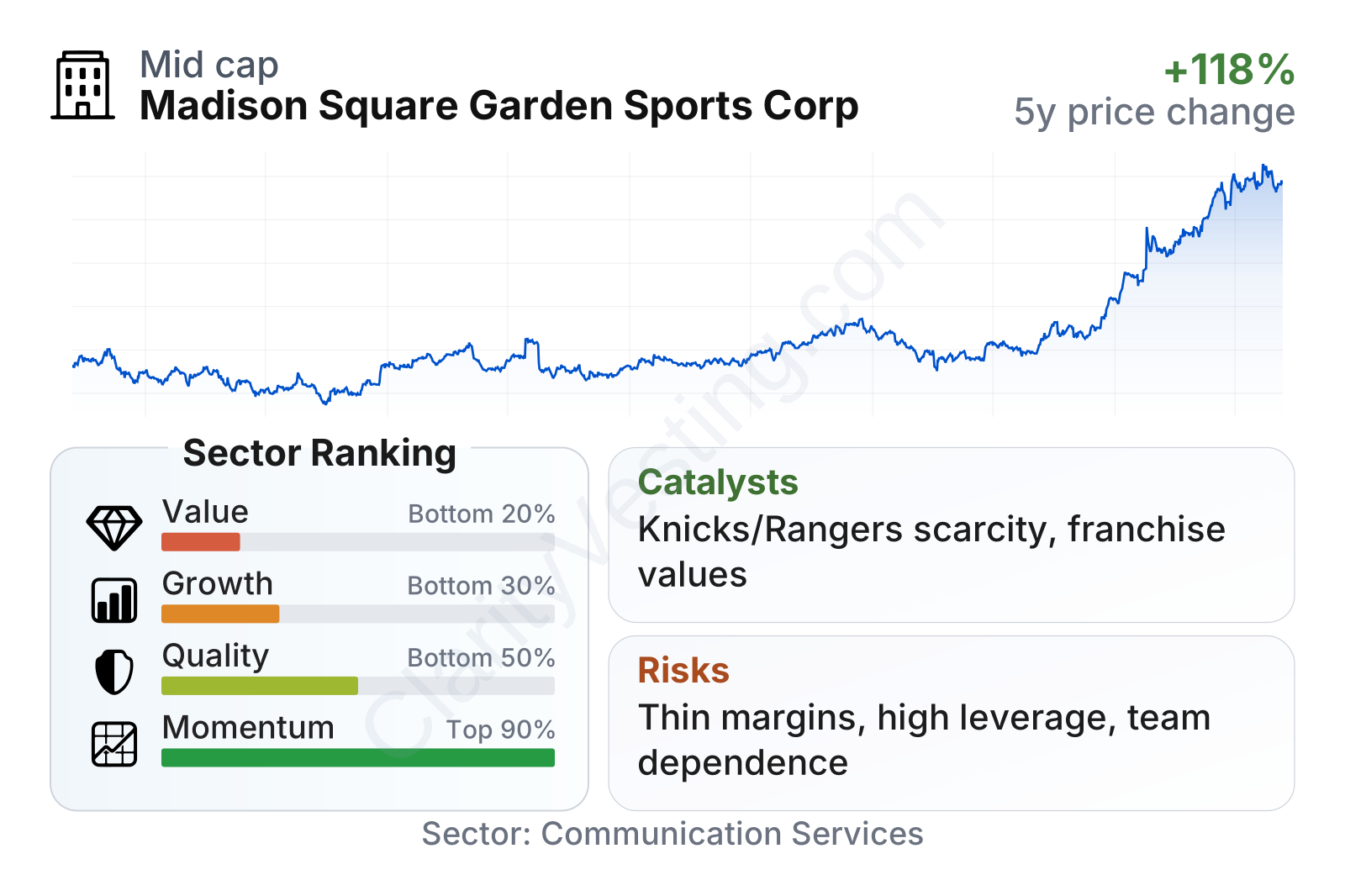
MSG Sports is a large publicly traded sports franchise owner with a market value around $10 billion and a relatively low beta, meaning its stock has historically moved less than the broader market. The scorecard is mixed: recent share price momentum is very strong, but value metrics rank weakly versus the sector, and quality and growth measures are pulled down by modest current profitability, heavy leverage relative to earnings, and uneven cash generation.
The stock chart reflects that change in market perception clearly. After moving in a fairly wide but contained range for several years, the shares accelerated sharply in 2026. That kind of move usually signals that the market is assigning greater value to the underlying franchises rather than responding only to near-term earnings.
Growth
Professional sports ownership sits in a niche with attractive long-term industry characteristics. The sector is supported by live content demand, media relevance, premium ticket pricing, sponsorship budgets, and the simple fact that top-tier teams are scarce assets. In an era when many entertainment formats are fragmented, live sports remains one of the few categories that still commands real-time audiences and pricing power.
MSG Sports’ strategy fits that backdrop. The company does not need to open hundreds of new locations or launch a large number of new products to expand. Its growth path is more focused: raise ticket prices where demand allows, increase premium hospitality revenue, benefit from playoff runs, expand sponsorship economics, and participate in the long-term appreciation of franchise values. That is a different kind of growth model from a normal operating company, but it can still be powerful over long periods.
Recent revenue growth has been volatile, which is normal for sports businesses because results can be affected by playoff schedules, team performance, and event timing. Even so, the latest year-over-year increase stands out as strong at roughly 37%, far above the sector median. Over a five-year span, revenue per share growth has also been better than the sector median, suggesting the top line has generally moved in the right direction despite periodic swings.
Cash generation is less smooth. Free cash flow has remained positive, but it has moved up and down materially from year to year. That matters because a long-term owner of sports franchises can still look financially uneven in any single period if player costs, taxes, working capital, or playoff-related timing move against it. The latest trailing free cash flow is positive but well below stronger periods seen earlier in the cycle.
One of the clearest catalysts is the ongoing rise in professional sports franchise values. Recent transactions and valuation benchmarks across the NBA and other major leagues have increased the market’s willingness to value teams far above what current accounting earnings alone would suggest. For MSG Sports, that matters because the Knicks and Rangers are not ordinary operating assets; they are premium franchises in an elite market.
Another supportive factor is team quality and fan demand. Strong on-court or on-ice performance can lift attendance, playoff revenue, sponsorship rates, and media interest. For a company with only a few flagship assets, performance by those teams has an outsized effect on perception and economics.
Risks
This article is for informational purposes only and does not constitute financial advice. Some content is AI-generated. See Disclaimer