Stock Analysis · Madison Square Garden Entertainment Corp (MSGE)
Overview
Madison Square Garden Entertainment Corp is a live entertainment company built around a small group of high-profile venues and event-related assets. Its best-known properties include Madison Square Garden, Radio City Music Hall, the Beacon Theatre, The Theater at Madison Square Garden, and the Chicago Theatre. The company makes money by hosting concerts, family shows, comedy, sporting events, special events, and venue-related experiences, while also monetizing premium hospitality, suites, sponsorships, signage, and other rights tied to those venues.
The business is fairly concentrated. Unlike a diversified media company or a large ticketing platform, MSGE depends heavily on the appeal, location, and booking strength of a limited number of iconic venues. That concentration can be a strength because these are well-known assets with strong brand recognition and scarce real estate value, but it also means results can move around with event schedules, one-time bookings, and venue utilization.
Based on recent annual filings, revenue is primarily generated from the company’s entertainment and venue operations, with the biggest sources broadly split as follows:
- Event-related revenue: ticketed concerts, shows, and other live events, typically the largest component.
- Food, beverage, and merchandise: sales tied to attendance at events.
- Suites, sponsorship, signage, and venue license arrangements: premium hospitality and commercial partnerships, a meaningful recurring stream.
- Other venue-related revenue: rentals, service fees, and special-use arrangements.
In broad terms, event revenue tends to represent the majority of sales, often around two-thirds or more of the total, while sponsorship, suite-related, concessions, and ancillary categories make up the balance. That mix matters because the company’s earnings power is tied not just to attendance, but also to the ability to fill premium inventory and secure corporate partnerships.
The multi-year financial flow also shows a business that recovered strongly after the pandemic period: revenue expanded sharply from fiscal 2022 through fiscal 2024, gross profit improved, and operating income turned positive. Fiscal 2025 revenue softened slightly from the prior year, but remained well above the earlier recovery stage, suggesting the company is now operating from a much higher base than it was a few years ago.
Key Figures
| Metric | Value | Sector ⓘ |
|---|---|---|
| Date | Jul 18, 2026 | |
| Context | ||
| Sector | Communication Services | |
| Industry | Entertainment | |
| Market Cap ⓘ | $3.50B | |
| Beta ⓘ | 0.55 | |
Value (Cheapness) | ||
| P/E Ratio ⓘ | 71.86 | 19.52 |
| FCF Yield ⓘ | 9.34% | 12.73% |
| EBIT / EV ⓘ | 1.91% | 4.37% |
| PEG ⓘ | N/A | |
Growth (Business expansion) | ||
| Revenue Growth ⓘ | 1.60% | 6.10% |
| RPS Growth (5Y CAGR) ⓘ | 54.94% | 5.02% |
| EPS Growth (5Y CAGR) ⓘ | N/A | -26.68% |
| Margin Growth (5Y Trend) ⓘ | 284.71% | 0.79% |
| FCF Growth (5Y CAGR) ⓘ | N/A | 5.18% |
Quality (Business durability) | ||
| ROIC (Latest) ⓘ | 5.60% | 8.74% |
| ROIC (5Y Median) ⓘ | 5.92% | 8.07% |
| Net Debt / EBIT (Latest) ⓘ | -5.33 | 2.09 |
| Net Debt / EBIT (5Y Median) ⓘ | 9.10 | 3.02 |
| Operating Margin (Latest) ⓘ | 8.18% | 15.46% |
| Operating Margin (5Y Median) ⓘ | 12.31% | 13.17% |
| Debt to Equity (Latest) ⓘ | 8.26% | 59.09% |
| Profit Margin (Latest) ⓘ | 4.81% | 9.11% |
| Free Cash Flow (Latest) ⓘ | $327.01M | |
Momentum (Price trend) | ||
| 3Y Return ⓘ | +113.05% | +36.38% |
| 12M Return (excl. last month) ⓘ | +97.08% | +8.16% |
| 6M Return ⓘ | +26.64% | +2.31% |
| Price vs. 200-Day MA ⓘ | +26.85% | +1.57% |
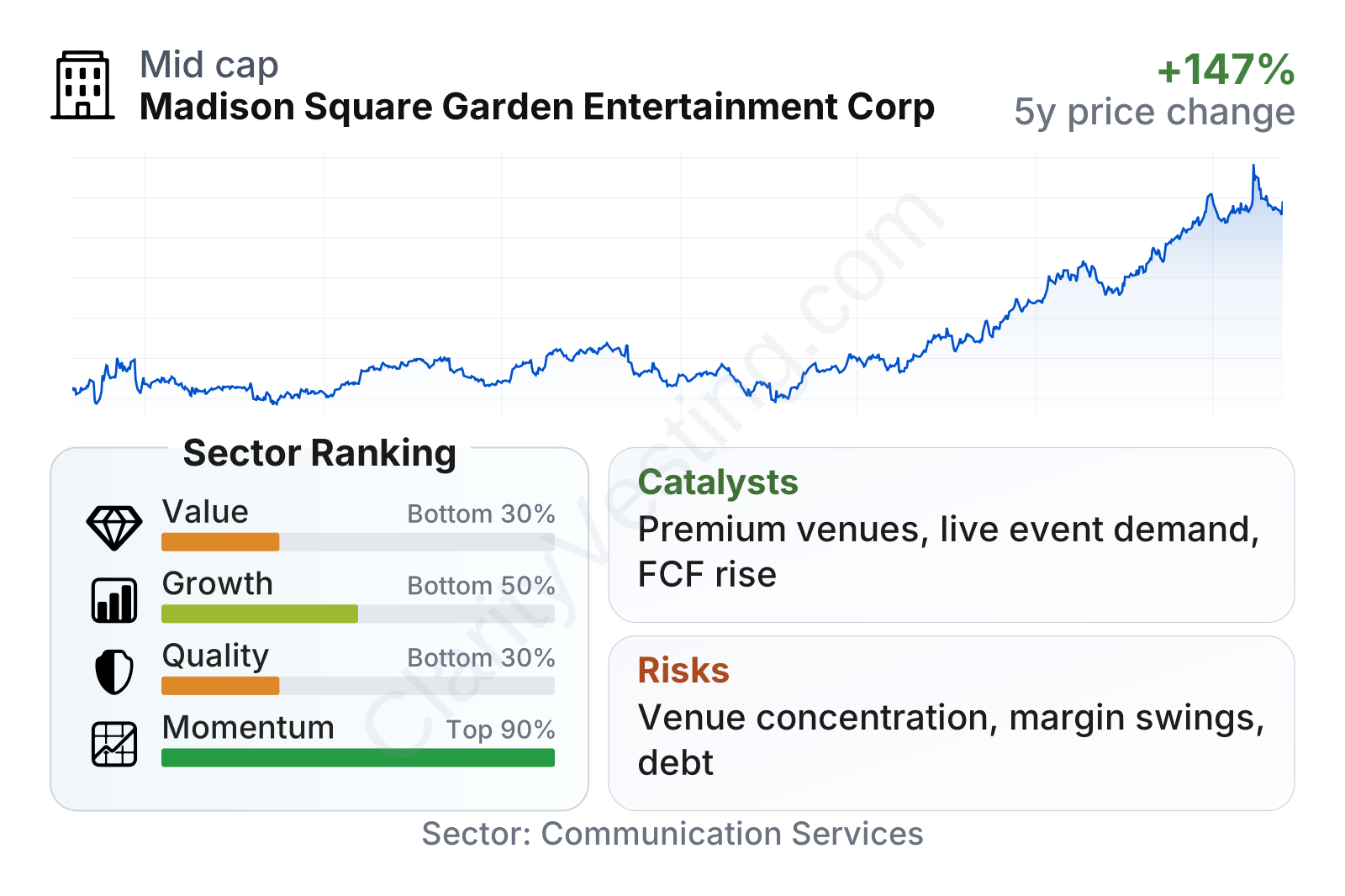
MSGE is a mid-cap entertainment company with a market value around the mid-$3 billion range. The stock has shown unusually strong market momentum over the past year and over three years, clearly outperforming much of its sector. At the same time, the factor profile is mixed: growth and momentum rank very high, while value and quality are weaker. In simple terms, the market has rewarded the company’s progress and asset appeal, but the current pricing leaves less room for mistakes than a cheaper stock would.
Another notable point is balance sheet strength. Debt relative to equity is currently very low compared with the sector, and net debt relative to EBIT has improved sharply into a net cash position on the latest reading. That stands out positively for a venue-based company, where fixed costs and event cyclicality can otherwise make leverage uncomfortable.
Growth
Live entertainment remains an attractive long-term sector. Consumers have continued to spend on experiences, especially premium and destination experiences that are difficult to replace online. MSGE is positioned in one of the most defensible parts of that trend: landmark venues in major cities with long operating histories and strong visibility among performers, promoters, tourists, and corporate clients.
The company’s strategy is sensible for this kind of business. It does not need to reinvent consumer habits; it mainly needs to keep its venues heavily booked, maintain pricing power, expand premium offerings, and deepen sponsorship and hospitality monetization. That is a practical model because iconic venues can generate more revenue not only through more events, but also through better revenue per guest and per event night.
Revenue growth has not been smooth from quarter to quarter, which is normal for an event-driven business. The latest year-over-year growth rate is modest, and below the sector median, but the longer trend is much stronger. Five-year revenue-per-share growth is exceptionally high, reflecting the rebound from earlier disruptions and the company’s improved operating scale. This is not the kind of company that delivers perfectly steady quarterly expansion; it is better understood through multi-year recovery and venue monetization.
Cash generation has improved meaningfully. Trailing free cash flow has climbed to a much stronger level than in prior years, which supports the argument that the business is maturing into a more productive post-recovery phase. Stronger cash flow matters here because it gives the company more flexibility for capital returns, venue investments, and protection against softer event calendars.
Recent company communications have also highlighted ongoing programming activity across its venues, continued demand for marquee events, and the value of premium seating and sponsorship inventory. The main near-term catalysts are therefore not a single transformative product launch, but a combination of booking strength, pricing, premium hospitality, and the scarcity value of its properties. For a venue owner, those can be powerful advantages when the live events market stays healthy.
Risks
MSGE’s biggest risk is concentration. A large share of its economics comes from a limited set of venues in a limited number of markets. If event demand weakens, key artists bypass those venues, tourism softens, or local operating issues emerge, the effect can be meaningful. This is very different from a broad entertainment platform with hundreds of assets spread across regions.
A second risk is earnings volatility. Revenue, margins, and profit can shift noticeably with the event mix, timing of large shows, and one-off items. That shows up clearly in the company’s profitability pattern: margins have been healthy at times, but they have also moved sharply lower more recently. A business can still be sound while producing uneven reported profits, but that tends to complicate valuation.
The debt picture is currently favorable, with leverage now sitting well below the sector median after some very erratic readings in prior periods. That lowers financial risk, but it does not eliminate operating risk. In a venue business, low debt helps absorb volatility, yet it cannot fully offset a weak booking cycle or cost inflation.
Profitability is another area to watch closely. The latest margin trend is weaker than the sector median, and recent readings have turned negative after a stronger stretch in 2024 and early 2025. That does not necessarily mean the franchise is damaged, but it does suggest that the business is sensitive to event timing, operating expenses, and accounting effects. For long-term analysis, this makes normalized earnings more important than any single quarter.
Competitive positioning is nuanced. MSGE is not the overall leader in live entertainment; much larger companies such as Live Nation dominate concert promotion, ticketing ecosystems, and broad venue networks. Sphere Entertainment also matters in the broader New York live entertainment landscape because of its shared history and overlapping public profile, even though the businesses are distinct. Regional venue operators, theaters, arenas, and other destination entertainment assets also compete for events and sponsorship dollars. MSGE’s advantage is not scale leadership, but venue scarcity, location, history, and brand prestige. Those strengths can be durable, though they are narrower than the advantages of a national platform.
Another practical risk is governance and corporate complexity. The broader Madison Square Garden family of companies has gone through separations and restructurings over time, which can make comparisons harder for casual readers and can create occasional confusion around assets, related-party relationships, and strategic priorities. There is no need to assume that complexity is inherently negative, but it does raise the bar for understanding the business.
Valuation
Valuation looks demanding relative to the sector. The latest earnings multiple is far above the sector median, and the company’s broader value ranking sits in the lower tier of its peer group. Historically, the stock often traded at much lower earnings multiples, but the recent share-price rise combined with weaker near-term earnings has pushed the headline multiple up sharply.
That does not automatically mean the market is irrational. Investors may be assigning a premium to the company’s unique assets, cleaner balance sheet, cash flow improvement, and the scarcity value of flagship venues in New York and other major markets. Still, the current valuation appears to require confidence that earnings volatility will normalize and that cash generation will remain solid.
In that sense, the stock price seems easier to justify on asset quality and balance sheet strength than on conventional earnings value. When a company trades at a premium while current margins are under pressure, the market is effectively assuming that the weaker profitability is temporary rather than structural. That can be a reasonable interpretation, but it leaves less margin for disappointment.
Conclusion
Madison Square Garden Entertainment stands out as a focused live entertainment company built around rare, high-profile venues that are difficult to replicate. The business has recovered strongly from earlier disruption, improved its cash generation, and now shows a notably cleaner balance sheet than many peers. Those are meaningful positives, especially in an industry where iconic assets and premium event economics can support long-lasting relevance.
The challenge is that the company remains concentrated, somewhat uneven in quarter-to-quarter performance, and currently priced as if the market expects continued normalization and durable cash flow. That creates a profile in which the underlying assets look more robust than the recent earnings line. Overall, MSGE appears stronger operationally than a simple glance at recent profit margins might suggest, but the stock’s premium valuation means the quality of the venues is already receiving substantial recognition.
Sources:
- U.S. Securities and Exchange Commission (EDGAR) — Madison Square Garden Entertainment Corp. Annual Report on Form 10-K for fiscal year ended June 30, 2025
- U.S. Securities and Exchange Commission (EDGAR) — Madison Square Garden Entertainment Corp. Quarterly Reports on Form 10-Q filed in fiscal 2026
- Madison Square Garden Entertainment Corp. Investor Relations — earnings releases and shareholder materials
- Madison Square Garden Entertainment Corp. Investor Relations — company overview and venue portfolio information
- Wikipedia — Madison Square Garden Entertainment basic company and venue background
This article is for informational purposes only and does not constitute financial advice. Some content is AI-generated. See Disclaimer