Stock Analysis · Microsoft Corporation (MSFT)
Stock Analysis · Microsoft Corporation (MSFT)

Overview

Microsoft is one of the world’s largest software and cloud companies. Its products and services are used by consumers, businesses, developers, schools, and governments. The company is best known for Windows, Microsoft 365, Azure, LinkedIn, GitHub, Xbox, and a broad range of enterprise software tools. In simple terms, Microsoft earns money by providing the digital infrastructure and applications that help people work, communicate, build software, manage data, and increasingly use artificial intelligence.

Its business is diversified across three large reporting segments: Productivity and Business Processes, Intelligent Cloud, and More Personal Computing. That mix matters because it reduces reliance on any single product and gives Microsoft exposure to both recurring software subscriptions and long-term enterprise technology spending.

Based on Microsoft’s latest annual reporting structure, the main sources of revenue can be approximated as follows:

  • Intelligent Cloud: about 40% of revenue. This includes Azure, server products, enterprise support, and other cloud services.
  • Productivity and Business Processes: about 30% to 35% of revenue. This includes Microsoft 365 Commercial and Consumer, LinkedIn, Dynamics, and other business software.
  • More Personal Computing: about 25% to 30% of revenue. This includes Windows, search and news advertising, devices, and gaming.

Within those groups, Azure and Microsoft 365 are widely seen as the core growth engines, while Windows, gaming, and advertising add scale and user reach. The business model is especially attractive because much of Microsoft’s revenue comes from subscriptions, long-term contracts, and deeply embedded enterprise systems, which tend to be more stable than one-time product sales.

The overall financial flow also shows a strong pattern: revenue has expanded sharply over the last several years, while gross profit, operating income, and net income have all risen faster than many large technology peers. Research and development spending has also climbed, which suggests Microsoft is using its scale to fund future platforms rather than simply protecting mature businesses.

Key Figures

MetricValueSector
DateJul 18, 2026
Context
SectorTechnology
IndustrySoftware - Infrastructure
Market Cap $2.93T
Beta 1.13
Value
(Cheapness)
P/E Ratio 23.4331.76
FCF Yield 2.49%4.18%
EBIT / EV 5.32%2.56%
PEG 1.24
Growth
(Business expansion)
Revenue Growth 18.30%13.50%
RPS Growth (5Y CAGR) 14.32%8.57%
EPS Growth (5Y CAGR) 8.07%-21.87%
Margin Growth (5Y Trend) 1.03%0.41%
FCF Growth (5Y CAGR) 6.28%9.76%
Quality
(Business durability)
ROIC (Latest) 30.38%8.54%
ROIC (5Y Median) 31.57%8.12%
Net Debt / EBIT (Latest) 0.590.38
Net Debt / EBIT (5Y Median) 0.440.38
Operating Margin (Latest) 49.43%9.58%
Operating Margin (5Y Median) 43.70%8.25%
Debt to Equity (Latest) 30.27%33.52%
Profit Margin (Latest) 39.34%6.96%
Free Cash Flow (Latest) $72.92B
Momentum
(Price trend)
3Y Return +12.14%+30.91%
12M Return (excl. last month) -20.10%+28.90%
6M Return -13.38%+5.38%
Price vs. 200-Day MA -10.06%+7.61%
Better than sector median
Slightly worse than sector median
More than 20% worse than sector median

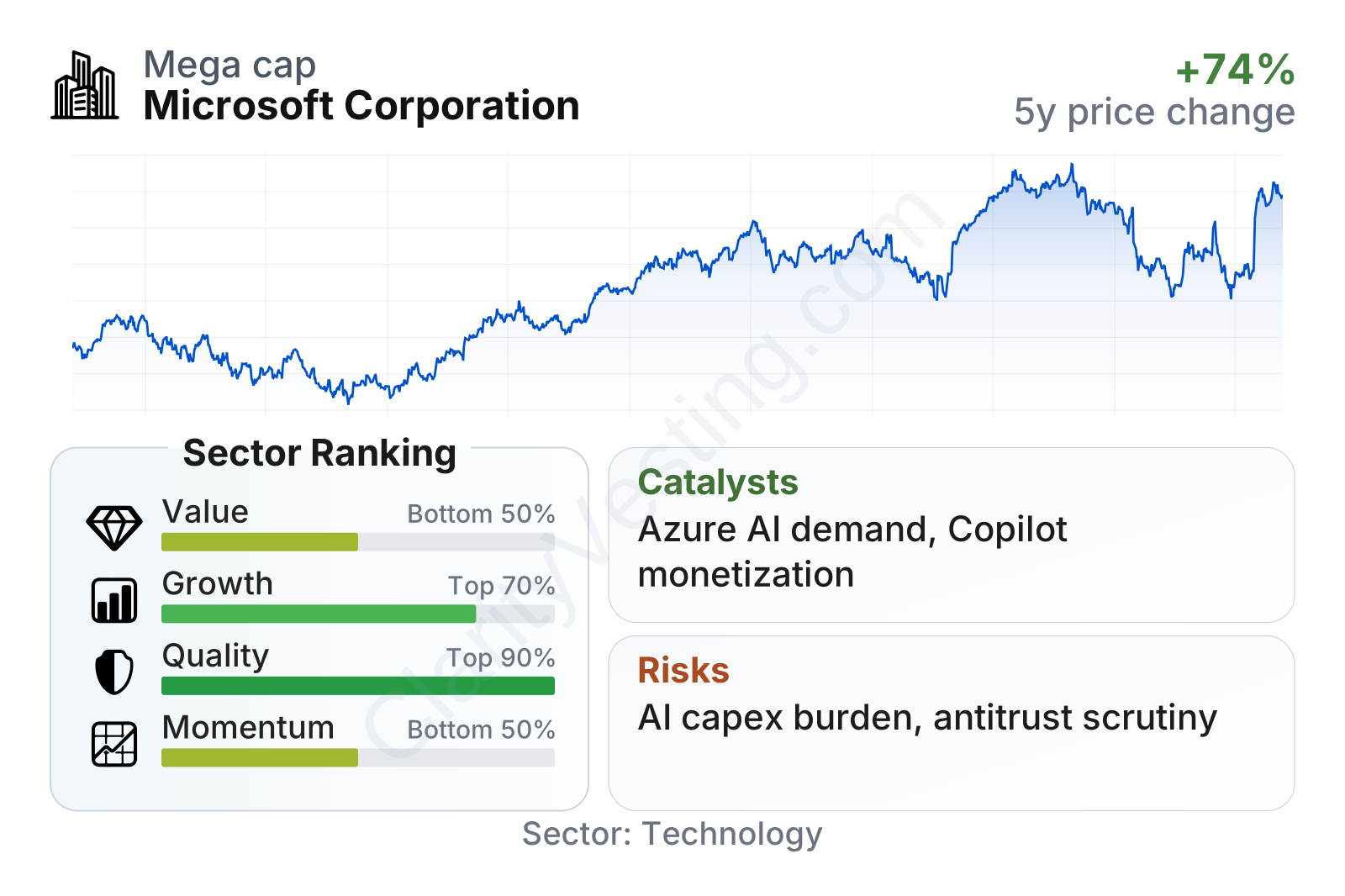
Microsoft stands out for business quality more than for short-term market momentum. Profitability is exceptionally high for a company of this size, with returns on invested capital and operating margins far above typical sector levels. Balance-sheet risk also appears limited, as leverage is low relative to many peers. Growth remains solid, especially compared with much of the software and infrastructure universe, although recent share-price behavior has been weaker than the sector, showing that market enthusiasm has cooled despite strong underlying fundamentals.

Its market value remains enormous, around the multi-trillion-dollar range, which reflects both scale and investor confidence in the durability of its business. The stock’s beta is close to the broader market, suggesting the shares are not unusually volatile for a large technology company, even if they can still swing meaningfully when sentiment around AI or cloud spending changes.

Growth

Microsoft operates in some of the most attractive parts of technology: cloud computing, enterprise software, cybersecurity, developer tools, and artificial intelligence. These are large markets that still appear to have room for expansion as companies continue moving workloads to the cloud, modernizing internal systems, and adopting AI tools. That gives Microsoft exposure to several long-duration growth themes at the same time rather than depending on a single trend.

The company’s strategy looks coherent. Azure gives Microsoft a foundation in cloud infrastructure, Microsoft 365 gives it daily user engagement, GitHub connects it to developers, LinkedIn adds business data and professional reach, and its AI products sit on top of that stack. This creates a strong ecosystem effect: a customer using Microsoft for cloud, productivity, security, and AI may find it easier to stay within the same platform than to piece together tools from many vendors.

Revenue growth has slowed and accelerated at different points, but the broader pattern remains healthy. After a softer phase in 2022 and early 2023, growth recovered into the mid-to-high teens range, which is notable for a company already operating at massive scale. Over a five-year view, revenue per share growth has also outpaced the sector median, indicating that Microsoft has not only grown, but done so from a very large base.

Cash generation supports the growth story. Free cash flow has remained very large even while Microsoft spends heavily on data centers, chips, and AI infrastructure. That matters because artificial intelligence is capital-intensive, and Microsoft has more financial flexibility than most rivals to keep investing without putting the balance sheet under major strain.

One of the clearest catalysts is the company’s effort to weave AI across its product lineup. Copilot features in Microsoft 365, Azure AI services, GitHub Copilot, and enterprise automation tools all create potential for higher spending per customer. The commercial logic is straightforward: if AI meaningfully improves productivity, Microsoft can capture that value through premium subscriptions, cloud usage, and broader platform adoption.

Recent company communications have continued to emphasize AI demand, cloud expansion, and data center investment. The OpenAI partnership, the rollout of Copilot across enterprise offerings, and continued enterprise interest in Azure AI services all point to a significant opportunity if adoption remains strong. The important point for long-term analysis is that Microsoft is not approaching AI as a side project; it is integrating it into products that already have huge installed bases.

Risks

Microsoft’s strengths do not remove its risks. The biggest business risk is execution in artificial intelligence and cloud infrastructure. Demand for AI services is growing, but so are the costs of building the required capacity. If customer adoption rises more slowly than expected, or if pricing becomes more competitive, returns on those investments could come under pressure.

Competition is also intense. In cloud infrastructure, Microsoft competes primarily with Amazon Web Services and Google Cloud. In productivity software and collaboration, it faces Google Workspace and a range of specialized software vendors. In enterprise applications, Salesforce, Oracle, SAP, and ServiceNow are important rivals. In AI platforms, the landscape is even broader, with large technology groups and specialized model providers all competing for customers, developers, and computing resources.

Microsoft is clearly a leader, but leadership depends on category. It is one of the top two players in enterprise software and cloud, and it has unusually strong cross-selling power because many organizations already rely on Windows, Office, Teams, Azure, Active Directory, and security tools. That installed base is a real competitive advantage. Still, Amazon remains formidable in cloud, Google is strong in AI research and productivity, and niche providers can move faster in specific software segments.

On financial risk, the picture is favorable. Leverage has trended down over time and is now well below the sector median, which gives Microsoft room to fund expansion and absorb periods of heavier investment. This is particularly relevant in AI, where data center spending may stay elevated for years.

Profitability remains one of Microsoft’s strongest defenses. Net margin has stayed far above the sector median and has recently improved further, showing that the company still converts a large share of revenue into earnings even while investing heavily. The risk is that future AI-related costs, regulatory compliance, or pricing pressure could narrow those margins from unusually high levels.

Regulation is another important issue. Microsoft faces antitrust scrutiny and broader oversight in areas such as cloud competition, software bundling, cybersecurity, and AI governance. The company is large enough that regulatory outcomes may not threaten its existence, but they can affect growth rates, product design, contract structures, and acquisition flexibility.

Cybersecurity and operational resilience also matter. Because Microsoft provides critical infrastructure to governments and enterprises, security failures can create reputational damage and stricter oversight. Recent years have shown that even highly capable technology firms are not immune from security incidents, and Microsoft’s central role in enterprise IT means the consequences can be amplified.

Valuation

Microsoft’s valuation needs to be judged against two opposing forces: exceptional business quality on one side, and already high market expectations on the other. The company has historically traded at a premium because of its scale, recurring revenue, strong margins, and broad competitive moat. Even so, valuation still matters when growth expectations become tied to a major theme like AI.

The valuation picture has changed meaningfully. Microsoft’s price-to-earnings ratio was often above the sector median over the last few years, sometimes by a wide margin, reflecting optimism around cloud and AI. More recently, that multiple has fallen to a level below the sector median. That suggests the market has become less willing to pay a large premium, even though the underlying business remains stronger than most peers on profitability and capital efficiency.

On balance, the current valuation does not look stretched in the same way it did during parts of 2023 through 2025. It still reflects a high-quality franchise, and free-cash-flow yield is not especially generous, but the earnings multiple appears more grounded relative to Microsoft’s growth profile, balance-sheet strength, and strategic position in AI and cloud. In other words, the stock price seems to be demanding continued execution, but not the same degree of optimism that was embedded earlier.

Conclusion

Microsoft enters this period from a position of unusual strength. It combines massive scale, recurring enterprise revenue, elite profitability, and a balance sheet that can support very large investments. Few companies are as deeply embedded in day-to-day business operations, and that installed base gives Microsoft a powerful platform for expanding cloud services, security offerings, and AI tools.

The main challenge is not whether Microsoft has attractive businesses today, but whether it can translate the AI wave into durable, high-return growth without allowing costs or competition to erode the economics that make the company exceptional. That is a real hurdle, especially in a field moving as quickly as artificial intelligence. Regulatory pressure and cybersecurity scrutiny also deserve continued attention because Microsoft’s size makes it a visible target.

Even with those risks, the overall profile remains compelling from a long-term business perspective. Microsoft looks less like a speculative AI story and more like a highly profitable digital infrastructure company using AI to deepen relationships across an already dominant ecosystem. With growth still solid, margins unusually strong, and valuation more moderate than in recent peak periods, the current backdrop points to a company whose fundamental quality remains ahead of most of the technology sector.

Sources:

  • Microsoft Corporation — Annual Report on Form 10-K for fiscal year ended June 30, 2025
  • Microsoft Corporation — Quarterly Report on Form 10-Q for quarter ended March 31, 2026
  • SEC EDGAR — Microsoft Corporation filings
  • Microsoft Investor Relations — Earnings Release FY26 Q3
  • Microsoft Investor Relations — FY26 Q3 Earnings Call materials
  • Microsoft Investor Relations — Annual Reports and Shareholder Information
  • Wikipedia — Microsoft

This article is for informational purposes only and does not constitute financial advice. Some content is AI-generated. See Disclaimer
Sign up for exclusive research and insights.

Unsubscribe anytime.