Stock Analysis · Marvell Technology Group Ltd (MRVL)
Overview
Marvell Technology is a semiconductor company that designs chips and related technology used to move, store, process, and secure data. In simple terms, Marvell sells the building blocks that help data centers, cloud providers, telecom operators, and equipment makers handle ever-larger amounts of digital traffic. Its products are found in networking gear, custom AI infrastructure, storage systems, broadband equipment, and automotive and industrial applications.
The company has shifted over the years toward infrastructure semiconductors rather than consumer electronics. That matters for long-term analysis because infrastructure chips often benefit from large, multi-year spending cycles tied to cloud computing, artificial intelligence, mobile networks, and enterprise upgrades.
Based on Marvell’s recent annual reporting, revenue is primarily organized by end market rather than by individual chip family. The largest sources are:
- Data center: approximately 72% of fiscal 2026 revenue. This includes interconnect, electro-optics DSPs, custom compute programs, switching, and storage-related silicon used in cloud and AI infrastructure.
- Enterprise networking: approximately 11%. This covers chips used in campus and enterprise network equipment.
- Carrier infrastructure: approximately 10%. This includes products used by telecom operators, such as networking and connectivity silicon for wired and wireless infrastructure.
- Consumer: approximately 4%. This segment is much smaller than in the past and includes broadband and other consumer-oriented connectivity applications.
- Automotive and industrial: approximately 3%. This includes automotive Ethernet and other industrial connectivity uses.
That mix shows a company now heavily exposed to data center demand, especially AI-related infrastructure. It also means Marvell is less diversified by end market than some larger semiconductor peers, but more focused on the area currently attracting the strongest spending.
Recent business flow also looks materially improved. Over the last fiscal year, revenue expanded strongly, gross profit increased sharply, and the company moved from operating losses to sizable operating income. Research and development spending remains very large in absolute dollars, which is typical for a semiconductor designer trying to win long-duration platform positions.
The business profile now looks much more profitable than it did during the weaker part of the cycle. Revenue has risen from roughly the mid-$4 billion range several years ago to above $8 billion, while operating leverage improved significantly as AI and cloud programs scaled.
Key Figures
| Metric | Value | Sector ⓘ |
|---|---|---|
| Date | Sep 12, 2026 | |
| Context | ||
| Sector | Technology | |
| Industry | Semiconductors | |
| Market Cap ⓘ | $212.18B | |
| Beta ⓘ | 2.25 | |
Value (Cheapness) | ||
| P/E Ratio ⓘ | 75.19 | 29.51 |
| FCF Yield ⓘ | 0.82% | 4.25% |
| EBIT / EV ⓘ | 1.70% | 2.85% |
| PEG ⓘ | 1.21 | |
Growth (Business expansion) | ||
| Revenue Growth ⓘ | 36.50% | 15.40% |
| RPS Growth (5Y CAGR) ⓘ | 13.89% | 8.56% |
| EPS Growth (5Y CAGR) ⓘ | -10.83% | -11.88% |
| Margin Growth (5Y Trend) ⓘ | N/A | 0.46% |
| FCF Growth (5Y CAGR) ⓘ | 21.91% | 9.80% |
Quality (Business durability) | ||
| ROIC (Latest) ⓘ | 13.85% | 9.44% |
| ROIC (5Y Median) ⓘ | -2.18% | 8.30% |
| Net Debt / EBIT (Latest) ⓘ | 0.39 | 0.54 |
| Net Debt / EBIT (5Y Median) ⓘ | N/A | 0.44 |
| Operating Margin (Latest) ⓘ | 36.99% | 9.58% |
| Operating Margin (5Y Median) ⓘ | -7.71% | 8.25% |
| Debt to Equity (Latest) ⓘ | 28.52% | 33.33% |
| Profit Margin (Latest) ⓘ | 27.93% | 7.14% |
| Free Cash Flow (Latest) ⓘ | $1.73B | |
Momentum (Price trend) | ||
| 3Y Return ⓘ | +328.22% | +45.48% |
| 12M Return (excl. last month) ⓘ | +179.58% | +23.48% |
| 6M Return ⓘ | +169.51% | +20.93% |
| Price vs. 200-Day MA ⓘ | +52.56% | +7.43% |
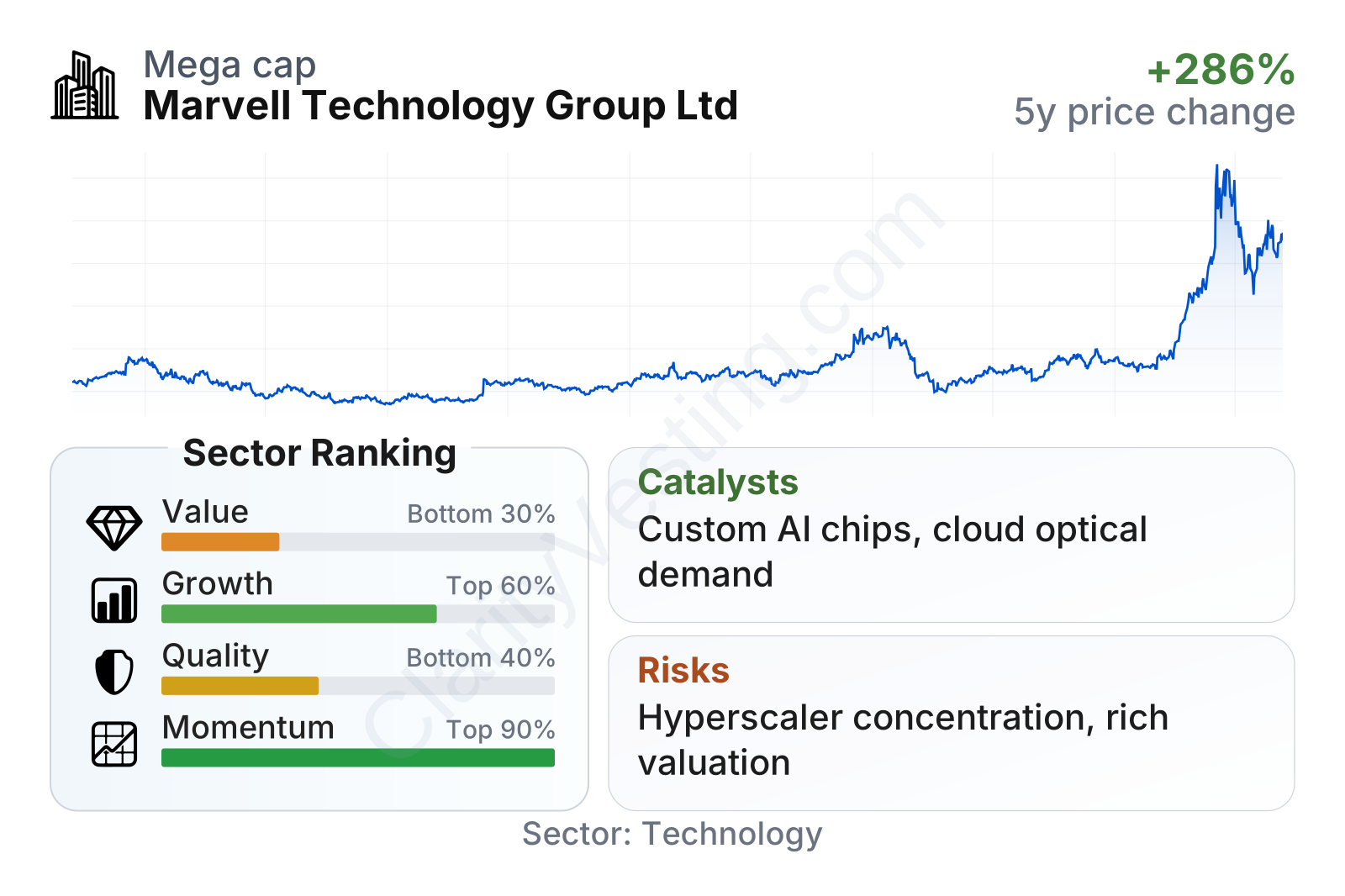
Marvell is now a very large semiconductor company by market value, but its share price behavior remains more volatile than average, with a beta above 2. The broader snapshot is mixed: growth and market momentum rank well versus the sector, while value metrics look weaker because the stock trades at a high earnings multiple and a low free cash flow yield. Quality is not weak across the board, however. Current profitability and returns on invested capital have improved meaningfully, and leverage remains moderate rather than stretched.
Growth
Marvell operates in parts of the semiconductor market that are supported by powerful long-term themes. The clearest one is artificial intelligence infrastructure. AI is not only about GPUs. It also requires high-speed connectivity, custom accelerators, optical links, switching, storage movement, and efficient data transport inside and between data centers. Those are all areas where Marvell has meaningful exposure.
The company’s strategy is logical for this environment. Instead of competing head-on in every category, it focuses on infrastructure silicon where performance, power efficiency, and customer integration matter. A particularly important part of the strategy is custom silicon for large cloud customers. If those programs scale, they can create durable multiyear revenue streams, although they can also produce customer concentration risk.
Revenue growth has been cyclical, with a period of declines followed by a sharp recovery. The latest year-over-year pace, around the mid-30% range, is well ahead of the semiconductor sector median. That rebound suggests the company is not just recovering from a weak base; it is also benefiting from real demand tied to cloud and AI deployments.
Cash generation has also moved in the right direction over time. Trailing free cash flow is comfortably above $1.5 billion, and the multiyear trend is upward despite periods of uneven profitability. That is an important sign because semiconductor companies can show accounting volatility while still proving that their products are commercially valuable through sustained cash generation.
One of the strongest catalysts is the buildout of custom AI infrastructure. Marvell has highlighted growing opportunities in custom XPU programs, interconnect, and optical connectivity for hyperscale customers. These are not small side businesses; they sit close to where the largest technology companies are increasing capital spending. The company has also discussed a larger addressable market in cloud-optimized and AI-focused silicon, which supports the idea that recent growth is tied to a structural shift, not only a short-term rebound.
Another positive element is that Marvell’s portfolio lines up with bottlenecks in modern computing systems. As computing workloads become more distributed, fast and power-efficient data movement becomes more valuable. That dynamic can support demand even outside the most visible AI chips.
Risks
This article is for informational purposes only and does not constitute financial advice. Some content is AI-generated. See Disclaimer


