Stock Analysis · MERLIN Properties SOCIMI S.A (MRPRF)
Overview
MERLIN Properties SOCIMI S.A. is one of the largest listed real estate owners in Spain. It operates as a property company focused on renting out commercial assets rather than developing homes for sale. Its portfolio is concentrated in Spain and Portugal and includes offices, logistics facilities, shopping centers, and a smaller business built around data centers. As a SOCIMI, the Spanish version of a REIT, its model is based on generating recurring rental income, preserving asset occupancy, managing financing costs, and recycling capital into properties with better long-term potential.
The company’s revenue base is diversified across several property types, although offices remain the largest contributor. Based on its recent reporting structure and portfolio mix, the main sources of revenue are approximately:
- Offices: about 45% to 50% of rental income, mainly prime office buildings in Madrid, Barcelona, and Lisbon.
- Logistics: about 25% to 30%, including warehouses and distribution assets linked to e-commerce, transport, and supply chains.
- Shopping centers and retail: about 20% to 25%, coming from large retail destinations and related leases.
- Data centers and other: about 5% to 10%, a smaller but increasingly strategic activity tied to digital infrastructure and ancillary property income.
This mix matters because it gives MERLIN exposure to both traditional commercial real estate and newer demand areas such as logistics and digital infrastructure. It also reduces reliance on a single tenant category, even though offices still set the tone for overall portfolio performance.
The business has shown strong operating conversion from revenue into property-level profit, which is typical for landlords with stabilized assets. At the same time, earnings can swing sharply from year to year because property revaluations and asset sales can materially affect reported profit even when rental operations are more stable.
Key Figures
| Metric | Value | Sector ⓘ |
|---|---|---|
| Date | Nov 21, 2026 | |
| Context | ||
| Sector | Real Estate | |
| Industry | REIT - Office | |
| Market Cap ⓘ | $8.05B | |
| Beta ⓘ | 0.98 | |
Value (Cheapness) | ||
| P/E Ratio ⓘ | 7.74 | 17.59 |
| P/B Ratio ⓘ | N/A | 1.58 |
| FCF Yield ⓘ | 1.74% | 5.76% |
| Dividend Yield ⓘ | 3.23% | 4.81% |
| EBIT / EV ⓘ | 5.53% | 4.97% |
| PEG ⓘ | 2.30 | |
Growth (Business expansion) | ||
| Revenue Growth ⓘ | -0.60% | 5.70% |
| RPS Growth (5Y CAGR) ⓘ | -4.58% | 5.96% |
| EPS Growth (5Y CAGR) ⓘ | -13.41% | -3.46% |
| BVPS Growth (5Y CAGR) ⓘ | -5.09% | 0.32% |
| Margin Growth (5Y Trend) ⓘ | 105.97% | -0.65% |
| FCF Growth (5Y CAGR) ⓘ | 15.60% | 5.08% |
| DPS Growth (5Y CAGR) ⓘ | 5.60% | 5.00% |
Quality (Business durability) | ||
| ROIC (Latest) ⓘ | N/A | 5.13% |
| ROE (Latest) ⓘ | 9.91% | 7.64% |
| ROA (Latest) ⓘ | 5.78% | 3.05% |
| ROIC (5Y Median) ⓘ | 2.48% | 4.20% |
| ROE (5Y Median) ⓘ | 4.04% | 6.03% |
| ROA (5Y Median) ⓘ | 2.22% | 2.41% |
| Net Debt / EBIT (Latest) ⓘ | 6.52 | 7.59 |
| Net Debt / EBIT (5Y Median) ⓘ | 10.91 | 8.34 |
| Net Debt / EBITDA (Latest) ⓘ | 6.45 | 5.43 |
| Net Debt / Assets ⓘ | 24.93% | 38.21% |
| EBITDA / Interest ⓘ | 4.78 | 4.20 |
| Operating Margin (Latest) ⓘ | 101.13% | 34.59% |
| Operating Margin (5Y Median) ⓘ | 79.84% | 37.64% |
| Debt to Equity (Latest) ⓘ | 57.25% | 90.32% |
| Profit Margin (Latest) ⓘ | 145.30% | 20.10% |
| Free Cash Flow (Latest) ⓘ | $140.27M | |
Momentum (Price trend) | ||
| 3Y Return ⓘ | +48.63% | +27.88% |
| 12M Return (excl. last month) ⓘ | -13.64% | +1.16% |
| 6M Return ⓘ | -27.17% | -3.06% |
| Price vs. 200-Day MA ⓘ | -16.78% | -0.73% |
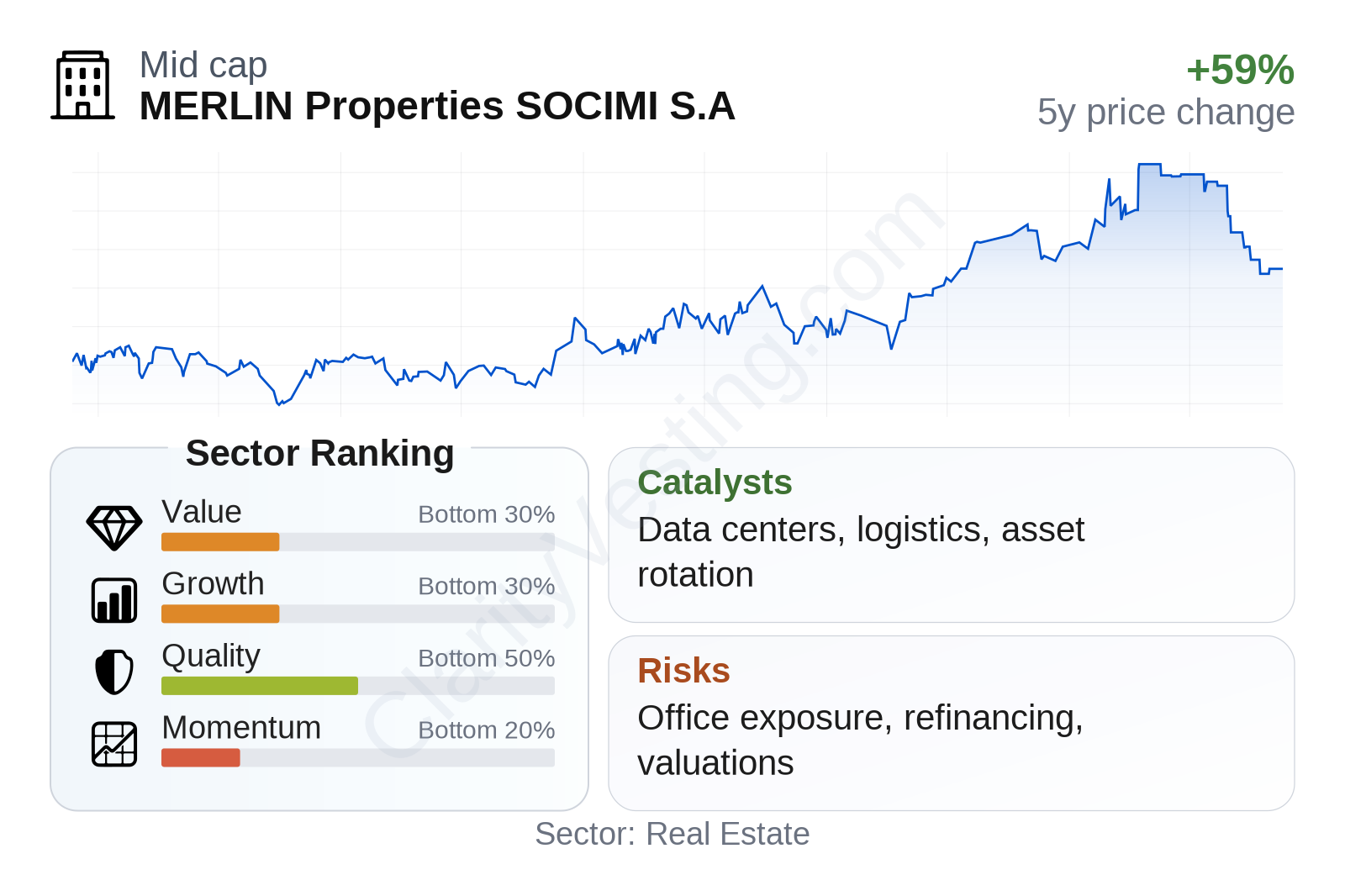
MERLIN sits in the large-cap range for its niche, with share-price volatility close to the broader market. The valuation profile looks mixed: the earnings multiple is low relative to the real estate sector, but the company ranks weakly on the broader value screen because free cash flow yield and dividend yield are below sector medians. Quality is also mixed. Current profitability ratios are solid, with return on equity near 10% and return on assets around 6%, both above many peers, while leverage against assets and equity is lower than typical sector levels. The weak area is growth: revenue and book value trends over five years have been soft, and recent share-price momentum has turned negative after a strong earlier run.
Growth
MERLIN operates in a sector that is mature overall, but not stagnant. Long-term demand drivers differ by property type. Logistics continues to benefit from supply-chain modernization and e-commerce penetration. Data centers are backed by cloud computing, AI-related infrastructure needs, and rising enterprise data usage. Offices are a more selective market, with demand strongest for modern, energy-efficient buildings in prime urban locations. Retail has become more polarized, favoring dominant assets with strong foot traffic over weaker secondary malls.
MERLIN’s strategy broadly fits those trends. Over recent years it has been reducing exposure to less attractive assets, focusing on better-located properties, and building a presence in data centers through its own platform. That makes strategic sense because digital infrastructure offers a structurally stronger growth path than traditional office or retail leasing. The company also has scale in Iberia, which can matter when attracting multinational tenants or funding larger projects.
Revenue per share has been broadly flat to down over the last several years rather than showing a clear upward slope. That suggests the growth case is less about rapid expansion in rent today and more about portfolio upgrading, development completions, occupancy gains, and new asset classes such as data centers.
The dividend record has been uneven in absolute yearly amounts, which is common in listed property companies because payouts can reflect asset disposals, accounting results, and financing conditions. Even so, the longer-term pattern still points to distributions that have generally grown over a multi-year period, though not in a straight line.
A meaningful catalyst is the company’s push into data centers, where demand fundamentals are considerably stronger than in most traditional real estate segments. Another potential support is the interest-rate backdrop: commercial property values and financing costs tend to respond favorably when rate pressure eases. In addition, prime logistics space in Iberia remains a structurally healthier niche than many office markets, offering room for rent growth and high occupancy if supply stays disciplined.
Recent corporate updates have also highlighted continued asset rotation and a focus on high-quality buildings and infrastructure-ready projects. For a long-term view, that matters more than short-term accounting swings because it shapes the earning power of the portfolio several years ahead.
Risks
This article is for informational purposes only and does not constitute financial advice. Some content is AI-generated. See Disclaimer