Stock Analysis · Mapfre SA (MPFRY)
Overview
Mapfre S.A. is a large multinational insurance group based in Spain. It sells a broad range of insurance products to individuals, families, and businesses, and it also manages savings and retirement-related products. For long-term readers, the key point is that Mapfre is not a narrow niche insurer: it operates across property and casualty insurance, life insurance, health, reinsurance, and assistance services, with business spread across Spain, Latin America, Brazil, North America, and other regions.
The company’s revenue comes mainly from insurance premiums and, to a lesser extent, investment and service-related income. Based on Mapfre’s recent annual reporting structure, the business is largely organized by geography and product line, with the biggest contributions generally coming from non-life insurance and from its core Iberian and Latin American operations.
The main sources of revenue are approximately:
- Non-life insurance premiums: the largest source, likely around 70% to 80% of premiums. This includes auto, home, commercial property, liability, accident, and other general insurance products.
- Life insurance and savings products: roughly 15% to 25%. This includes protection policies, annuities, savings-linked contracts, and retirement-related products.
- Reinsurance and global risks: a meaningful but smaller share, generally within the broader insurance base. This covers insurance sold to other insurers and coverage for large corporate risks.
- Assistance, service, and other activities: a relatively small contribution. This includes roadside assistance, travel support, and related service businesses.
- Investment income: an important earnings contributor rather than a standalone operating segment. Insurers invest premium float in bonds and other assets, and this can materially support profit.
Mapfre’s earnings mix matters because insurance is a scale business: premium growth alone is not enough. What really drives long-term value is pricing discipline, claims control, geographic diversification, and the ability to invest policyholder funds profitably. Over the last several years, Mapfre has expanded revenue steadily, while net income has improved more sharply in the latest period, suggesting that underwriting conditions and investment income have become more favorable.
The broad trend is constructive: revenue has moved up from roughly $23 billion in 2021 to about $29 billion in 2025, while net income recovered from a weaker 2022 and reached a notably higher level by 2024 and 2025. That points to a business that is benefiting from scale and better operating conditions, although margins remain modest compared with many financial peers.
Key Figures
| Metric | Value | Sector ⓘ |
|---|---|---|
| Date | Nov 21, 2026 | |
| Context | ||
| Sector | Financial Services | |
| Industry | Insurance - Diversified | |
| Market Cap ⓘ | $13.69B | |
| Beta ⓘ | 0.29 | |
Value (Cheapness) | ||
| P/E Ratio ⓘ | 10.02 | 12.01 |
| P/B Ratio ⓘ | N/A | 1.48 |
| FCF Yield ⓘ | 4.12% | 8.77% |
| Dividend Yield ⓘ | 4.70% | 3.01% |
| EBIT / EV ⓘ | N/A | 8.31% |
| PEG ⓘ | N/A | |
Growth (Business expansion) | ||
| Revenue Growth ⓘ | 43.10% | 6.70% |
| RPS Growth (5Y CAGR) ⓘ | 6.17% | 12.35% |
| EPS Growth (5Y CAGR) ⓘ | 8.12% | -0.27% |
| BVPS Growth (5Y CAGR) ⓘ | -0.66% | 4.83% |
| Margin Growth (5Y Trend) ⓘ | -0.16% | -4.16% |
| FCF Growth (5Y CAGR) ⓘ | N/A | 4.69% |
| DPS Growth (5Y CAGR) ⓘ | 17.59% | 8.82% |
Quality (Business durability) | ||
| ROIC (Latest) ⓘ | N/A | 9.49% |
| ROE (Latest) ⓘ | N/A | 14.02% |
| ROA (Latest) ⓘ | N/A | 1.53% |
| ROIC (5Y Median) ⓘ | 8.93% | 7.80% |
| ROE (5Y Median) ⓘ | 9.67% | 12.09% |
| ROA (5Y Median) ⓘ | 1.18% | 1.28% |
| Net Debt / EBIT (Latest) ⓘ | N/A | 0.88 |
| Net Debt / EBIT (5Y Median) ⓘ | 1.49 | 0.73 |
| Net Debt / EBITDA (Latest) ⓘ | N/A | 0.71 |
| Operating Margin (Latest) ⓘ | N/A | 23.37% |
| Operating Margin (5Y Median) ⓘ | 6.43% | 24.29% |
| Debt to Equity (Latest) ⓘ | 28.94% | 59.34% |
| Profit Margin (Latest) ⓘ | 3.94% | 26.65% |
| Free Cash Flow (Latest) ⓘ | $564.03M | |
Momentum (Price trend) | ||
| 3Y Return ⓘ | +135.13% | +73.29% |
| 12M Return (excl. last month) ⓘ | +8.54% | +18.35% |
| 6M Return ⓘ | -5.55% | +3.24% |
| Price vs. 200-Day MA ⓘ | +29.43% | +2.17% |
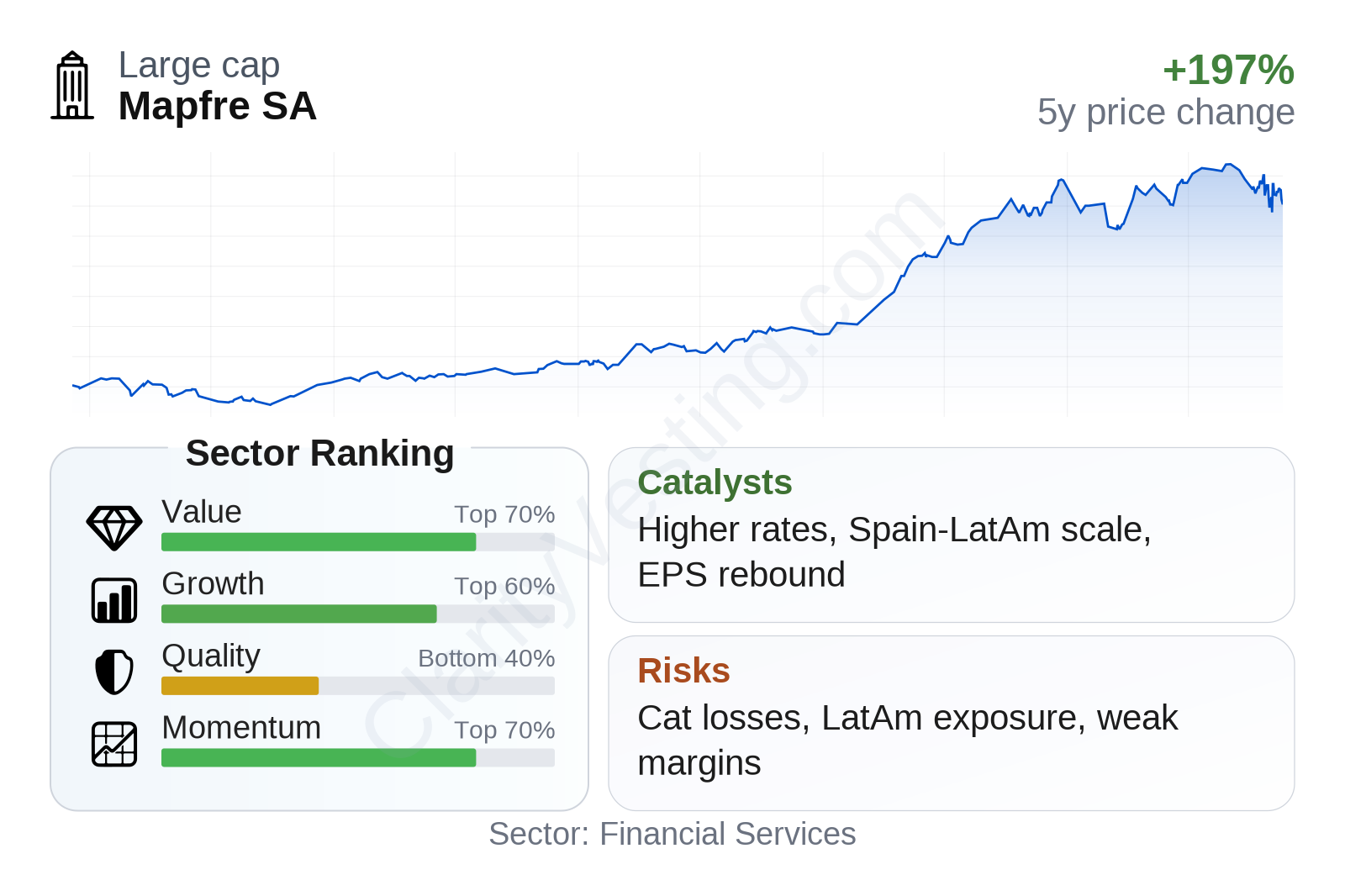
Mapfre is a large insurer with a market value in the mid-teens of billions of dollars and a relatively low beta, which suggests the stock has been less volatile than the broader market. On valuation, the earnings multiple is somewhat below the sector median, while the dividend yield is above the sector median. That combination usually signals a company the market views as established and income-generative rather than high growth.
The factor breakdown is mixed. Value and growth sit around the better half of the sector, while quality ranks weaker. That pattern fits the operating profile: recent revenue growth has been strong, long-term earnings growth has been positive, and the stock has performed well over three years, but profitability ratios and margins remain less impressive than many financial peers. In short, the current picture is that of a solid, mature insurer with improving results, but not a standout efficiency leader.
Growth
Insurance is generally a durable long-term sector rather than a rapid-growth one. Demand is supported by structural needs: people insure cars, homes, health, businesses, and retirement savings in almost every economic environment. For Mapfre, this is reinforced by exposure to Spain and Latin America, where insurance penetration can still deepen over time, especially in health, protection, savings, and commercial lines.
Mapfre’s strategy makes sense for steady expansion because it combines geographic diversification with product breadth. That matters in insurance: weak performance in one line or one country can be offset by stronger conditions elsewhere. The company also benefits from having meaningful reinsurance and corporate-risk capabilities, which add another layer of diversification beyond retail policies.
A major catalyst for insurers recently has been the interest-rate backdrop. Higher rates can improve returns on the bond portfolios where insurers place large amounts of their investable assets. That does not solve underwriting problems, but it can lift overall profitability if claims trends remain controlled. For Mapfre, this is particularly relevant because recent net income has risen faster than revenue.
The earnings path has been uneven, which is normal in insurance because results can swing with catastrophe losses, reserving, inflation in repair costs, and financial-market effects. Even so, the broader five-year trend still points to positive earnings growth, and dividend growth over that period has also been strong. That suggests a business that has recovered from temporary pressure rather than one in structural decline.
Book value per share is another useful measure for insurers because it reflects the capital base supporting underwriting. Mapfre’s book value fell earlier in the period and then rebuilt gradually. That recovery is encouraging, but the five-year trend remains slightly negative overall, which means growth has not been consistently compounding through the balance sheet. For long-term analysis, that keeps the focus on whether current profitability can continue long enough to turn book value growth more decisively positive.
Recent company updates have also pointed to continued emphasis on underwriting discipline, capital strength, and international operations. In practical terms, the opportunity is straightforward: if premium pricing stays firm, claims inflation moderates, and investment returns remain supportive, Mapfre has room to keep translating moderate revenue growth into faster bottom-line improvement.
Risks
This article is for informational purposes only and does not constitute financial advice. Some content is AI-generated. See Disclaimer