Stock Analysis · Moncler S.p.A (MONRY)
Overview
Moncler S.p.A is an Italian luxury apparel group best known for premium outerwear, especially down jackets, and for selling a branded lifestyle built around exclusivity, fashion, and technical performance. The group operates mainly through two brands: Moncler, the larger and more established label, and Stone Island, which adds a more experimental and streetwear-oriented identity. The business model is straightforward: design high-end products, control brand image tightly, and sell a large share directly through its own stores and digital channels rather than relying too heavily on third-party retailers.
Revenue is primarily driven by the Moncler brand, with Stone Island representing a smaller but meaningful second pillar. The company’s annual reporting also shows that direct-to-consumer sales are the core engine of the business, which is important because directly operated stores and e-commerce usually carry higher margins and give management more control over pricing, customer relationships, and inventory.
Based on recent annual disclosures, Moncler’s revenue mix can be summarized approximately as follows:
- Moncler brand: roughly 80%+ of group revenue
- Stone Island: roughly 15%–20% of group revenue
- Direct-to-consumer channel: roughly 80%+ of sales
- Wholesale channel: roughly 15%–20% of sales
- Geographically: Asia remains a major contributor, with EMEA and the Americas also important
The company sits in the global luxury segment rather than mass-market apparel. That matters because demand in luxury tends to depend less on volume and more on brand strength, pricing power, and desirability. Over the last several years, Moncler has shown that it can expand revenue while keeping unusually strong profitability for the broader apparel industry.
The long-term pattern is favorable: revenue rose markedly from 2021 to 2024, while gross profit expanded even faster than operating costs. Although 2025 appears slightly softer, the overall picture still shows a business with strong pricing power and disciplined expense control, which is unusual in apparel.
Key Figures
| Metric | Value | Sector ⓘ |
|---|---|---|
| Date | Jun 22, 2026 | |
| Context | ||
| Sector | Consumer Cyclical | |
| Industry | Apparel Manufacturing | |
| Market Cap ⓘ | $16.71B | |
| Beta ⓘ | 1.07 | |
Value (Cheapness) | ||
| P/E Ratio ⓘ | 22.92 | 18.52 |
| FCF Yield ⓘ | 9.43% | 7.88% |
| EBIT / EV ⓘ | N/A | 6.07% |
| PEG ⓘ | 2.94 | |
Growth (Business expansion) | ||
| Revenue Growth ⓘ | 1.50% | 5.40% |
| RPS Growth (5Y CAGR) ⓘ | 9.18% | 9.20% |
| EPS Growth (5Y CAGR) ⓘ | -51.70% | -30.36% |
| Margin Growth (5Y Trend) ⓘ | 2.52% | -0.16% |
| FCF Growth (5Y CAGR) ⓘ | -0.77% | 4.78% |
Quality (Business durability) | ||
| ROIC (Latest) ⓘ | 37.65% | 12.03% |
| ROIC (5Y Median) ⓘ | 19.29% | 10.85% |
| Net Debt / EBIT (Latest) ⓘ | -0.05 | 2.18 |
| Net Debt / EBIT (5Y Median) ⓘ | -0.11 | 2.30 |
| Operating Margin (Latest) ⓘ | 30.09% | 9.21% |
| Operating Margin (5Y Median) ⓘ | 30.26% | 9.57% |
| Debt to Equity (Latest) ⓘ | 29.31% | 74.88% |
| Profit Margin (Latest) ⓘ | 20.01% | 5.22% |
| Free Cash Flow (Latest) ⓘ | $1.57B | |
Momentum (Price trend) | ||
| 3Y Return ⓘ | -10.18% | +12.39% |
| 12M Return (excl. last month) ⓘ | -3.73% | +1.89% |
| 6M Return ⓘ | -4.78% | -0.25% |
| Price vs. 200-Day MA ⓘ | +1.65% | +0.87% |
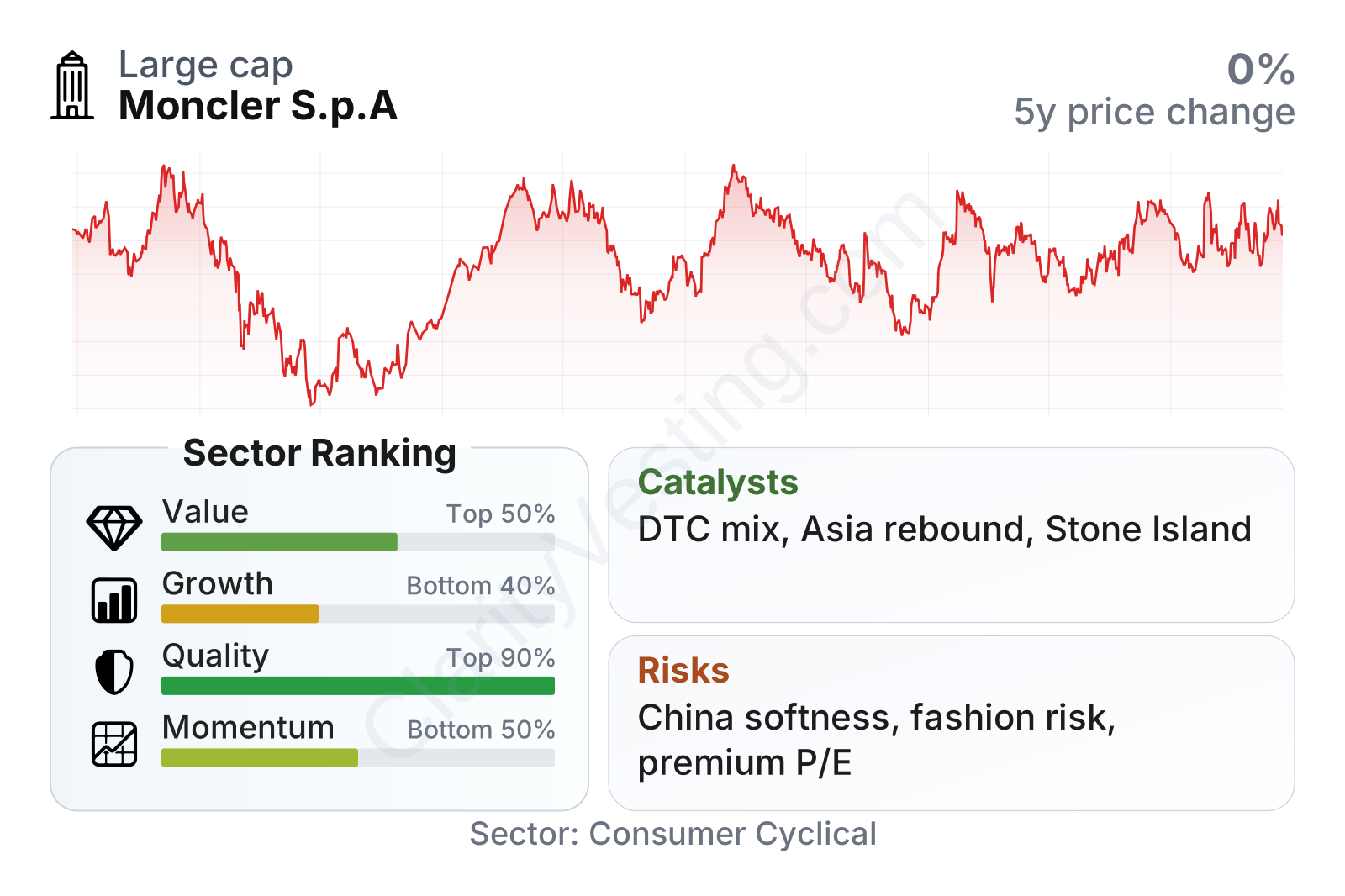
Moncler stands out most on business quality. Profitability is far above the sector median, returns on invested capital are exceptionally strong, and leverage remains modest. The balance sheet is especially notable because net debt relative to earnings is effectively absent, giving the company flexibility in a cyclical and fashion-sensitive industry.
The weaker area is recent growth and market performance. Revenue growth has slowed to low single digits, and the stock’s medium-term performance has lagged much of the consumer discretionary universe. In other words, the market is still recognizing Moncler as a high-quality company, but not rewarding it as aggressively as during earlier growth phases.
At around a mid-sized to large luxury market capitalization, Moncler is no longer a niche label, yet it is still much smaller than the biggest global luxury houses. That leaves room for expansion if brand momentum stays intact.
Growth
The luxury apparel and accessories market is still supported by long-term structural drivers: rising wealth in Asia and the Middle East, global tourism, and the continued shift toward direct digital engagement with consumers. Within that environment, Moncler occupies an attractive niche. It is not trying to compete across every category like the largest luxury conglomerates. Instead, it has built a focused identity around outerwear, fashion credibility, and premium positioning, then extended that identity into broader ready-to-wear and accessories.
Its strategy for future growth is sensible. Management has spent years strengthening direct distribution, selective store expansion, and brand elevation through collaborations and high-visibility marketing events. That approach can deepen customer loyalty without depending on aggressive discounting. Stone Island is also part of the longer-term opportunity: if the brand broadens internationally and improves execution, it can become a more meaningful second growth engine rather than simply a supporting asset.
Near-term growth has clearly cooled compared with the post-pandemic rebound period. That does not necessarily mean the business model is weakening; it more likely reflects a tougher backdrop for global luxury demand, particularly in parts of Asia, and a more mature base after several years of strong expansion. Over five years, however, revenue per share growth has still been solid and broadly in line with the sector.
Cash generation remains a major strength. Even with slower recent growth, Moncler is still producing substantial free cash flow, which supports store investments, brand-building, selective shareholder returns, and balance-sheet resilience. For a luxury company, that combination of premium margins and strong cash conversion is one of the clearest signals that the brand retains pricing power.
One of the more important catalysts is the company’s ability to keep increasing the share of direct sales. Every improvement there can support margins, improve customer data, and reduce dependence on wholesale partners. Another is geographic normalization in luxury demand if Chinese consumption and travel spending become more supportive again. Product category expansion beyond outerwear is also meaningful, because it can reduce seasonality and make the brand relevant across more of the year.
Recent corporate communication has continued to emphasize brand investment, retail execution, and disciplined expansion rather than rapid volume chasing. For a luxury name, that is usually a healthier signal than aggressive short-term sales tactics, because preserving exclusivity often matters more than maximizing near-term units sold.
Risks
Moncler’s biggest risk is that it operates in a category where brand heat matters enormously. Luxury customers are willing to pay high prices only while a label remains desirable. If fashion relevance slips, growth and margins can weaken faster than in many other consumer businesses. This is especially relevant for Moncler because the brand has a strong association with outerwear, a category that is distinctive but narrower than the product breadth offered by larger rivals.
A second risk is geographic exposure. Luxury demand has been uneven in recent years, especially in China, and Moncler has meaningful exposure to Asian consumers both domestically and through travel retail patterns. A prolonged slowdown in that customer base would likely weigh on sales productivity and limit operating leverage.
Balance-sheet risk appears manageable. Debt relative to equity is well below the sector median, and the company’s earnings power gives it room to absorb cyclical pressure. This does not remove operational risk, but it does reduce the chance that a softer demand period turns into a financing problem.
Margins are a competitive advantage, but they also create expectations. Moncler’s profit margin is far above the sector median, which shows excellent brand economics. The flip side is that premium valuations and premium margins can come under pressure if sales growth remains muted, if markdown activity rises, or if operating costs climb faster than revenue.
Competition is intense. In luxury outerwear, Moncler competes most directly with Canada Goose in premium performance-inspired apparel. In broader luxury fashion, it faces much larger groups such as LVMH, Kering, Prada, and labels under Hermès or Burberry in overlapping customer wallets. Compared with these companies, Moncler is highly profitable and brand-focused, but it is also less diversified. It is stronger than many apparel names on margin and brand equity, yet it lacks the category breadth and portfolio diversification of the largest luxury houses.
There is also execution risk around Stone Island. The acquisition makes strategic sense, but scaling a second brand globally without diluting its identity is not simple. If Stone Island underperforms, Moncler remains heavily reliant on its flagship label for the vast majority of earnings.
No major governance scandal defines the current picture, but the usual reputation risks in luxury remain relevant: supply chain scrutiny, counterfeiting, brand overexposure, and any marketing misstep that could damage exclusivity. These are not unique to Moncler, but they matter more in luxury than in ordinary apparel.
Valuation
Moncler trades at a valuation that remains above the broader sector on earnings multiples.
That premium is not hard to understand. The company has much stronger margins, much better returns on capital, and a cleaner balance sheet than the average consumer cyclical peer. In other words, this is not being valued like a standard apparel manufacturer; it is being valued like a high-quality luxury franchise.
The harder question is whether the premium is fully supported by current growth. Right now, that is less obvious. Revenue growth has slowed to low single digits, free cash flow growth over a longer period has been uneven, and market momentum has been relatively soft. A price-to-earnings ratio in the low 20s is not extreme for luxury, but it is not clearly cheap when compared with the company’s present growth profile. It looks more like a valuation that assumes Moncler can preserve elite profitability and eventually return to stronger top-line expansion.
That makes the current price easier to justify on quality than on near-term growth. If demand improves and direct sales continue to expand, the multiple can look reasonable. If growth remains subdued for longer, the valuation leaves less room for disappointment than a more cyclical apparel business would.
Conclusion
Moncler is a high-quality luxury company with a strong brand, unusually high margins, impressive returns on capital, and a balance sheet that looks far healthier than most apparel peers. Its business model is attractive because it combines exclusivity, direct distribution, and substantial cash generation. Those are the kinds of characteristics that often separate durable luxury franchises from ordinary fashion companies.
The main challenge is not financial weakness but the gap between exceptional quality and more moderate current growth. The company still appears well positioned over the long term, especially if it keeps strengthening direct sales, broadening product categories, and developing Stone Island into a stronger second platform. At the same time, the valuation still reflects a meaningful premium, so the market is not ignoring those strengths.
The overall picture is that of a disciplined and profitable luxury operator whose long-term appeal remains intact, but whose share price still depends on renewed growth momentum to fully support its premium standing.
Sources:
- Moncler S.p.A. – Annual Report 2025
- Moncler S.p.A. – 2025 Full Year Results Press Release
- Moncler S.p.A. – Corporate Website, Brands and Business Model Overview
- Moncler S.p.A. – Investor Relations Presentations, 2025 Results Materials
- U.S. SEC EDGAR – Moncler S.p.A. filings and submitted reports
- Wikipedia – Moncler basic company history and corporate background
This article is for informational purposes only and does not constitute financial advice. Some content is AI-generated. See Disclaimer