Stock Analysis · Modine Manufacturing Company (MOD)
Overview
Modine Manufacturing Company designs and manufactures thermal management products. In simple terms, it helps control heat, cooling, and air flow in vehicles, buildings, industrial equipment, and data centers. The company has been shifting its business mix away from lower-growth, more cyclical activities and toward areas tied to energy efficiency, climate solutions, and infrastructure with stronger demand.
Based on the company’s latest fiscal 2026 reporting, revenue is mainly organized across two broad segments:
- Climate Solutions – about 80% to 85% of revenue: this includes data center cooling systems, HVAC equipment, school and commercial ventilation, heat-transfer products for buildings, and other air quality and temperature-control applications. This is now the core of the company and the main driver of its recent expansion.
- Performance Technologies – about 15% to 20% of revenue: this includes thermal systems and coatings used in vehicles, off-highway equipment, powertrain applications, and selected industrial end markets.
That mix matters because Climate Solutions generally has better long-term demand support. Data center cooling, indoor air quality, and energy-efficient heating and cooling systems are benefiting from structural investment rather than only normal vehicle production cycles.
Another useful way to look at the business is by end market. A rising share of Modine’s revenue now comes from commercial and industrial customers that need cooling and ventilation systems, while the company’s exposure to traditional automotive components is smaller than it used to be. This transformation is one of the most important changes in the investment case.
The company’s recent financial flow also shows meaningful scaling. Revenue has climbed strongly over the past several years, gross profit has expanded faster than sales, and operating income increased materially from fiscal 2022 through fiscal 2025. In fiscal 2026, revenue continued to rise sharply, but net income did not keep pace, suggesting a mix of cost pressure, acquisition integration, taxes, or other below-operating-line effects that deserve attention.
The broad picture is positive: the business is much larger than it was a few years ago, and profit generation before interest and taxes improved significantly even though bottom-line conversion became less smooth in the latest period.
Key Figures
| Metric | Value | Sector ⓘ |
|---|---|---|
| Date | Sep 12, 2026 | |
| Context | ||
| Sector | Consumer Cyclical | |
| Industry | Auto Parts | |
| Market Cap ⓘ | $10.05B | |
| Beta ⓘ | 1.73 | |
Value (Cheapness) | ||
| P/E Ratio ⓘ | 66.65 | 17.10 |
| FCF Yield ⓘ | 1.00% | 8.53% |
| EBIT / EV ⓘ | 2.23% | 6.46% |
| PEG ⓘ | 0.60 | |
Growth (Business expansion) | ||
| Revenue Growth ⓘ | 28.00% | 5.75% |
| RPS Growth (5Y CAGR) ⓘ | 10.83% | 9.14% |
| EPS Growth (5Y CAGR) ⓘ | -7.19% | -18.21% |
| Margin Growth (5Y Trend) ⓘ | 1.14% | -0.23% |
| FCF Growth (5Y CAGR) ⓘ | N/A | 4.91% |
Quality (Business durability) | ||
| ROIC (Latest) ⓘ | 11.23% | 12.61% |
| ROIC (5Y Median) ⓘ | 17.12% | 10.72% |
| Net Debt / EBIT (Latest) ⓘ | 2.59 | 2.10 |
| Net Debt / EBIT (5Y Median) ⓘ | 2.32 | 2.32 |
| Operating Margin (Latest) ⓘ | 6.57% | 9.25% |
| Operating Margin (5Y Median) ⓘ | 6.86% | 9.64% |
| Debt to Equity (Latest) ⓘ | 55.76% | 75.78% |
| Profit Margin (Latest) ⓘ | 4.28% | 5.33% |
| Free Cash Flow (Latest) ⓘ | $100.20M | |
Momentum (Price trend) | ||
| 3Y Return ⓘ | +320.57% | +14.53% |
| 12M Return (excl. last month) ⓘ | +40.40% | +3.08% |
| 6M Return ⓘ | -1.37% | +0.55% |
| Price vs. 200-Day MA ⓘ | -10.46% | -0.54% |
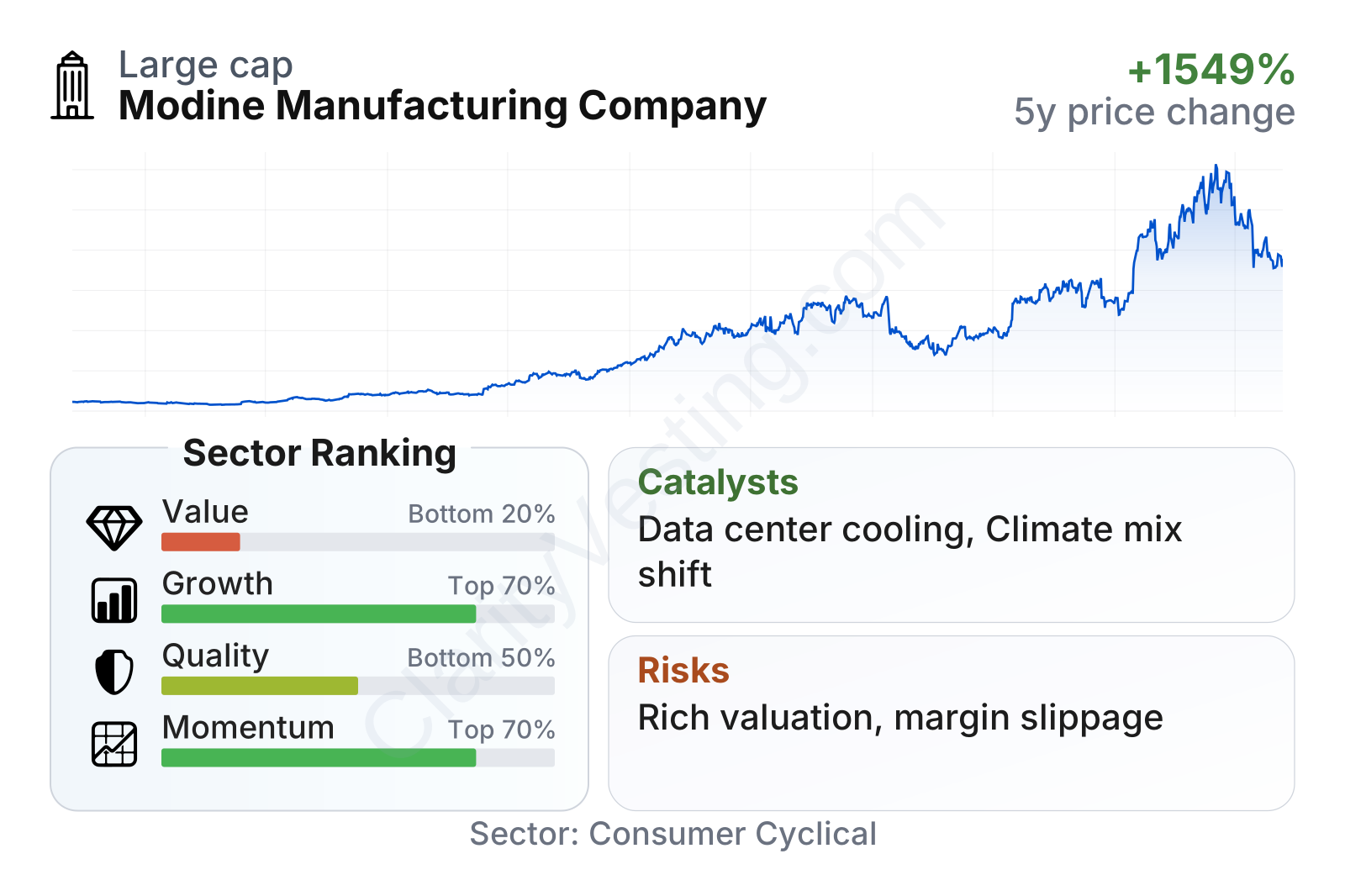
Modine sits in the mid-cap range and has shown unusually strong stock momentum over the last three years, far ahead of the typical company in its sector. At the same time, the table points to an important trade-off. Growth and momentum look strong, balance-sheet leverage is now lower than the sector median, and long-term returns on invested capital have been respectable. On the other hand, traditional valuation measures look demanding, current profitability is not especially high versus peers, and free cash flow yield is low at the current market value.
In other words, the market is not pricing Modine like a typical industrial parts supplier anymore. It is assigning a premium more consistent with a company exposed to faster-growing cooling and infrastructure niches.
Growth
Modine operates in markets with attractive long-term demand drivers, especially where cooling and air-management systems are becoming more important. The clearest example is data centers. As computing density rises and AI workloads increase power consumption, more cooling capacity is needed to keep servers operating reliably. That trend has been pushing demand toward specialized thermal management providers. Energy efficiency rules in buildings and demand for better air quality also support the company’s broader Climate Solutions portfolio.
The company’s strategy appears coherent. Management has spent the last several years repositioning the portfolio toward higher-growth, higher-value applications and away from lower-margin legacy exposure. That does not eliminate cyclicality, but it improves the quality of the revenue base. The strongest strategic logic is that Modine already has expertise in heat transfer, manufacturing, and engineered systems, so moving deeper into advanced cooling is an extension of existing capabilities rather than a completely new direction.
Recent growth has been striking. Year-over-year revenue moved from low and mid-single-digit growth periods into much stronger expansion, reaching roughly 28% most recently and spiking even higher in the prior quarter. That is well above the sector median and suggests that the portfolio shift is producing visible commercial results, not just a narrative.
Cash generation also supports the growth case, although less dramatically than revenue. Free cash flow improved from negative territory a few years ago to consistently positive levels above $100 million in more recent periods. That gives Modine more flexibility to fund expansion, invest in capacity, pursue bolt-on acquisitions, or reduce debt. The slight pullback from the peak does not undo the improvement, but it shows that rapid growth does not always translate into steadily rising cash in every period.
A notable catalyst is the company’s data center cooling exposure, which has become central to how the market views Modine. Public company communications in 2026 continued to highlight strong demand in this area and capacity expansion efforts. If data center infrastructure spending remains elevated, this business could keep increasing its share of revenue and lift the overall margin profile over time.
Another opportunity comes from cross-selling and product mix. As more revenue shifts toward engineered thermal systems instead of lower-value components, Modine may be able to improve not only sales growth but also the economics of each dollar of revenue. That is often where industrial transformations become most powerful.
Risks
This article is for informational purposes only and does not constitute financial advice. Some content is AI-generated. See Disclaimer