Stock Analysis · Minth Group Limited (MNTHF)
Overview
Minth Group Limited is an automotive parts manufacturer best known for exterior and structural components used by global carmakers. The company supplies products such as body structural parts, battery box systems, trim parts, decorative components, and other metal and plastic parts that go into passenger vehicles. In simple terms, Minth helps automakers build lighter, safer, and more visually finished vehicles, with a growing focus on electric vehicles.
The business has gradually shifted from traditional decorative auto parts toward higher-value structural products, especially aluminum parts and battery housing systems for electric vehicles. That matters because these products are more closely tied to long-term industry trends such as vehicle lightweighting, safety upgrades, and EV adoption.
Based on company disclosures in recent annual reporting, Minth’s revenue mix is broadly driven by product categories rather than consumer brands. Approximate revenue drivers can be summarized as follows:
- Metal and trim products for vehicles – historically the largest contributor, including body and decorative components.
- Body structural parts – a fast-growing category, supported by lightweight aluminum penetration and EV platform demand.
- Battery housing and related EV components – increasingly important as automakers expand electric vehicle production.
- Other automotive parts and processing services – a smaller but still meaningful share.
Geographically, China remains the core market, but Minth also serves North America, Europe, and other Asian markets through production sites close to major automakers. This global manufacturing footprint is important in the auto supply chain, where carmakers often prefer suppliers that can serve multiple regions.
The long-term financial picture shows a business that has been expanding sales steadily while also lifting gross profit over several years. Revenue has risen materially since 2021, and operating profit has generally trended upward as newer product lines gained scale. Research and development spending has also remained sizable, which fits the company’s move toward more advanced vehicle structures and EV-related systems.
The business mix has been moving toward larger, more technical components. That shift helps explain why revenue and gross profit have grown meaningfully over time, while research and development has stayed elevated rather than falling as a share of effort. This is not a low-effort parts supplier model; it is increasingly tied to engineering-intensive vehicle programs.
Key Figures
| Metric | Value | Sector ⓘ |
|---|---|---|
| Date | Sep 12, 2026 | |
| Context | ||
| Sector | Consumer Cyclical | |
| Industry | Auto Parts | |
| Market Cap ⓘ | $4.04B | |
| Beta ⓘ | 1.32 | |
Value (Cheapness) | ||
| P/E Ratio ⓘ | 9.86 | 17.10 |
| FCF Yield ⓘ | 85.60% | 8.53% |
| EBIT / EV ⓘ | N/A | 6.46% |
| PEG ⓘ | N/A | |
Growth (Business expansion) | ||
| Revenue Growth ⓘ | 9.10% | 5.75% |
| RPS Growth (5Y CAGR) ⓘ | 15.84% | 9.14% |
| EPS Growth (5Y CAGR) ⓘ | -15.97% | -18.21% |
| Margin Growth (5Y Trend) ⓘ | 2.57% | -0.23% |
| FCF Growth (5Y CAGR) ⓘ | N/A | 4.91% |
Quality (Business durability) | ||
| ROIC (Latest) ⓘ | N/A | 12.61% |
| ROIC (5Y Median) ⓘ | 6.26% | 10.72% |
| Net Debt / EBIT (Latest) ⓘ | 0.69 | 2.10 |
| Net Debt / EBIT (5Y Median) ⓘ | 1.82 | 2.32 |
| Operating Margin (Latest) ⓘ | 14.44% | 9.25% |
| Operating Margin (5Y Median) ⓘ | 9.56% | 9.64% |
| Debt to Equity (Latest) ⓘ | 40.78% | 75.78% |
| Profit Margin (Latest) ⓘ | 10.61% | 5.33% |
| Free Cash Flow (Latest) ⓘ | $3.46B | |
Momentum (Price trend) | ||
| 3Y Return ⓘ | +29.46% | +14.53% |
| 12M Return (excl. last month) ⓘ | +16.54% | +3.08% |
| 6M Return ⓘ | -28.92% | +0.55% |
| Price vs. 200-Day MA ⓘ | +37.89% | -0.54% |
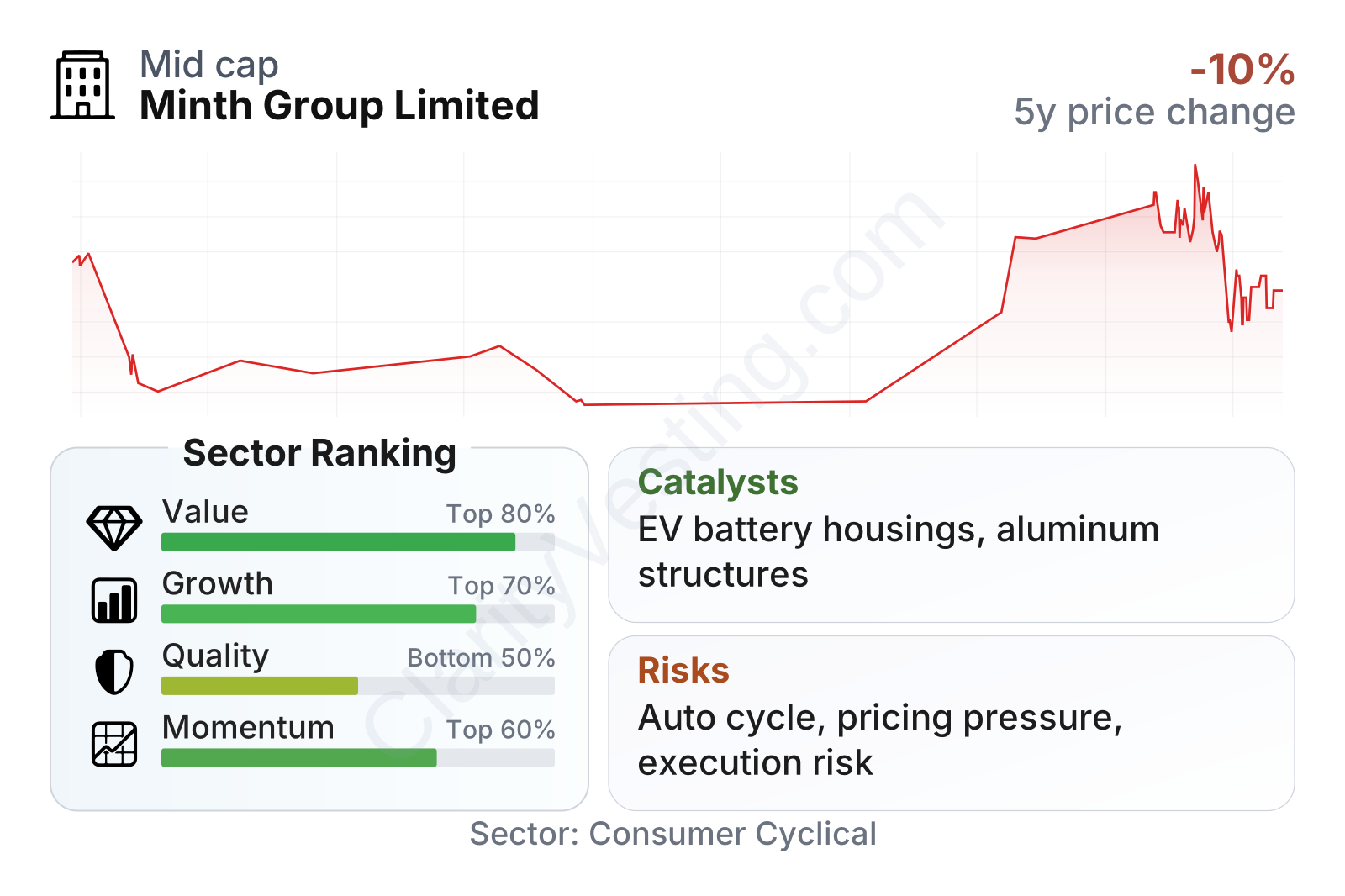
Minth stands out for a combination that is not always easy to find in auto parts: decent growth, strong profitability relative to many peers, and a balance sheet that appears controlled. The market value is in the mid-single-digit billions of dollars, so this is not a tiny niche supplier, but it is also far smaller than the largest global auto parts groups. The share price has shown strong multi-year momentum, which suggests the market has already recognized part of the operational improvement.
On valuation and cash generation, the company screens well versus much of the sector. Its earnings multiple sits below the sector median, while free cash flow generation looks unusually strong. Growth measures are mixed but broadly favorable: recent revenue growth and five-year revenue-per-share growth are ahead of the sector median, although long-term earnings-per-share progression has been less consistent. Profitability is a more nuanced picture: current returns and margins look solid, but the broader quality ranking is held back by a less impressive multi-year record.
Growth
The company operates in a sector that is mature on the surface but still has powerful internal growth pockets. Traditional auto parts are not usually seen as a high-growth area, yet Minth is exposed to several themes that can expand faster than global vehicle production: electric vehicles, lightweight materials, battery protection systems, and more complex body structures. These trends are driven by regulation, efficiency goals, and automakers’ efforts to extend range and improve crash performance.
Minth’s strategy makes sense in that context. Instead of relying mainly on cosmetic trim, it has expanded into aluminum body structures and battery enclosures, which are harder to produce and often more valuable per vehicle. This can raise content per car even if total vehicle production grows only modestly. It also creates closer ties with automakers during vehicle platform development, which tends to make supplier relationships stickier.
Recent growth metrics support that strategic direction. Revenue growth has been running above the sector median, and the five-year trend in revenue per share also points to a company that has been expanding faster than many peers. Margin trends over the last five years have improved rather than deteriorated, which suggests Minth has not simply chased volume at the expense of profitability.
Cash generation is another important positive signal. Free cash flow is strong, indicating that earnings are not just accounting profits but are being converted into cash at a healthy level. For a capital-intensive supplier, that matters because growth often requires tooling, plant investment, and working capital. Strong cash flow gives the company more flexibility to fund expansion while keeping leverage in check.
A meaningful catalyst is the ongoing build-out of EV platforms by global automakers, especially in China, where competition is intense and product cycles are fast. Minth’s battery housing and structural component capabilities position it to benefit if EV production continues rising and if lightweighting becomes even more important across both electric and hybrid models. Another catalyst is customer diversification across international automakers and newer Chinese vehicle manufacturers, which can broaden the company’s opportunity set beyond any single nameplate cycle.
Risks
This article is for informational purposes only and does not constitute financial advice. Some content is AI-generated. See Disclaimer


