Stock Analysis · Monday.Com Ltd (MNDY)
Overview
monday.com is a software company that helps teams plan work, organize projects, track tasks, and build workflows without needing deep technical skills. Its products are part of the broad “work management” and business software market, where companies want a single platform to coordinate people, data, and processes across departments. What started as a visual project management tool has expanded into a wider platform that now includes monday work management, monday CRM, monday dev, monday service, and a growing set of AI features.
The business model is mainly subscription-based. Customers pay recurring fees, usually based on the number of users and the product tier they choose. That creates predictable revenue and gives the company room to expand within existing accounts over time as teams add more seats, more use cases, or higher-value plans.
Based on company disclosures, most revenue still comes from the core platform sold as subscription software, while product-level revenue details are not broken out precisely in public filings. A simple way to think about the revenue mix is:
- Subscription revenue from the monday.com platform: effectively the overwhelming majority of total revenue, likely well above 95%.
- Professional services and other revenue: a small share, likely low single digits.
Geographically, monday.com serves customers globally, with the United States representing its largest market, followed by Europe and other international regions. This broad footprint helps reduce dependence on a single country, although it also means the company must manage currency movements and varied economic conditions.
One notable business feature is the company’s strong gross profitability. Revenue has climbed quickly over the last several years while the cost to deliver the software has remained relatively low, which is typical of successful cloud software models. At the same time, monday.com has continued to spend heavily on product development and customer acquisition in order to widen its platform and compete for larger enterprise customers.
The long-term pattern is encouraging: revenue has risen sharply, gross profit has scaled with it, and the business has moved from sizable losses to positive net income. Research and development has also increased meaningfully, showing that management is still investing for expansion rather than simply harvesting profits.
Key Figures
| Metric | Value | Sector ⓘ |
|---|---|---|
| Date | Jul 18, 2026 | |
| Context | ||
| Sector | Technology | |
| Industry | Software - Application | |
| Market Cap ⓘ | $3.39B | |
| Beta ⓘ | 1.25 | |
Value (Cheapness) | ||
| P/E Ratio ⓘ | 35.28 | 31.76 |
| FCF Yield ⓘ | 8.97% | 4.18% |
| EBIT / EV ⓘ | 2.55% | 2.56% |
| PEG ⓘ | 0.28 | |
Growth (Business expansion) | ||
| Revenue Growth ⓘ | 24.50% | 13.50% |
| RPS Growth (5Y CAGR) ⓘ | 35.31% | 8.57% |
| EPS Growth (5Y CAGR) ⓘ | N/A | -21.87% |
| Margin Growth (5Y Trend) ⓘ | 45.70% | 0.41% |
| FCF Growth (5Y CAGR) ⓘ | 230.51% | 9.76% |
Quality (Business durability) | ||
| ROIC (Latest) ⓘ | 10.69% | 8.54% |
| ROIC (5Y Median) ⓘ | -0.28% | 8.12% |
| Net Debt / EBIT (Latest) ⓘ | -13.22 | 0.38 |
| Net Debt / EBIT (5Y Median) ⓘ | -32.84 | 0.38 |
| Operating Margin (Latest) ⓘ | 4.77% | 9.58% |
| Operating Margin (5Y Median) ⓘ | 0.52% | 8.25% |
| Debt to Equity (Latest) ⓘ | 23.41% | 33.52% |
| Profit Margin (Latest) ⓘ | 9.17% | 6.96% |
| Free Cash Flow (Latest) ⓘ | $304.15M | |
Momentum (Price trend) | ||
| 3Y Return ⓘ | -57.86% | +30.91% |
| 12M Return (excl. last month) ⓘ | -74.64% | +28.90% |
| 6M Return ⓘ | -40.75% | +5.38% |
| Price vs. 200-Day MA ⓘ | -29.57% | +7.61% |
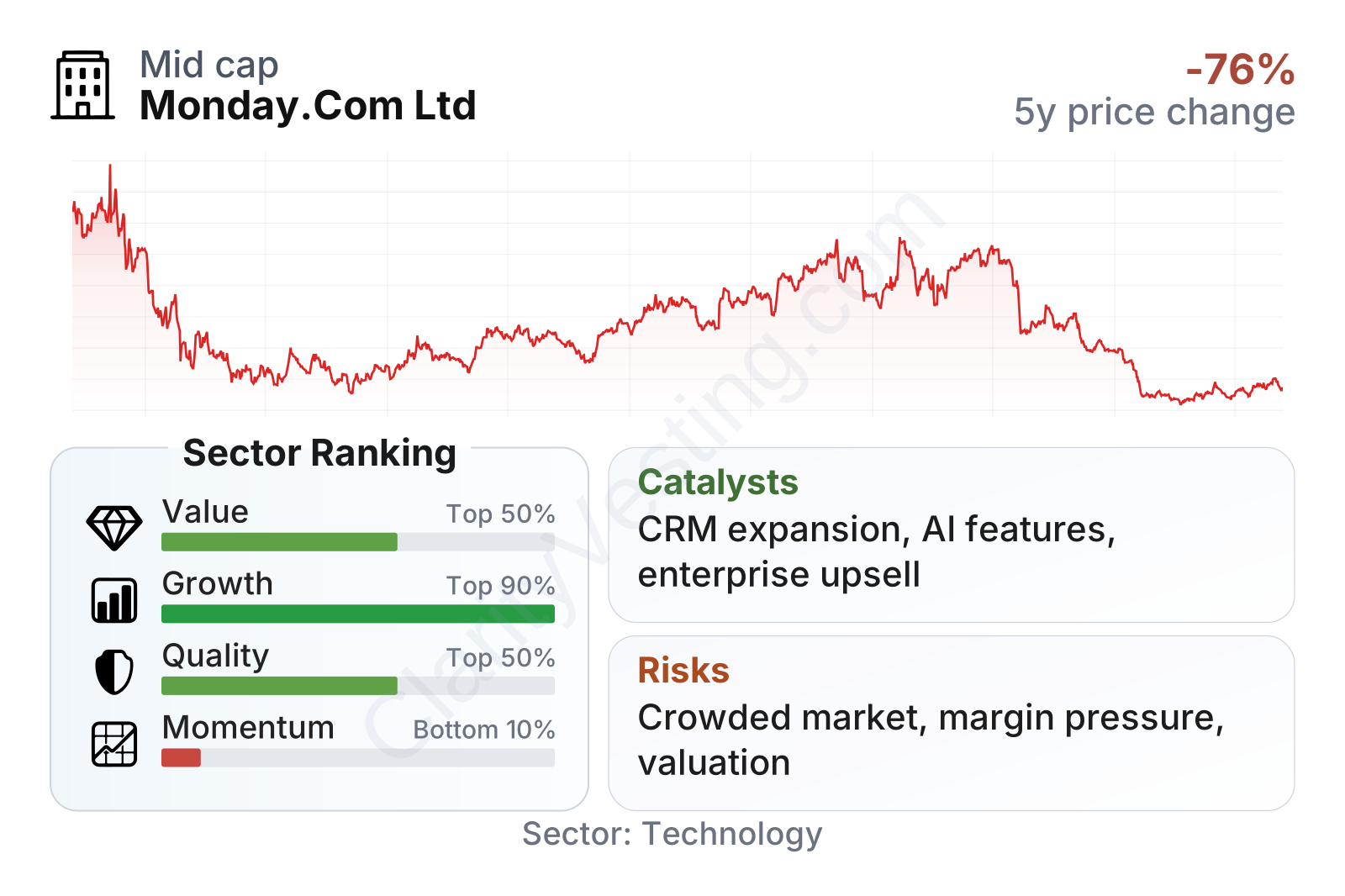
The company stands out most clearly on growth and cash generation. Revenue growth remains well above the software sector median, free cash flow yield is stronger than many peers, and the balance sheet is unusually clean with net cash rather than financial strain. Quality is more mixed: profitability has improved a lot, but operating margins are still not consistently as strong as the best-established software companies. Market behavior has also been volatile, with recent share price momentum sitting near the bottom of the sector despite solid business execution.
At a market capitalization of roughly $3.7 billion, monday.com is no longer an early micro-cap, but it is still much smaller than the largest enterprise software platforms it competes against. That size can leave more room for expansion, while also making the stock more sensitive to changes in growth expectations. Its beta above 1 suggests the shares have tended to move more sharply than the broader market.
Growth
monday.com operates in a favorable part of the software industry. Companies continue to digitize workflows, reduce manual coordination, and connect teams through cloud-based tools. That trend is not limited to technology businesses. It reaches marketing, sales, product development, customer service, operations, and internal IT. In practical terms, the company is selling productivity infrastructure, which remains a durable area of spending even when budgets become more selective.
The strategy for future growth is coherent. Rather than remaining a single-purpose task manager, monday.com has been building a broader multi-product platform. That matters because larger customers often prefer to work with fewer software vendors, especially when a platform can support several departments. Expanding from work management into CRM, development, and service management also increases the company’s potential revenue per customer.
Growth has naturally slowed from the extremely high rates seen earlier after the IPO, but the current pace is still strong by software industry standards. Recent year-over-year growth has remained around the mid-20% range, clearly above the sector median. That deceleration is not unusual; what matters more is that monday.com has kept a healthy pace while becoming much larger in absolute revenue.
Cash generation is another important positive sign. The company has gone from negative free cash flow a few years ago to more than $300 million on a trailing basis. That shift suggests the business model is scaling well: monday.com is no longer just growing quickly, it is also converting a meaningful share of sales into cash. For a long-term view, that is often more important than headline growth alone.
Several catalysts appear meaningful. One is continued upmarket expansion into larger enterprises, where contract sizes can be much higher and retention tends to be stronger once the software becomes embedded in daily operations. Another is the ongoing rollout of AI capabilities, which can make the platform more useful for automation, reporting, workflow creation, and service tasks. If AI features improve productivity in visible ways, they can support both customer acquisition and pricing power. A third catalyst is cross-selling: a customer that starts with one product may later adopt CRM, dev, or service modules, lifting revenue without the same acquisition cost as a brand-new customer.
Recent company communications have also emphasized product innovation and enterprise traction, which fits the broader industry direction. The key opportunity is not merely adding more small teams, but becoming a wider operating layer for businesses that want flexible software without long deployment cycles.
Risks
The biggest risk is competition. monday.com is not operating in an empty field; it competes with large and well-funded software companies across project management, collaboration, CRM, service management, and low-code workflow tools. Rivals include Asana, Atlassian, Smartsheet, Salesforce, Microsoft, ServiceNow, ClickUp, and several private platforms. Some of these companies have larger sales forces, broader ecosystems, deeper enterprise relationships, or the ability to bundle products together.
monday.com does have competitive advantages, but it is not the undisputed leader across the whole category. Its strengths are usability, flexibility, fast deployment, attractive visual design, and a product philosophy that allows non-technical users to build workflows quickly. That gives it a good position with teams that want more structure than spreadsheets but less complexity than traditional enterprise software. Still, in the largest enterprises, buying decisions can favor vendors with broader installed bases and longer procurement track records.
The balance sheet is a clear area of strength. Debt levels remain below the sector median, and the company’s net cash position provides room to keep investing through weaker market periods. That lowers financial risk materially compared with software peers that rely more heavily on leverage or that still burn cash.
Profitability has improved dramatically, moving from deep losses a few years ago to positive margins that now sit above the sector median on a net income basis. Even so, operating margin remains below the sector median, which means part of the profit picture still depends on the company maintaining discipline as it scales. If it needs to spend much more on sales, marketing, or product development to sustain growth, margin progress could become uneven.
Another risk is execution. monday.com is trying to evolve from a popular work management application into a broader business platform. That transition can be rewarding, but it also increases complexity. The company needs to keep its product simple while adding more capabilities, and it must convince larger organizations that the platform can meet enterprise requirements in security, governance, and reliability.
Macroeconomic sensitivity also matters. Because the company sells software tied to team growth and business activity, slower hiring, budget tightening, or delayed IT projects can affect seat expansion and new customer wins. For international operations, foreign exchange swings can also create short-term pressure on reported results.
There does not appear to be any widely documented recent scandal or major governance crisis from the company’s own public disclosures reviewed here. The more relevant near-term risk is valuation sensitivity combined with volatile market sentiment: this is the type of stock that can move sharply when growth expectations change.
Valuation
Valuation looks more grounded than it did during earlier periods when the shares traded at very elevated earnings multiples or when profitability was too limited for a normal P/E reading to be useful. The current P/E is close to the software sector median, which is notable for a company still growing materially faster than many peers. On that narrow comparison, the stock does not look obviously stretched.
That said, P/E alone is not enough for a company like monday.com. The better way to frame valuation is to weigh three things together: the still-strong revenue growth, the recent move into real profitability and free cash flow, and the fact that the stock has already gone through a large reset from prior highs. Those factors make the current valuation easier to justify than in the past.
There is still an important caveat. monday.com is in a transition stage between high-growth software entrant and more mature profitable platform. If growth continues to slow toward industry averages, the market may not continue assigning it a premium for long. On the other hand, if the company keeps expanding products, wins larger customers, and sustains cash generation, the present valuation range appears more understandable than the company’s earlier extremes.
In short, the share price seems to reflect a business with attractive fundamentals but with less market enthusiasm than before. That combination is often more rational than the kind of valuations seen when software names are priced mainly on distant expectations.
Conclusion
monday.com currently looks like a maturing software company that has preserved much of its growth appeal while developing a more credible financial profile. The business is positioned in a large and expanding market, its product set is becoming broader, and its subscription model has already produced a meaningful jump in free cash flow and profitability. Those are important signs that the company is moving beyond a pure expansion phase.
The main challenge is that monday.com must keep proving it can scale into a broader enterprise platform without losing the simplicity that made it popular in the first place. Competition is intense, and the company is not large enough to dominate by size alone. Its advantage comes from execution, product quality, and the ability to deepen customer relationships across multiple use cases.
From a valuation perspective, the stock appears far less demanding than it once was, especially relative to the company’s growth rate and balance sheet strength. The market’s recent caution suggests expectations are no longer excessively optimistic. Overall, monday.com stands out as a growth-oriented software business that now has stronger financial substance behind it, even if its long-term outcome will depend heavily on whether it can turn product expansion into durable leadership.
Sources:
- Monday.com Ltd. — Annual Report on Form 10-K for the fiscal year ended December 31, 2025
- Monday.com Ltd. — Quarterly Report on Form 10-Q for the quarter ended March 31, 2026
- SEC EDGAR — Monday.com Ltd. filings database
- Monday.com Investor Relations — shareholder letters and earnings materials
- Monday.com Investor Relations — company press releases on product and business updates
- Wikipedia — Monday.com
This article is for informational purposes only and does not constitute financial advice. Some content is AI-generated. See Disclaimer


