Stock Analysis · MakeMyTrip Limited (MMYT)
Overview
MakeMyTrip Limited is one of the largest online travel platforms focused on India. Through its main brands, including MakeMyTrip, Goibibo, and redBus, the company helps people search, compare, and book flights, hotels, holiday packages, bus tickets, rail tickets, car rentals, and other travel-related services. Its role is similar to a digital marketplace: travelers use the platform to plan trips, while airlines, hotels, transport operators, and other partners use it to reach customers.
The business is mainly driven by travel demand in India, especially domestic travel, where rising incomes, improving digital payments, and broader internet access continue to move bookings online. MakeMyTrip earns most of its revenue from commissions, service fees, incentives, advertising, and other booking-related income rather than from owning hotels, aircraft, or buses directly.
Based on the company’s recent annual reporting, revenue is broadly split across the following segments:
- Air ticketing: about 48% of revenue. This includes flight booking commissions, convenience fees, and related income from domestic and international air travel.
- Hotels and packages: about 45% of revenue. This covers hotel bookings, holiday packages, and other accommodation-led travel services. This segment has become increasingly important because it usually carries better economics than pure flight distribution.
- Bus ticketing: about 7% of revenue. This is mainly generated by redBus and related intercity bus reservations.
That mix matters because the company is not only a flight-booking website. It has been expanding toward lodging and packages, which can strengthen margins and improve customer value over time. The recent financial profile also shows a business that has scaled meaningfully: revenue has risen sharply over the last several years, operating income has turned solidly positive, and cash generation has improved, although the latest year shows pressure from higher costs below the operating line.
The broader picture is a company that has grown from recovery mode after the pandemic into a more profitable platform business, with hotels and packages becoming a larger strategic driver alongside its core air business.
Key Figures
| Metric | Value | Sector ⓘ |
|---|---|---|
| Date | Sep 12, 2026 | |
| Context | ||
| Sector | Consumer Cyclical | |
| Industry | Travel Services | |
| Market Cap ⓘ | $4.71B | |
| Beta ⓘ | 1.00 | |
Value (Cheapness) | ||
| P/E Ratio ⓘ | 208.71 | 17.10 |
| FCF Yield ⓘ | 3.24% | 8.53% |
| EBIT / EV ⓘ | 3.54% | 6.46% |
| PEG ⓘ | 5.39 | |
Growth (Business expansion) | ||
| Revenue Growth ⓘ | 6.20% | 5.75% |
| RPS Growth (5Y CAGR) ⓘ | 35.76% | 9.14% |
| EPS Growth (5Y CAGR) ⓘ | 0.65% | -18.21% |
| Margin Growth (5Y Trend) ⓘ | 27.86% | -0.23% |
| FCF Growth (5Y CAGR) ⓘ | 26.72% | 4.91% |
Quality (Business durability) | ||
| ROIC (Latest) ⓘ | 9.18% | 12.61% |
| ROIC (5Y Median) ⓘ | 7.97% | 10.72% |
| Net Debt / EBIT (Latest) ⓘ | 7.11 | 2.10 |
| Net Debt / EBIT (5Y Median) ⓘ | -1.50 | 2.32 |
| Operating Margin (Latest) ⓘ | 17.60% | 9.25% |
| Operating Margin (5Y Median) ⓘ | 13.58% | 9.64% |
| Debt to Equity (Latest) ⓘ | -500.17% | 75.78% |
| Profit Margin (Latest) ⓘ | 3.23% | 5.33% |
| Free Cash Flow (Latest) ⓘ | $152.88M | |
Momentum (Price trend) | ||
| 3Y Return ⓘ | +23.65% | +14.53% |
| 12M Return (excl. last month) ⓘ | -36.97% | +3.08% |
| 6M Return ⓘ | +10.02% | +0.55% |
| Price vs. 200-Day MA ⓘ | -11.46% | -0.54% |
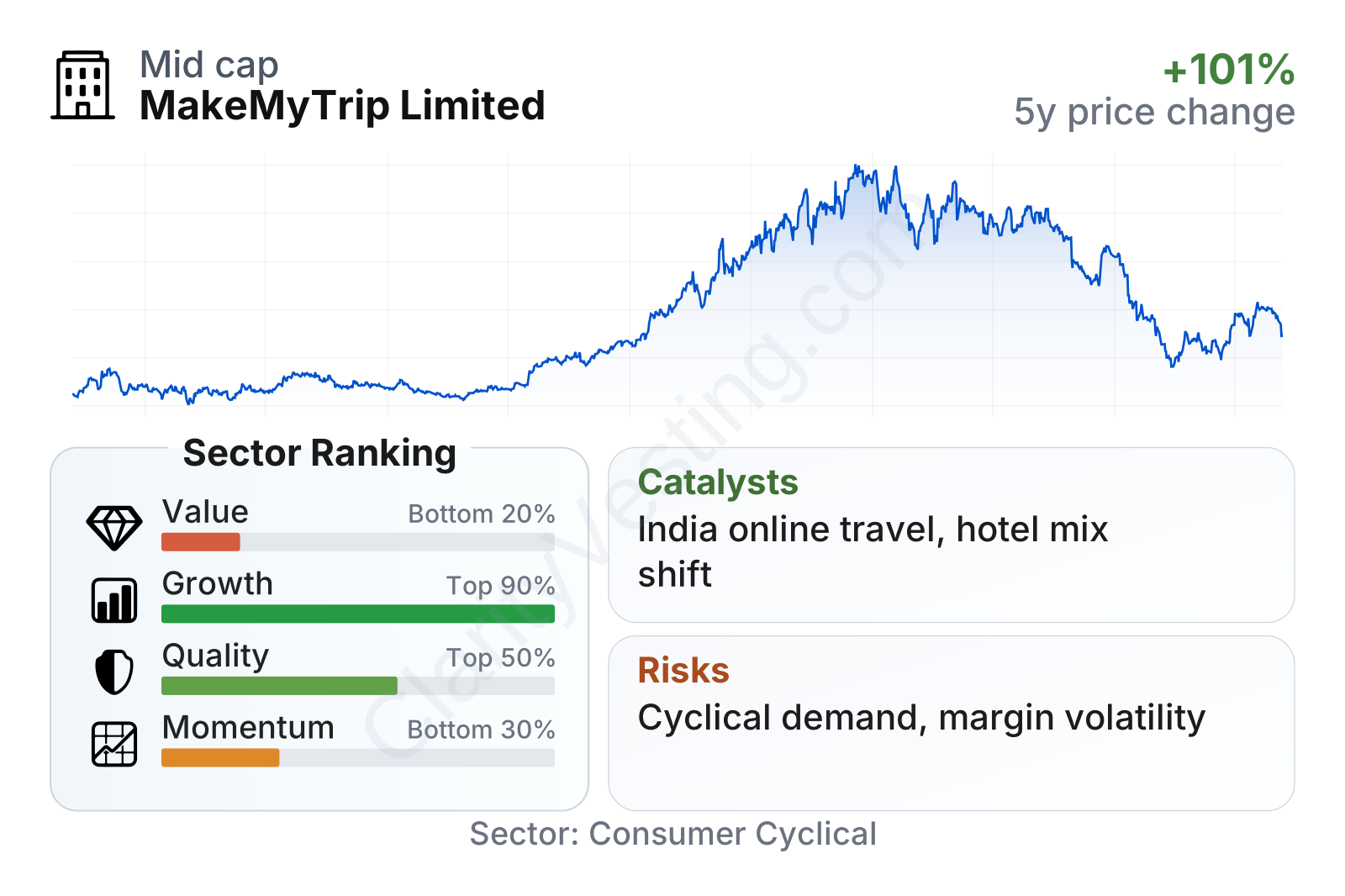
MakeMyTrip stands out for growth more than for cheapness. Its growth profile ranks near the top of the consumer cyclical sector, supported by strong multi-year expansion in revenue per share, free cash flow, and operating margins. Quality is more mixed: operating profitability is better than many peers, but return on invested capital remains below the sector median and recent net debt relative to EBIT looks elevated. Value metrics are weak, with earnings and cash flow multiples far above typical sector levels. In short, the market has tended to price the company as a premium travel platform rather than a conventional cyclical business.
Growth
MakeMyTrip operates in a sector with attractive long-term structural support. India’s travel market still has room to expand as more consumers move online, air traffic rises, hotel supply becomes more organized, and discretionary spending grows. Online travel penetration remains well below that of more mature markets, which leaves space for digital platforms to capture a bigger share of bookings over time. That gives the company exposure to both travel growth and the continued shift from offline agents to app-based booking.
The company’s strategy also makes sense for future expansion. Management has been emphasizing customer acquisition, repeat usage, cross-selling, and a broader mix of services across flights, hotels, ground transport, and packages. This ecosystem approach matters because a traveler who uses the app for multiple needs can be more valuable than a one-time flight customer. Hotels and packages are especially important because they typically offer better monetization than airline bookings, where competition is often intense and pricing is more transparent.
Recent growth remains positive, but the pace has clearly cooled from the very strong rebound phase seen after the pandemic. In the earlier part of the recovery, year-over-year revenue growth often ran at very high double-digit rates and sometimes much higher due to easy comparisons. More recently, growth has settled into a more normal range around the mid-single digits. That is not unusual after a sharp recovery, but it does mean the next phase will depend more on market share gains, higher take rates, and mix improvement rather than simple demand normalization.
Cash generation is one of the more encouraging parts of the case. Free cash flow moved from roughly break-even a few years ago to a clearly positive level, and although the latest trailing figure is below the recent peak, it still shows a business producing meaningful cash. This is important because it suggests that earnings improvement has not been purely accounting-driven. The company has also highlighted product investments, loyalty initiatives, and supply expansion in accommodations as building blocks for deeper engagement.
One important catalyst is the ongoing formalization of India’s travel ecosystem. As branded hotels, digital payments, and online discovery continue to grow, large platforms can capture more traffic and convert that traffic into repeat bookings. Another potential opportunity comes from cross-border travel and premium travel demand, areas where established scale and brand recognition can matter. Recent company updates have also emphasized healthy demand trends in travel bookings and continued focus on hotel supply, both of which support the idea that the business is trying to grow beyond its historic dependence on air ticketing.
Risks
This article is for informational purposes only and does not constitute financial advice. Some content is AI-generated. See Disclaimer


