Stock Analysis · MillerKnoll Inc (MLKN)
Overview
MillerKnoll is a global design and furnishings company best known for office furniture, seating, storage, and interior solutions sold under brands such as Herman Miller, Knoll, Design Within Reach, HAY, Geiger, Maharam, and Holly Hunt. The company serves large businesses, small and mid-sized organizations, government and healthcare customers, architects and designers, and individual consumers buying through retail and e-commerce channels. In simple terms, MillerKnoll makes money by furnishing workplaces, public spaces, and homes with higher-end design products.
Its business is diversified across three operating segments disclosed in company filings. The largest segment is the Americas contract business, which mainly sells office and institutional furnishings to organizations in North America. Next comes the international contract business, covering similar products outside the Americas. The third segment is the retail business, which includes direct-to-consumer brands, stores, and online sales.
Based on recent annual reporting, revenue is approximately split as follows:
- Americas Contract: roughly 55% to 60% of total revenue
- International Contract & Specialty: roughly 20% to 25%
- Global Retail: roughly 18% to 22%
This mix matters because it means MillerKnoll is not purely an office-furniture company anymore. It still depends heavily on workplace demand, but it also has exposure to home furnishings, premium design retail, textiles, and hospitality-oriented products. Over the past few years, revenue has held in the mid-$3 billion range, but earnings have been much less stable, showing that the challenge is not attracting sales alone, but turning those sales into consistently strong profits.
The business model shows a company with a solid gross profit pool, but a large share of that is consumed by selling, administrative, and interest costs. That helps explain why revenue has remained fairly resilient while net income has been uneven.
Key Figures
| Metric | Value | Sector ⓘ |
|---|---|---|
| Date | Sep 12, 2026 | |
| Context | ||
| Sector | Consumer Cyclical | |
| Industry | Furnishings, Fixtures & Appliances | |
| Market Cap ⓘ | $1.43B | |
| Beta ⓘ | 1.35 | |
Value (Cheapness) | ||
| P/E Ratio ⓘ | 16.38 | 17.10 |
| FCF Yield ⓘ | 9.72% | 8.53% |
| EBIT / EV ⓘ | 6.62% | 6.46% |
| PEG ⓘ | 0.90 | |
Growth (Business expansion) | ||
| Revenue Growth ⓘ | 4.40% | 5.75% |
| RPS Growth (5Y CAGR) ⓘ | 0.65% | 9.14% |
| EPS Growth (5Y CAGR) ⓘ | N/A | -18.21% |
| Margin Growth (5Y Trend) ⓘ | 4.84% | -0.23% |
| FCF Growth (5Y CAGR) ⓘ | -21.84% | 4.91% |
Quality (Business durability) | ||
| ROIC (Latest) ⓘ | 5.83% | 12.61% |
| ROIC (5Y Median) ⓘ | 3.94% | 10.72% |
| Net Debt / EBIT (Latest) ⓘ | 7.91 | 2.10 |
| Net Debt / EBIT (5Y Median) ⓘ | 13.46 | 2.32 |
| Operating Margin (Latest) ⓘ | 5.38% | 9.25% |
| Operating Margin (5Y Median) ⓘ | 2.99% | 9.64% |
| Debt to Equity (Latest) ⓘ | 134.27% | 75.78% |
| Profit Margin (Latest) ⓘ | 2.38% | 5.33% |
| Free Cash Flow (Latest) ⓘ | $138.90M | |
Momentum (Price trend) | ||
| 3Y Return ⓘ | +37.97% | +14.53% |
| 12M Return (excl. last month) ⓘ | +19.47% | +3.08% |
| 6M Return ⓘ | +14.62% | +0.55% |
| Price vs. 200-Day MA ⓘ | +14.31% | -0.54% |
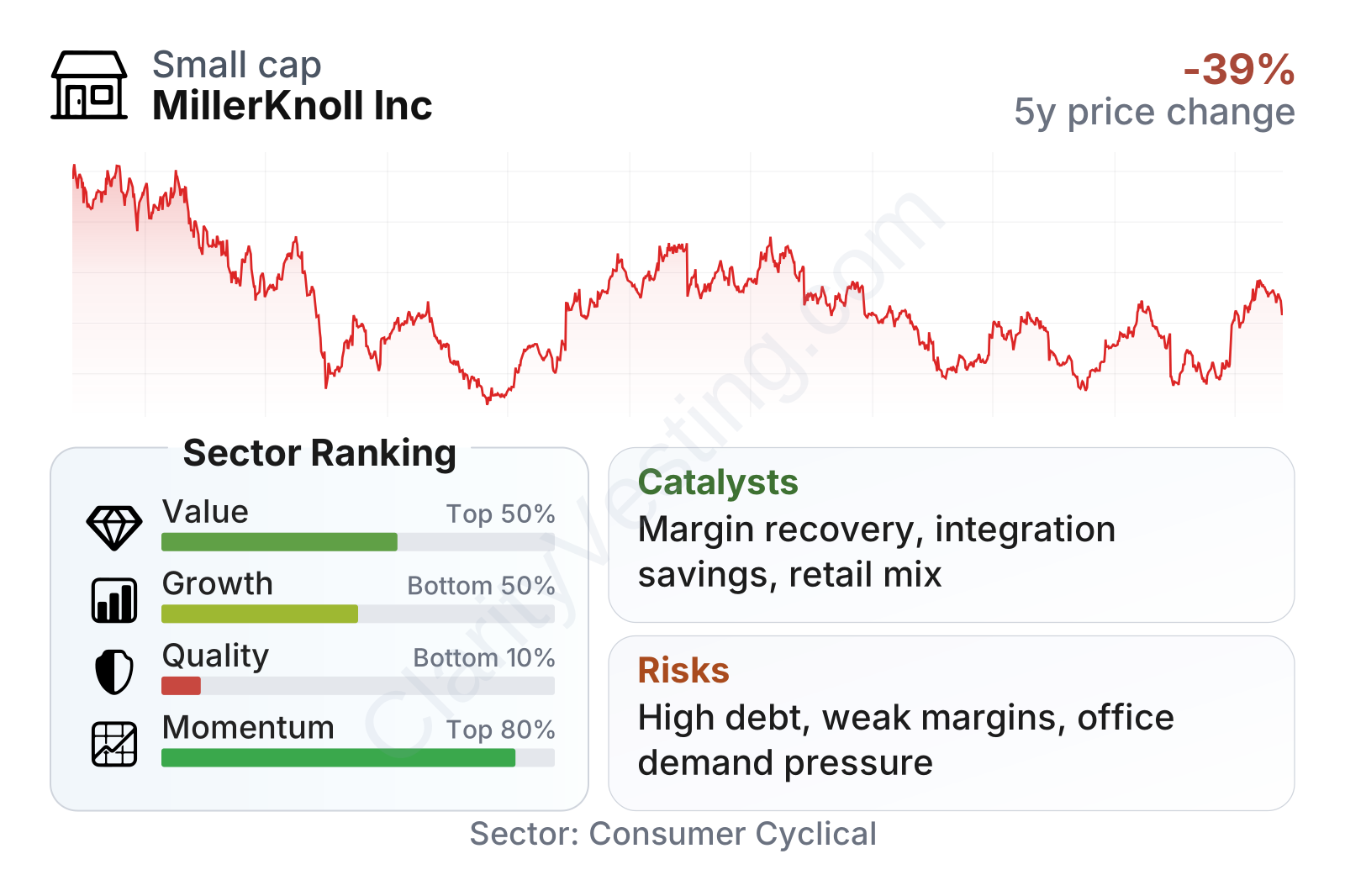
MillerKnoll stands out as a mid-cap company with a stock that has been more volatile than the broader market. The overall picture from the latest metrics is mixed: valuation measures based on cash generation look more normal than the headline earnings multiple suggests, but quality and balance-sheet indicators rank weakly versus much of the sector. Growth is not absent, yet it has not translated into strong returns on capital or durable margin strength. That combination usually points to a business in transition rather than one already operating at peak efficiency.
Growth
MillerKnoll operates in a market that is still relevant long term, but not one that grows in a straight line. Demand for office furniture and interiors is tied to corporate hiring, office construction, renovation cycles, public-sector budgets, and business confidence. At the same time, demand for premium home furnishings and design retail is influenced by housing activity and consumer discretionary spending. These are real markets with long-run need, but they are cyclical and can weaken quickly when customers delay projects.
The company’s strategy does make sense on paper. The merger that created MillerKnoll brought together iconic brands, broadened the product range, and increased exposure beyond traditional office systems. Management has also emphasized cross-selling between brands, pricing discipline, dealer network strength, retail expansion, and operational simplification. If that strategy works well, the company could become less dependent on a single end market and better able to capture spending on hybrid workspaces, hospitality upgrades, healthcare environments, and premium home design.
Recent revenue trends suggest the worst of the earlier post-pandemic slowdown may be passing, although the recovery is not perfectly steady. Sales growth turned positive again after a period of contraction, which indicates demand has improved from prior lows. Even so, the longer-term record remains modest compared with many consumer-cyclical peers, so the key question is not simply whether sales can grow, but whether growth can persist without giving back margin.
Cash generation is an encouraging part of the picture. Free cash flow recovered sharply from earlier weakness and remains positive, even though it has come down from a stronger peak. For a company in a cyclical industry, positive free cash flow can be valuable because it gives management room to reduce debt, invest in brands, and maintain operations during softer demand periods.
One practical catalyst is the company’s ability to improve profitability if office demand normalizes even modestly. Because MillerKnoll already has a large installed commercial platform and recognized brands, a better sales mix or improved utilization could have an outsized effect on operating income. Another possible tailwind is continued integration and cost-efficiency work following the Herman Miller-Knoll combination, especially if management can remove duplication without weakening the premium positioning of the brands.
Recent company communications have also pointed to ongoing product launches, workplace demand tied to redesign rather than pure new construction, and efforts to strengthen global retail and dealer relationships. None of these is a dramatic one-time event, but together they support the idea that MillerKnoll still has several levers for gradual improvement.
Risks
This article is for informational purposes only and does not constitute financial advice. Some content is AI-generated. See Disclaimer