Stock Analysis · MKS Instruments Inc (MKSI)
Overview
MKS Instruments is a technology company that makes the tools, subsystems, and software used to build advanced products rather than the end products consumers buy directly. Its equipment helps customers measure, control, power, monitor, and process highly demanding manufacturing steps. The company is especially tied to semiconductor production, but it also serves electronics, industrial technology, life and health sciences, and defense-related markets.
After acquiring Atotech in 2022, MKS became more diversified. Today, the business combines semiconductor process equipment, photonics and laser-based manufacturing tools, and chemical process solutions used in electronics plating and surface finishing. That mix matters because it gives the company exposure to several long-term technology trends at once: more advanced chips, AI-related infrastructure, precision manufacturing, and increasingly complex electronics packaging.
Based on the company’s recent annual reporting structure, revenue is primarily organized into three operating segments.
- Vacuum Solutions: about 39% of revenue in 2025. This segment includes pressure measurement and control, gas delivery, vacuum components, and power solutions used heavily in semiconductor fabrication and other advanced manufacturing environments.
- Photonics Solutions: about 32% of revenue in 2025. This business includes lasers, optics, motion and control technologies, and related equipment used in precision industrial processing, electronics manufacturing, and scientific applications.
- Materials Solutions: about 29% of revenue in 2025. This segment mainly reflects the Atotech business, including chemistry, equipment, and software for plating and surface finishing in printed circuit boards, package substrates, and specialty industrial uses.
Geographically, MKS is also international, with a large share of sales tied to Asia because that region dominates much of global electronics and semiconductor manufacturing. The business model is a mix of equipment sales, subsystems, consumables, and recurring service-related activity, which can help smooth results somewhat, although the company still remains cyclical overall.
The long-term picture is one of a mid-to-large-size enabling technology supplier rather than a consumer-facing brand. MKS sits inside the supply chain where manufacturing complexity is rising, which can create durable demand if customers keep investing in more advanced production lines.
The business has expanded meaningfully since 2021, but the path has not been smooth. Revenue rose from roughly $3.0 billion in 2021 to about $3.9 billion in 2025, while profitability was heavily disrupted in 2023 before recovering. Gross profit stayed sizable through the cycle, but higher operating costs and acquisition-related burdens, especially interest expense, compressed earnings during the difficult period.
Key Figures
| Metric | Value | Sector ⓘ |
|---|---|---|
| Date | Sep 12, 2026 | |
| Context | ||
| Sector | Technology | |
| Industry | Scientific & Technical Instruments | |
| Market Cap ⓘ | $18.07B | |
| Beta ⓘ | 1.97 | |
Value (Cheapness) | ||
| P/E Ratio ⓘ | 41.64 | 29.51 |
| FCF Yield ⓘ | 2.51% | 4.25% |
| EBIT / EV ⓘ | 2.35% | 2.85% |
| PEG ⓘ | 1.32 | |
Growth (Business expansion) | ||
| Revenue Growth ⓘ | 28.30% | 15.40% |
| RPS Growth (5Y CAGR) ⓘ | 2.33% | 8.56% |
| EPS Growth (5Y CAGR) ⓘ | -15.38% | -11.88% |
| Margin Growth (5Y Trend) ⓘ | -10.26% | 0.46% |
| FCF Growth (5Y CAGR) ⓘ | -2.63% | 9.80% |
Quality (Business durability) | ||
| ROIC (Latest) ⓘ | 7.55% | 9.44% |
| ROIC (5Y Median) ⓘ | 7.27% | 8.30% |
| Net Debt / EBIT (Latest) ⓘ | 6.72 | 0.54 |
| Net Debt / EBIT (5Y Median) ⓘ | 7.35 | 0.44 |
| Operating Margin (Latest) ⓘ | 13.61% | 9.58% |
| Operating Margin (5Y Median) ⓘ | 14.56% | 8.25% |
| Debt to Equity (Latest) ⓘ | 140.09% | 33.33% |
| Profit Margin (Latest) ⓘ | 10.10% | 7.14% |
| Free Cash Flow (Latest) ⓘ | $454.00M | |
Momentum (Price trend) | ||
| 3Y Return ⓘ | +200.17% | +45.48% |
| 12M Return (excl. last month) ⓘ | +198.19% | +23.48% |
| 6M Return ⓘ | +25.42% | +20.93% |
| Price vs. 200-Day MA ⓘ | +1.09% | +7.43% |
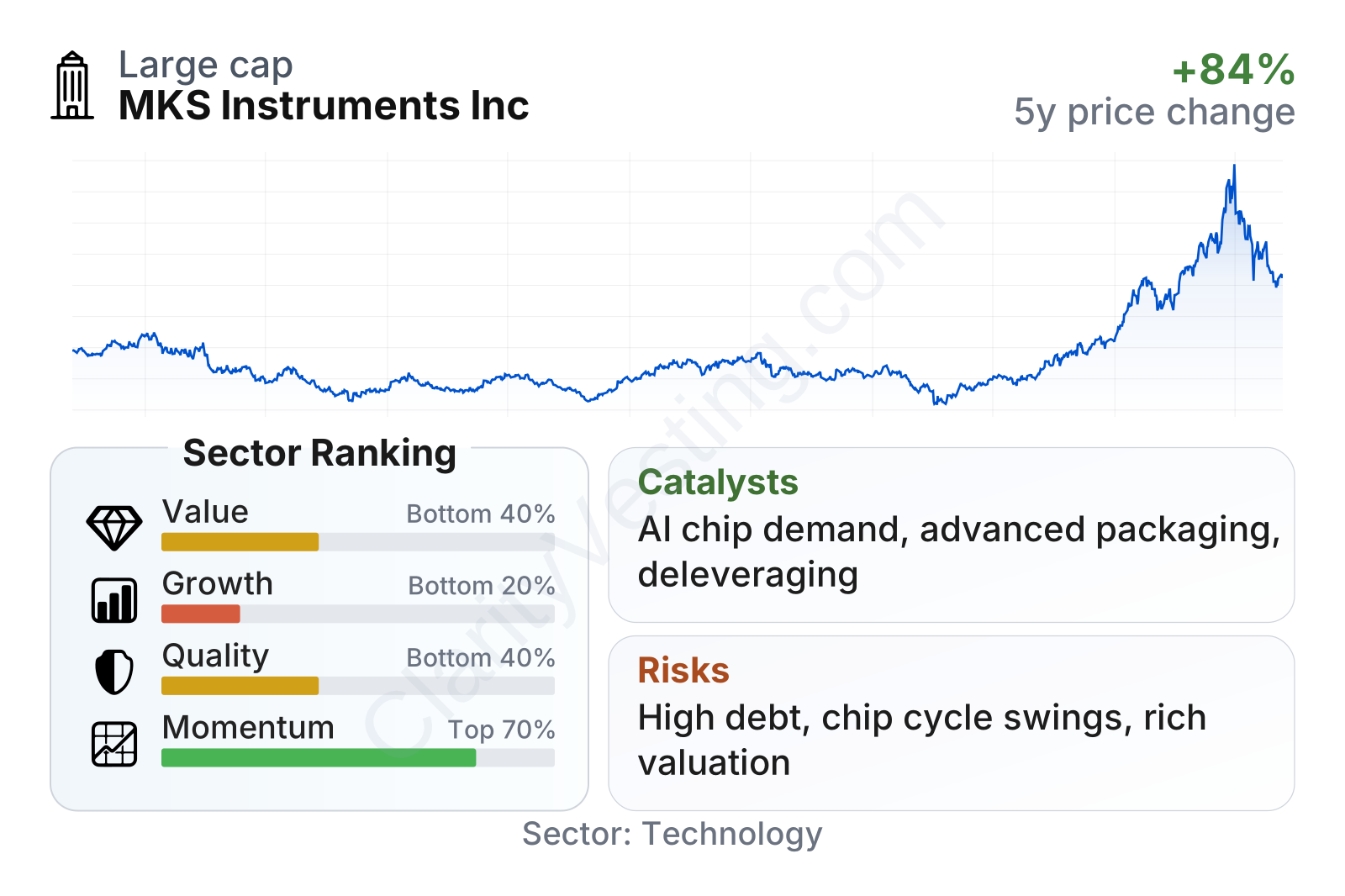
MKS currently looks mixed on the main financial checkpoints. Profitability has recovered to respectable levels, with operating and net margins above the sector median, and free cash flow remains positive at roughly the mid-hundreds of millions of dollars. However, leverage is still much heavier than typical peers, and the valuation multiples are above sector norms despite that balance-sheet burden. The stock’s market performance has been very strong recently, which helps explain why momentum ranks well even though value, growth consistency, and overall quality do not.
The stock price history also shows how cyclical and sentiment-driven this company can be. Shares fell sharply during the post-2021 downturn, then rebounded very strongly into 2026 as semiconductor demand expectations improved and execution stabilized. That pattern is important for long-term readers because MKS is not a steady utility-like business; it tends to move with capital spending cycles in technology manufacturing.
Growth
MKS operates in markets that have credible long-term expansion drivers. Semiconductor manufacturing is becoming more complex as chipmakers move to more advanced nodes, high-bandwidth memory, advanced packaging, and AI infrastructure. Those shifts typically require tighter process control, more specialized subsystems, and more precise manufacturing tools, which fits MKS well. Outside semiconductors, electronics interconnect, industrial laser processing, and photonics also benefit from ongoing automation and miniaturization.
The strategy broadly makes sense for future growth because the company is positioned in difficult, highly engineered parts of the production process. The Atotech acquisition added exposure to electronics plating and package substrates, which can be attractive as advanced packaging becomes more important. In simple terms, MKS is trying to participate in more steps of how modern chips and electronics are made, not just one niche.
Recent revenue trends point to a business coming out of a weak phase. Growth turned negative in parts of 2023 and 2024, then improved through 2025 and accelerated further into 2026, with the latest year-over-year pace well above the broader sector median. That is encouraging, but it should be viewed as a rebound pattern rather than proof of smooth structural growth, because the five-year revenue-per-share record is still modest.
Cash generation has also held up better than headline earnings might suggest. Free cash flow stayed positive through the period and recovered after a softer stretch, showing that the company still converts a meaningful portion of its business activity into cash even when reported profit is volatile. That matters because cash supports debt reduction, continued research spending, and resilience during cyclical slowdowns.
As for catalysts, the strongest ones appear tied to semiconductor capital spending recovery, AI-related demand for advanced chips and packaging, and continued integration benefits from Atotech. Recent company reporting has also pointed to improving conditions in semiconductor and electronics end markets, which supports the idea that MKS is participating in an industry upcycle rather than relying only on cost cutting.
Risks
This article is for informational purposes only and does not constitute financial advice. Some content is AI-generated. See Disclaimer