Stock Analysis · M/I Homes Inc (MHO)
Overview
M/I Homes Inc is a U.S. homebuilder. The company develops communities, buys and prepares land, builds single-family homes and townhomes, and sells those homes to buyers across multiple states. It also provides mortgage loans, title services, and insurance-related services that support the home purchase process. The business is aimed largely at entry-level, move-up, and luxury buyers, which gives it exposure to different parts of the housing market rather than a single customer niche.
The company’s revenue is heavily concentrated in homebuilding, while financial services provide a much smaller contribution. Based on recent annual reporting, the mix is approximately:
- Home sales: about 97% to 98% — revenue from delivering completed homes and, to a much smaller extent, selling land and lots.
- Financial services: about 2% to 3% — mortgage origination, loan sales, title services, and related insurance activities tied to home closings.
M/I Homes operates as a regional builder rather than a national leader by size. That matters because local market selection, land discipline, and pricing execution are especially important in this industry. Its footprint includes markets in the Midwest, South, Mid-Atlantic, and Florida, giving it some geographic diversification while still keeping the business focused on U.S. residential construction.
Over the last several years, the business has shown a clear ability to turn revenue into profit, with gross profit and operating income expanding strongly through 2024 before easing in 2025 as conditions became less favorable. Even with that moderation, the structure still shows a company that has maintained meaningful profitability rather than one struggling to cover costs.
Key Figures
| Metric | Value | Sector ⓘ |
|---|---|---|
| Date | Sep 12, 2026 | |
| Context | ||
| Sector | Consumer Cyclical | |
| Industry | Residential Construction | |
| Market Cap ⓘ | $3.54B | |
| Beta ⓘ | 1.61 | |
Value (Cheapness) | ||
| P/E Ratio ⓘ | 11.75 | 17.10 |
| FCF Yield ⓘ | 5.69% | 8.53% |
| EBIT / EV ⓘ | 13.66% | 6.46% |
| PEG ⓘ | 0.95 | |
Growth (Business expansion) | ||
| Revenue Growth ⓘ | -8.50% | 5.75% |
| RPS Growth (5Y CAGR) ⓘ | 6.55% | 9.14% |
| EPS Growth (5Y CAGR) ⓘ | -27.80% | -18.21% |
| Margin Growth (5Y Trend) ⓘ | -1.28% | -0.23% |
| FCF Growth (5Y CAGR) ⓘ | N/A | 4.91% |
Quality (Business durability) | ||
| ROIC (Latest) ⓘ | 10.23% | 12.61% |
| ROIC (5Y Median) ⓘ | 21.57% | 10.72% |
| Net Debt / EBIT (Latest) ⓘ | 0.45 | 2.10 |
| Net Debt / EBIT (5Y Median) ⓘ | 0.73 | 2.32 |
| Operating Margin (Latest) ⓘ | 12.53% | 9.25% |
| Operating Margin (5Y Median) ⓘ | 15.08% | 9.64% |
| Debt to Equity (Latest) ⓘ | 31.08% | 75.78% |
| Profit Margin (Latest) ⓘ | 7.44% | 5.33% |
| Free Cash Flow (Latest) ⓘ | $201.09M | |
Momentum (Price trend) | ||
| 3Y Return ⓘ | +52.12% | +14.53% |
| 12M Return (excl. last month) ⓘ | +10.40% | +3.08% |
| 6M Return ⓘ | +9.03% | +0.55% |
| Price vs. 200-Day MA ⓘ | +1.45% | -0.54% |
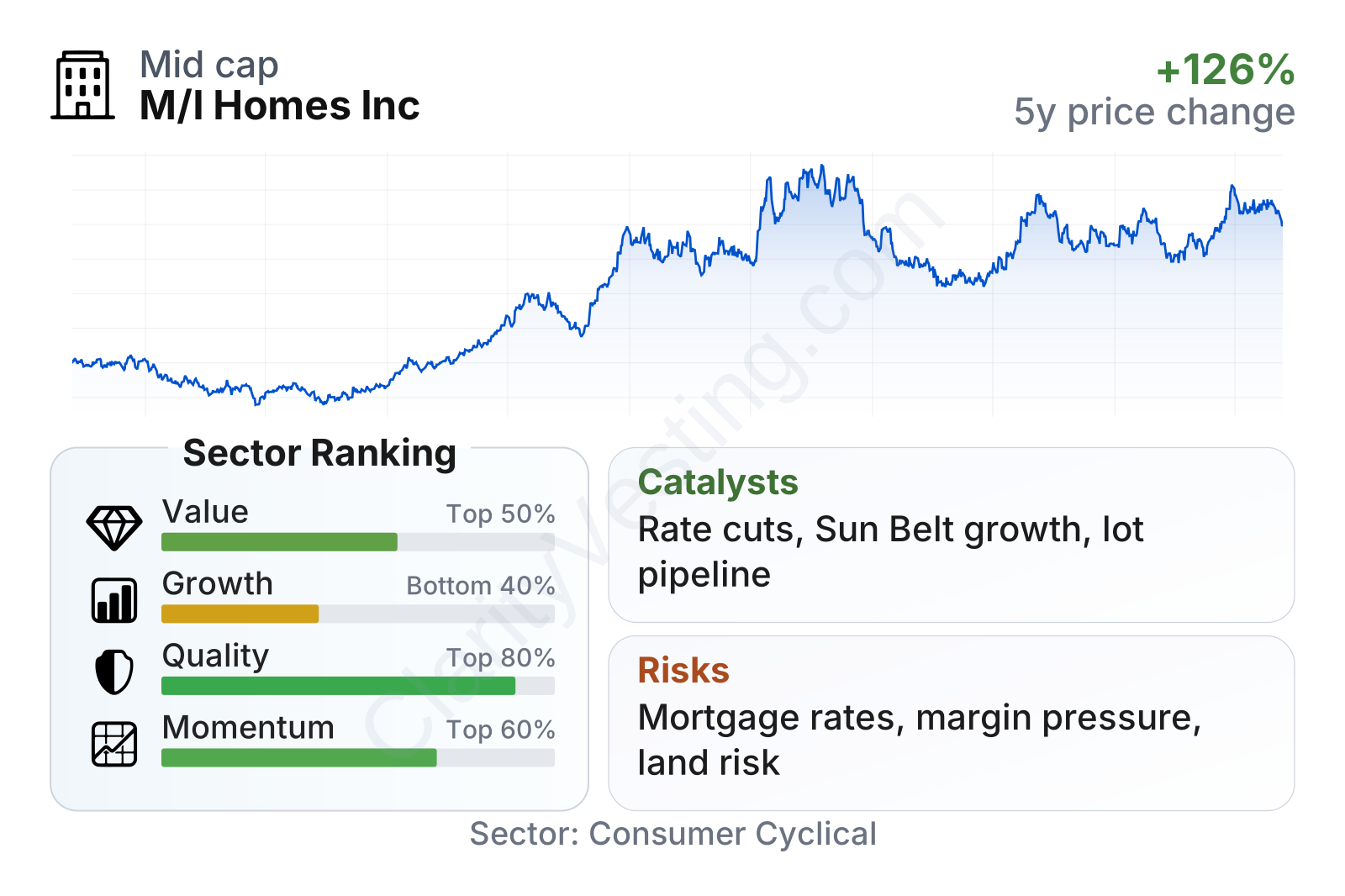
M/I Homes is a mid-sized homebuilder with above-average profitability and balance-sheet strength relative to much of the sector. The table points to a mixed profile: valuation remains below sector norms on earnings multiples, quality measures are strong, and market performance has been notably better than the broader sector. The weaker area is growth, where recent revenue and earnings trends have softened compared with peers.
Growth
Housing is a large and structurally important sector, supported over time by population growth, household formation, and the limited supply of homes in many U.S. markets. That said, homebuilding does not grow in a straight line. Demand is very sensitive to mortgage rates, consumer confidence, affordability, and local employment conditions. For M/I Homes, the long-term opportunity comes from staying active in markets with population inflows and managing product offerings across several price points.
The company’s strategy broadly makes sense for future growth. It combines homebuilding with mortgage and title capabilities, which can improve the customer experience and capture additional economics around each closing. M/I Homes has also historically emphasized disciplined land investment and returns rather than growth at any cost. That approach is useful in a cyclical industry where overly aggressive land buying can damage results when the market slows.
Recent growth has clearly become more uneven. After several strong periods, year-over-year revenue turned negative in the latest quarters, and the company now screens below the sector median on growth factors. This does not automatically signal a broken business, but it does indicate that the company is working through a slower part of the cycle, with tougher comparisons and a more demanding affordability environment.
Cash generation remains an important counterbalance. Free cash flow has been positive in recent periods, though it has moved around significantly, which is normal for homebuilders because land spending, development timing, and home closings can create large swings from one year to the next. The fact that cash flow remains positive after the post-2024 slowdown suggests the company still has room to fund operations and maintain flexibility without leaning heavily on debt.
A meaningful catalyst for the business would be any broad improvement in affordability, especially if mortgage rates stabilize or decline. That could unlock stronger order activity from first-time and move-up buyers. Another catalyst is continued migration into many Sun Belt markets where the company operates, particularly Florida and parts of the South. In addition, builders that can use incentives, financing support, and efficient construction to win share from the resale market may continue to benefit when existing homeowners remain reluctant to sell because they are locked into lower mortgage rates.
Recent company reporting and investor materials also indicate continued focus on community count, lot pipeline, and margin discipline. Those are key operational levers for a builder like M/I Homes: more communities support future sales capacity, while disciplined pricing and land costs support profitability even when volume growth slows.
Risks
This article is for informational purposes only and does not constitute financial advice. Some content is AI-generated. See Disclaimer