Stock Analysis · Mohawk Industries Inc (MHK)
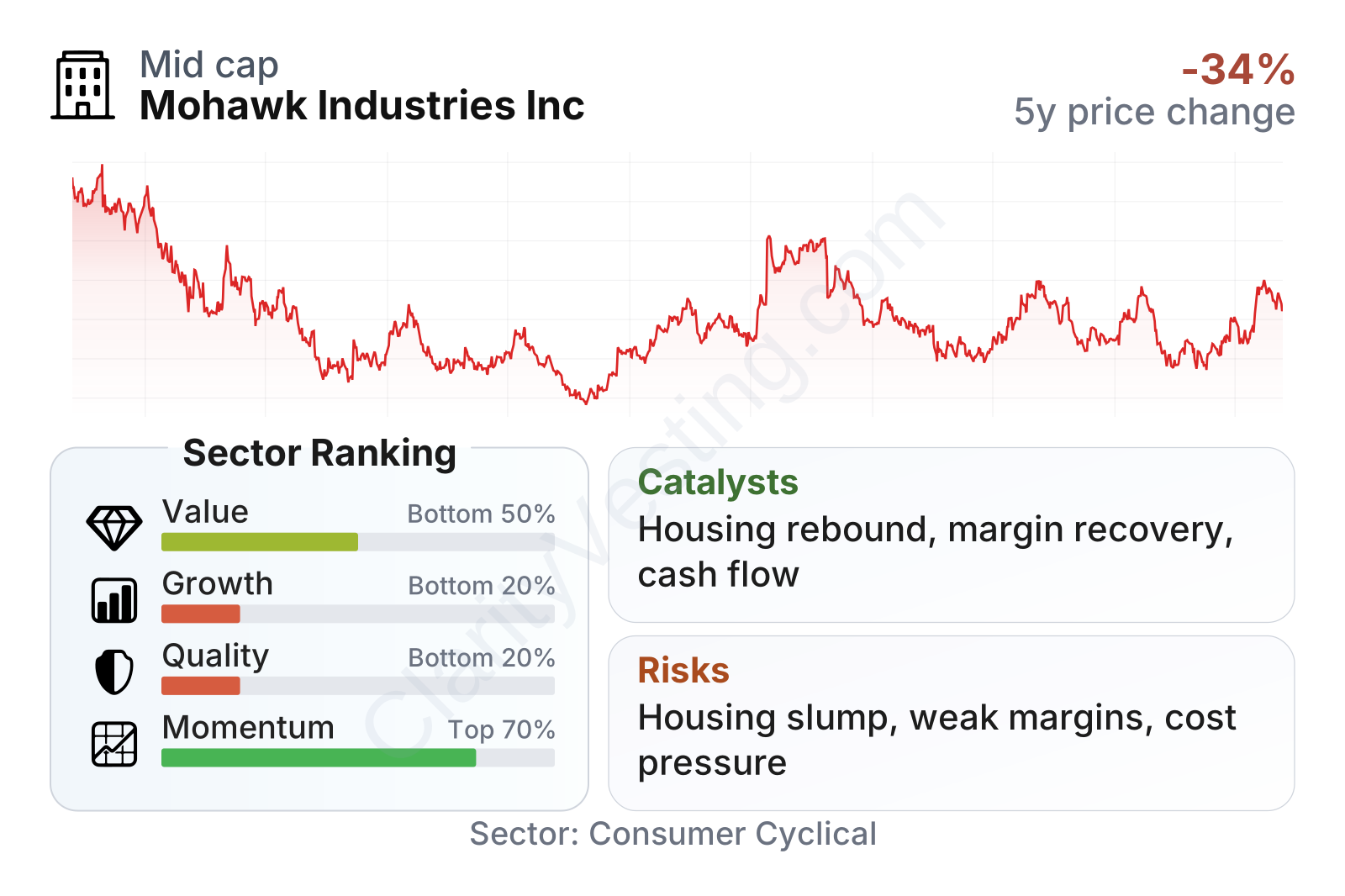
Stock Analysis · Mohawk Industries Inc (MHK)

Overview

Mohawk Industries is one of the world’s largest flooring manufacturers. The company makes products used in homes and commercial buildings, including carpet, rugs, ceramic tile, laminate, wood flooring, vinyl flooring, and related installation materials. Its business is closely tied to residential remodeling, new home construction, and commercial renovation, which makes demand sensitive to housing activity, interest rates, and broader consumer spending.

Mohawk operates through three main segments, and the business is fairly diversified across product categories and geographies. Based on recent annual reporting, revenue is split approximately as follows:

  • Global Ceramic: about 39% of revenue. This includes ceramic, porcelain, natural stone, quartz, and other hard-surface products sold in North America, Europe, Latin America, and other regions.
  • Flooring North America: about 35% of revenue. This segment includes carpet, rugs, carpet pad, laminate, vinyl, wood, and sheet vinyl, mainly for the U.S. and Canadian markets.
  • Flooring Rest of the World: about 26% of revenue. This business is centered on laminate, vinyl, wood panels, insulation panels, and flooring accessories outside North America, especially in Europe.

That mix matters because it gives Mohawk exposure to both soft flooring and hard flooring, as well as to several end markets rather than a single niche. At the same time, it also means the company must manage many factories, brands, raw material inputs, and regional demand cycles.

Over the past several years, revenue has stayed above $10 billion, but profitability has been far more volatile. The business generated very strong earnings in 2021, then margins compressed sharply in 2022 and 2023 as volumes weakened and costs remained elevated. Results improved in 2024, but 2025 showed that the recovery is still uneven rather than fully established.

The long-term pattern is clear: Mohawk remains a very large revenue business, but the main question is not scale. It is whether management can rebuild margins consistently after a difficult stretch of weaker demand and restructuring.

Key Figures

MetricValueSector
DateJul 18, 2026
Context
SectorConsumer Cyclical
IndustryFurnishings, Fixtures & Appliances
Market Cap $6.99B
Beta 1.18
Value
(Cheapness)
P/E Ratio 17.1818.58
FCF Yield 10.15%7.99%
EBIT / EV 5.79%5.91%
PEG 0.64
Growth
(Business expansion)
Revenue Growth 8.00%5.50%
RPS Growth (5Y CAGR) 1.63%9.20%
EPS Growth (5Y CAGR) -42.12%-26.43%
Margin Growth (5Y Trend) -7.52%-0.18%
FCF Growth (5Y CAGR) -0.67%5.02%
Quality
(Business durability)
ROIC (Latest) 4.09%12.03%
ROIC (5Y Median) 3.80%10.82%
Net Debt / EBIT (Latest) 3.302.12
Net Debt / EBIT (5Y Median) 3.062.25
Operating Margin (Latest) 4.55%9.28%
Operating Margin (5Y Median) 4.51%9.64%
Debt to Equity (Latest) 30.13%75.23%
Profit Margin (Latest) 3.77%5.28%
Free Cash Flow (Latest) $709.40M
Momentum
(Price trend)
3Y Return -0.83%+10.68%
12M Return (excl. last month) +9.76%+5.26%
6M Return -9.85%-2.41%
Price vs. 200-Day MA -0.70%+1.55%
Better than sector median
Slightly worse than sector median
More than 20% worse than sector median

Mohawk’s profile looks mixed. On valuation, it screens around the better half of its sector, with a price-to-earnings ratio below the sector median and a free cash flow yield that stands out positively. On the other hand, its quality and growth metrics are weaker: returns on invested capital are modest, margins remain below the industry midpoint, and multi-year growth has lagged many peers. In simple terms, the market is not valuing Mohawk like a premium compounder; it is valuing a large cyclical manufacturer that still has work to do on profitability.

The stock’s history also reflects that uncertainty. Shares are well below their 2021 levels and have moved sharply with changes in housing expectations, earnings pressure, and recovery hopes. That kind of path is common for businesses tied to construction and renovation cycles.

Growth

Flooring is not a fast-growth industry in the way software or semiconductors can be, but it is a large and durable category. Over long periods, demand tends to follow household formation, repair and remodeling activity, commercial refurbishment, and replacement cycles. In that sense, Mohawk operates in a sector with recurring need rather than explosive expansion. The attraction of the industry is scale, distribution, and manufacturing efficiency more than rapid top-line growth.

Mohawk’s strategy for future growth is sensible on paper. The company has built a broad manufacturing footprint, a wide product range across price points, and strong positions in ceramic tile, laminate, vinyl, and carpet. Management has also emphasized product innovation, cost reduction, plant optimization, and selective capital investment. Those efforts can matter a lot in a low-growth industry because even small margin improvements can have a meaningful effect on earnings.

Recent revenue trends suggest the company may be moving out of the worst part of the downturn. Year-over-year growth was negative for much of 2023 and 2024, then turned positive again, with a stronger rebound more recently. That does not yet prove a durable new cycle, but it does show that comparisons have improved and that volumes may be stabilizing in parts of the portfolio.

Cash generation is one of the more encouraging points. Free cash flow has recovered well from the low point and recently moved to a relatively strong level. For a capital-intensive manufacturer, this matters because it provides room for debt reduction, plant upgrades, restructuring spending, and share repurchases without relying too heavily on external financing.

The main catalysts are tied to normalization rather than transformation. Lower interest rates, an eventual housing recovery, improved European demand, and better factory utilization could all lift results. Mohawk has also been reshaping its cost base, so a modest improvement in demand could have an outsized effect on earnings if fixed costs are spread across higher volumes. In addition, its broad manufacturing presence and local production can be helpful when supply chains are unsettled or import conditions shift.

Recent company updates have also pointed to continued restructuring, operational simplification, and investments in higher-value product categories. Those are not dramatic headlines, but for a mature industrial business they can be meaningful if they lead to steadier margins and better returns on capital over time.

Risks

The biggest risk is cyclical exposure. Mohawk is heavily linked to home improvement, housing turnover, and construction activity. When mortgage rates stay high and consumers delay renovation projects, flooring demand can weaken quickly. Commercial demand is also exposed to economic conditions, especially in offices, retail, and discretionary projects.

A second risk is margin pressure. Mohawk’s profit profile has been much weaker than the sector median in recent years, and the company’s net margin remains in the mid-single digits after a period of losses. That matters because in manufacturing businesses, weak margins can turn even small sales declines into much larger earnings declines.

The margin trend shows both the challenge and the partial recovery. Profitability fell from strong levels in 2021 into losses during 2023 and part of 2024, then recovered back into positive territory. Even with that improvement, margins still trail the sector median by a noticeable amount, which suggests the turnaround is incomplete.

Debt is a more nuanced issue. Mohawk’s balance sheet is not highly leveraged relative to equity, and its debt-to-equity ratio is comfortably below the sector median. That is a positive. However, when measured against operating earnings, leverage looks less comfortable because earnings have been compressed.

The company’s debt-to-equity ratio has generally remained low compared with peers, which provides some financial flexibility. Still, low balance-sheet leverage does not fully remove risk when profits are under pressure, since debt becomes harder to carry when operating income is thin.

Competition is also intense. Mohawk faces large rivals in several categories, including Shaw Industries in carpet and resilient flooring, Interface in commercial flooring, Tarkett in resilient and sports surfaces, Armstrong Flooring-related competitors in hard surfaces, and many regional ceramic tile and laminate producers around the world. In ceramic and certain hard-surface categories, competition from imports and local manufacturers can be especially sharp. Mohawk’s advantages come from scale, broad distribution, vertical integration in some product lines, and a global manufacturing network. Those are real strengths, but they do not create an untouchable moat. Buyers can switch brands, and pricing power is limited when industry demand is soft.

As for leadership, Mohawk is clearly one of the largest players in global flooring and a category leader in several segments, but it is not a dominant monopoly with overwhelming pricing power. Its position is best described as large, diversified, and operationally important rather than uniquely insulated.

There have not been any widely known public issues suggesting an unusual governance scandal or reputation event on the scale that would overshadow the investment case. The more relevant recent risks are operational and market-driven: restructuring execution, weak end-market demand, ongoing cost inflation in inputs and energy, and the possibility that a recovery in housing arrives more slowly than expected.

Valuation

Mohawk’s valuation appears moderate rather than stretched. The current earnings multiple sits below the sector median, and the free cash flow yield is comparatively strong. That usually signals that the market is recognizing the company’s cyclical and profitability risks, while still giving credit for its scale, asset base, and ability to generate cash.

The earnings multiple has moved through wide swings over the last several years, partly because profits themselves became unusually volatile. More recently, the ratio has settled into a level that is below the sector median, which suggests the stock is not priced as if a full earnings recovery is already guaranteed.

The key question is whether today’s valuation is justified by the fundamentals. On one hand, Mohawk has a large installed market, broad manufacturing footprint, lower-than-average debt-to-equity, and meaningful cash generation. On the other hand, return on capital is weak, margins remain below historical highs, and long-term growth metrics are unimpressive. Put differently, the valuation looks consistent with a business in recovery rather than one delivering high-quality growth.

That context makes the current pricing easier to understand. The stock does not seem to carry an aggressive premium, but it also does not look like the market has ignored the company’s challenges. Much of the debate comes down to how durable the earnings recovery will be and whether management can convert scale into stronger profitability.

Conclusion

Mohawk Industries stands out as a major global flooring manufacturer with broad product exposure, sizable revenue, and enough financial flexibility to navigate a difficult cycle. The company is not built around fast secular growth, but around manufacturing scale, replacement demand, and operational execution. That can still be attractive over long periods when the cycle turns favorable and margins recover.

The challenge is that the business has not recently shown the consistency typically associated with higher-quality long-term compounders. Revenue has been relatively resilient in absolute size, yet profits and returns on capital have been much less convincing. The recent rebound in sales growth and free cash flow is encouraging, but margins remain below sector norms and competitive pressure is real.

Overall, Mohawk currently looks more like a cyclical recovery case with solid industrial assets than a clear-cut premium franchise. The valuation reflects that balance: not demanding, but also not detached from the operational work still ahead. For long-term analysis, the company’s appeal rests largely on whether margin rebuilding and demand normalization can become sustained rather than temporary.

Sources:

  • Mohawk Industries, Inc. — Annual Report on Form 10-K for fiscal year 2025
  • Mohawk Industries, Inc. — Quarterly Report on Form 10-Q for quarter ended March 29, 2026
  • U.S. Securities and Exchange Commission — EDGAR filings for Mohawk Industries, Inc.
  • Mohawk Industries Investor Relations — earnings releases and shareholder materials
  • Wikipedia — Mohawk Industries

This article is for informational purposes only and does not constitute financial advice. Some content is AI-generated. See Disclaimer
Sign up for exclusive research and insights.

Unsubscribe anytime.