Stock Analysis · Magna International Inc (MGA)
Overview
Magna International is one of the world’s largest automotive suppliers. Rather than selling cars under its own consumer brand, it designs and manufactures a very broad range of parts, systems, modules, and vehicle engineering solutions for global automakers. Its products go into body structures, seating, mirrors, lighting, powertrain-related components, electronics, driver-assistance systems, and complete vehicle assembly services. That breadth is one of Magna’s defining characteristics: it is not dependent on a single part category or a single carmaker.
The business is global, with major operations across North America, Europe, and Asia. Magna works with many large original equipment manufacturers, which gives it broad customer access but also ties results closely to global vehicle production, model launches, and automaker spending patterns. In simple terms, Magna benefits when carmakers build more vehicles and award more content per vehicle to suppliers.
Based on company reporting, revenue is mainly generated from a handful of operating segments. The mix can shift modestly from year to year, but the business is generally distributed as follows:
- Body Exteriors & Structures: roughly a quarter of revenue, making it the largest contributor.
- Power & Vision: also around a quarter, including mirrors, lighting, mechatronics, and electronics.
- Seating Systems: roughly one-fifth of revenue.
- Complete Vehicles: around the mid-teens as a percentage of sales, tied to contract vehicle engineering and assembly.
- Vehicle Access: around low-teens, including latches, door modules, and related systems.
This revenue structure matters because it shows Magna is more diversified than many auto suppliers that are concentrated in one niche. Over the last several years, sales have stayed in a very large range above $40 billion annually, but earnings conversion has been less consistent, reflecting the industry’s cost pressure and production volatility.
The flow of revenue through the income statement also highlights an important point: Magna produces enormous sales, but a very large share is absorbed by manufacturing costs. Gross profit recovered from the 2022 trough and held up reasonably well through 2024, yet net income has remained much thinner than revenue scale might suggest. That is typical for mass-market auto supply, where execution and cost control matter as much as top-line growth.
Key Figures
| Metric | Value | Sector ⓘ |
|---|---|---|
| Date | Jul 18, 2026 | |
| Context | ||
| Sector | Consumer Cyclical | |
| Industry | Auto Parts | |
| Market Cap ⓘ | $18.09B | |
| Beta ⓘ | 1.86 | |
Value (Cheapness) | ||
| P/E Ratio ⓘ | 28.52 | 18.58 |
| FCF Yield ⓘ | 15.44% | 7.99% |
| EBIT / EV ⓘ | 5.87% | 5.91% |
| PEG ⓘ | 0.41 | |
Growth (Business expansion) | ||
| Revenue Growth ⓘ | 3.10% | 5.50% |
| RPS Growth (5Y CAGR) ⓘ | 6.04% | 9.20% |
| EPS Growth (5Y CAGR) ⓘ | -26.71% | -26.43% |
| Margin Growth (5Y Trend) ⓘ | -2.10% | -0.18% |
| FCF Growth (5Y CAGR) ⓘ | 3.76% | 5.02% |
Quality (Business durability) | ||
| ROIC (Latest) ⓘ | 4.64% | 12.03% |
| ROIC (5Y Median) ⓘ | 7.73% | 10.82% |
| Net Debt / EBIT (Latest) ⓘ | 3.72 | 2.12 |
| Net Debt / EBIT (5Y Median) ⓘ | 3.26 | 2.25 |
| Operating Margin (Latest) ⓘ | 3.23% | 9.28% |
| Operating Margin (5Y Median) ⓘ | 4.32% | 9.64% |
| Debt to Equity (Latest) ⓘ | 56.24% | 75.23% |
| Profit Margin (Latest) ⓘ | 1.59% | 5.28% |
| Free Cash Flow (Latest) ⓘ | $2.79B | |
Momentum (Price trend) | ||
| 3Y Return ⓘ | +23.52% | +10.68% |
| 12M Return (excl. last month) ⓘ | +80.60% | +5.26% |
| 6M Return ⓘ | +19.65% | -2.41% |
| Price vs. 200-Day MA ⓘ | +18.82% | +1.55% |
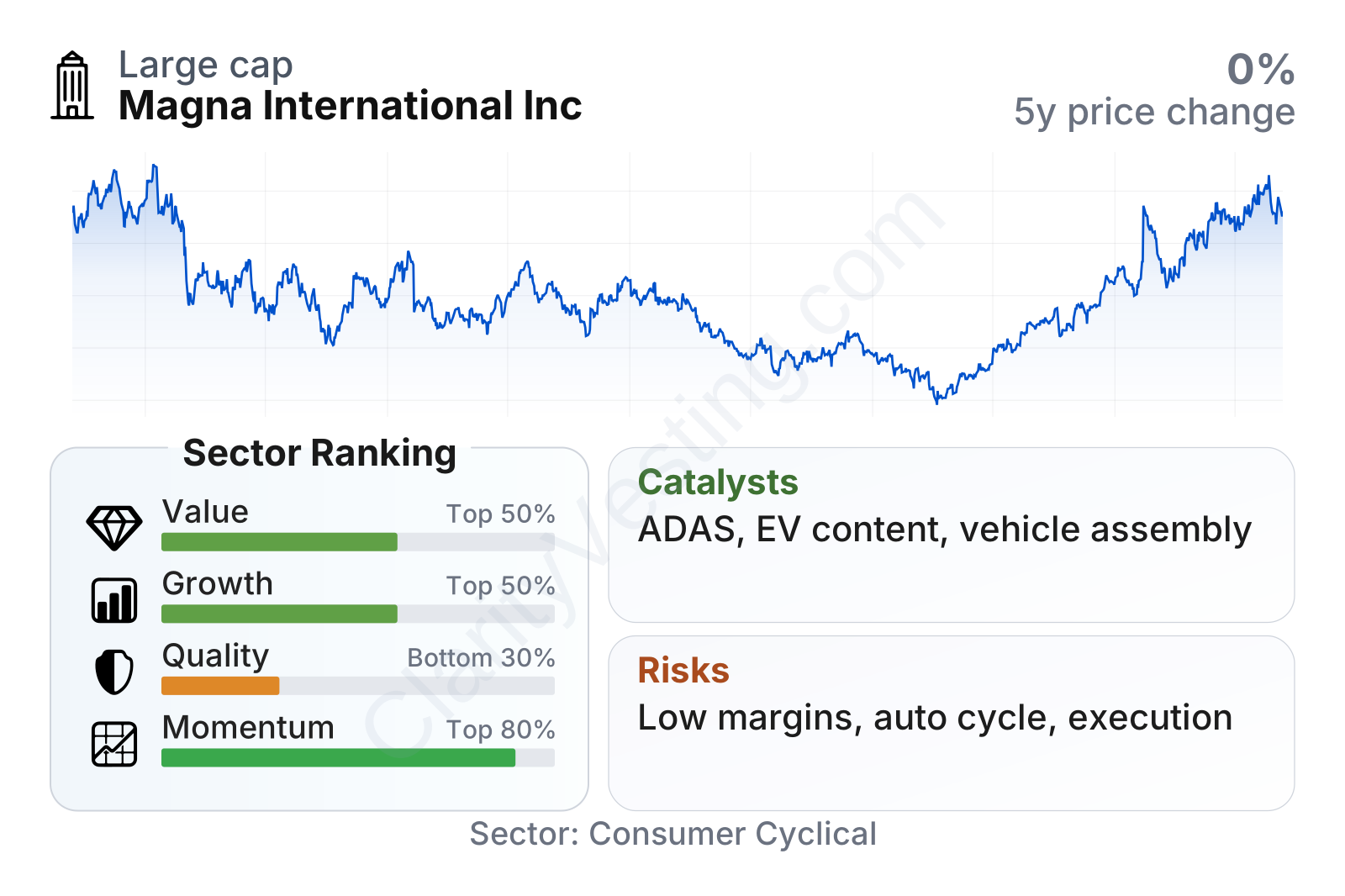
Magna sits in the large-cap range with a market value around $18 billion, and the stock has shown above-average volatility, which is not surprising for a company tied to auto production cycles. The broader picture from the metrics is mixed. On one hand, free cash flow generation looks notably strong, and recent share-price momentum has been much stronger than the sector median. On the other hand, profitability and returns on invested capital remain weaker than many peers, while growth ranks in the lower part of the sector.
That combination is important for long-term analysis. The company does not currently screen like a high-margin compounder, but it also does not look like a financially stretched turnaround. It appears more like a large, diversified industrial supplier whose valuation depends heavily on whether it can turn its scale and engineering reach into better margins over time.
Growth
Magna operates in a sector that is mature overall, but still has real pockets of growth. Global vehicle demand is not a classic high-growth market, yet the content inside each vehicle keeps changing. That creates opportunities for suppliers that can provide more electronics, advanced driver-assistance content, vehicle access systems, lightweight structures, and products aligned with electrified platforms. Magna is positioned across several of those areas, which gives it exposure to the parts of the auto market that are evolving fastest.
The company’s strategy for future growth is sensible in principle. It combines traditional scale manufacturing with higher-value engineering content. Magna has continued investing in driver-assistance technology, electrification-related systems, and integrated vehicle solutions. It also has a distinctive complete-vehicle assembly capability, which few suppliers can match at scale. That does not automatically guarantee faster growth, but it does create optionality if automakers want outsourcing partners with broader technical scope.
Recent revenue growth has been uneven. Magna posted strong rebounds during the post-supply-chain recovery period, but that momentum cooled materially afterward. The latest year-over-year growth pace is positive, though modest, and below the sector median. In other words, the company is still growing, but not at a pace that clearly separates it from the pack. For a supplier this large, gaining share often matters more than headline industry growth, and that tends to show up gradually rather than all at once.
The cash flow trend is one of the more encouraging parts of the picture. Free cash flow has improved sharply from the lows seen earlier in the cycle and recently reached a much stronger level. That suggests better working-capital performance, more disciplined capital spending, or both. For a capital-intensive manufacturer, stronger cash generation can provide flexibility for debt reduction, shareholder returns, and reinvestment in new programs.
Recent company updates have continued to emphasize launches tied to electrification, active safety, and efficiency-oriented vehicle content. Those are credible long-term catalysts because automakers increasingly need suppliers that can help reduce weight, add software-enabled functions, and support more complex vehicle architectures. Magna’s broad product set means it can participate across several of these trends rather than depending on a single technology bet.
Risks
The biggest risk is the basic nature of the business: Magna is deeply exposed to the auto cycle. If vehicle production slows because of weak consumer demand, high interest rates, recession, labor disruptions, or trade friction, suppliers usually feel the effect quickly. Even when revenue remains stable, profit can come under pressure because fixed manufacturing costs are high and automakers often push suppliers for price concessions.
Another major risk is margin pressure. Magna’s profitability is well below the sector median, and that is not a temporary one-quarter issue. Net margins have trended low for several years, and operating margins have also been thin relative to many peers. This means that small execution issues, launch costs, warranty expense, restructuring, or customer mix changes can have an outsized effect on earnings.
Balance-sheet leverage looks manageable rather than alarming. Debt to equity has generally remained below the sector median, which is a positive sign. However, that does not remove financing risk entirely. Interest costs have increased over time, and net debt relative to EBIT is still on the high side versus the sector median. So the balance sheet is not the main problem, but it is also not so light that it can be ignored.
The profit trend is the clearest operational weak spot. Margins have stayed well below the sector median and have drifted down from stronger levels seen several years ago. For a business with more than $40 billion in annual revenue, this leaves limited room for mistakes. A company can be large, technologically capable, and globally diversified, yet still struggle to convert sales into strong shareholder returns if margins remain narrow.
In terms of competitive position, Magna does have meaningful advantages. It is one of the largest and most diversified suppliers in the industry, it has deep manufacturing relationships with global automakers, and it can offer multi-system solutions that smaller specialists cannot easily replicate. It is not the unquestioned leader in every category, but it is clearly part of the top tier of global automotive suppliers by scale and breadth.
Main competitors include other major global parts makers such as Aptiv, Lear, Adient, BorgWarner, Valeo, Forvia, and ZF in various overlapping categories. Compared with these companies, Magna’s strength is diversification across product lines and geographies. Its weaker point is that its margins and returns on capital are not as strong as the best-performing global peers. So its competitive position is solid, but not dominant in the sense of producing clearly superior economics.
Other risks worth monitoring include customer concentration with large automakers, program launch execution, exposure to Europe, tariff and trade-policy changes, and the possibility that electric-vehicle adoption evolves differently than expected. There has not been a major scandal or governance event dominating the recent picture, but the company remains exposed to operational and industry-level disruptions that can materially affect results.
Valuation
Magna’s valuation is not straightforward because different metrics point in different directions. The earnings multiple is currently above the sector median, which makes the stock look less cheap than its industrial profile might suggest. That is a notable shift from earlier periods, when the shares often traded at a discount to the sector on earnings.
The history of the earnings multiple helps explain the debate. For much of the past several years, Magna traded on a clearly lower P/E than the sector median. More recently, the multiple moved up sharply and now sits above that median. When that happens while growth remains modest and margins stay weak, the market is effectively giving the company more credit for recovery, resilience, or future improvement than it did before.
At the same time, cash-flow-based measures make the picture look more favorable. Free cash flow yield is strong relative to the sector median, and the PEG ratio suggests the valuation is not especially demanding if earnings normalize as expected. So the stock does not screen as uniformly expensive across all measures. Instead, it looks like a company where the market is balancing weak current profitability against better cash generation and the possibility of improved execution.
Overall, the current price appears to reflect a partial recovery case rather than deep pessimism. That leaves less room for disappointment than when the stock traded at a clear discount, especially since margin quality is still below average. The valuation can be defended if cash flow remains strong and margins stabilize, but it does not leave a strong impression of obvious cheapness relative to the business risks.
Conclusion
Magna International stands out as a large, global, and unusually diversified automotive supplier with real engineering depth and exposure to several useful long-term themes, including vehicle electronics, active safety, advanced access systems, and electrification-related content. Its scale, customer relationships, and broad product mix give it staying power that many smaller suppliers do not have.
The challenge is that this industrial strength has not translated into equally strong profitability. Revenue is huge, free cash flow has improved sharply, and the company remains strategically relevant to automakers, but margins and returns on capital still trail much of the sector. That creates a split profile: solid business positioning and better cash generation on one side, weaker earnings quality and cyclical exposure on the other.
In valuation terms, the shares no longer look like a plain bargain based on earnings, especially after the recent rerating. That makes the long-term case more dependent on Magna proving it can convert its scale into steadier profit improvement. The overall picture is constructive but not carefree: a credible global supplier with genuine assets and catalysts, yet one that still needs better operating performance to fully justify the market’s improved confidence.
Sources:
- Magna International Inc. — Annual Report 2025
- Magna International Inc. — Quarterly Report 2026
- SEC EDGAR — Magna International Inc. filings
- Magna International Investor Relations — press releases and company presentations
- Magna International Investor Relations — earnings call materials
- Wikipedia — Magna International basic company background
This article is for informational purposes only and does not constitute financial advice. Some content is AI-generated. See Disclaimer


