Stock Analysis · Meta Platforms Inc (META)
Overview
Meta Platforms operates some of the world’s largest digital communication and content platforms. Its family of apps includes Facebook, Instagram, Messenger, Threads, and WhatsApp. In simple terms, Meta makes money by helping businesses reach users with targeted advertising across these services, while also investing heavily in newer technologies such as artificial intelligence, smart glasses, and virtual and augmented reality.
The business is still highly concentrated in advertising. Based on Meta’s segment reporting, the company has two operating segments: Family of Apps and Reality Labs. Family of Apps includes the social platforms and messaging ecosystem and generates almost all of the company’s revenue and nearly all of its profit. Reality Labs includes virtual reality headsets, AR/VR software, and related hardware, but it remains much smaller and loss-making.
Main sources of revenue can be summarized as follows:
- Advertising from Family of Apps: about 97% to 99% of total revenue in recent years. This includes ads shown on Facebook, Instagram, Messenger, and increasingly short-form video surfaces such as Reels, as well as ads tied to business messaging and other app engagement.
- Other revenue, mainly Reality Labs and other non-advertising items: about 1% to 3% of total revenue. This includes sales of Meta Quest devices, related accessories, software content, and limited other sources.
That revenue mix makes Meta easy to understand: it is still primarily an advertising company, but one with an enormous global audience and a growing AI layer that can improve both user engagement and ad performance. The newer hardware and immersive computing efforts are strategically important, yet they are still too small to change the company’s overall financial profile today.
Over the past several years, revenue, gross profit, and operating income have all expanded strongly after the 2022 slowdown. One visible pattern is that research and development spending has climbed sharply, showing that Meta is choosing to reinvest a large share of its profits into AI infrastructure and next-generation platforms rather than maximizing near-term earnings alone.
Key Figures
| Metric | Value | Sector ⓘ |
|---|---|---|
| Date | Sep 12, 2026 | |
| Context | ||
| Sector | Communication Services | |
| Industry | Internet Content & Information | |
| Market Cap ⓘ | $1.64T | |
| Beta ⓘ | 1.24 | |
Value (Cheapness) | ||
| P/E Ratio ⓘ | 24.63 | 18.61 |
| FCF Yield ⓘ | 2.50% | 13.68% |
| EBIT / EV ⓘ | 6.11% | 4.54% |
| PEG ⓘ | 0.86 | |
Growth (Business expansion) | ||
| Revenue Growth ⓘ | 28.00% | 5.40% |
| RPS Growth (5Y CAGR) ⓘ | 17.29% | 4.62% |
| EPS Growth (5Y CAGR) ⓘ | 13.82% | -18.01% |
| Margin Growth (5Y Trend) ⓘ | 3.11% | 1.10% |
| FCF Growth (5Y CAGR) ⓘ | 4.20% | 5.88% |
Quality (Business durability) | ||
| ROIC (Latest) ⓘ | 28.96% | 8.38% |
| ROIC (5Y Median) ⓘ | 25.09% | 8.32% |
| Net Debt / EBIT (Latest) ⓘ | 0.68 | 1.99 |
| Net Debt / EBIT (5Y Median) ⓘ | 0.07 | 2.94 |
| Operating Margin (Latest) ⓘ | 43.13% | 14.89% |
| Operating Margin (5Y Median) ⓘ | 39.65% | 12.96% |
| Debt to Equity (Latest) ⓘ | 43.00% | 59.59% |
| Profit Margin (Latest) ⓘ | 29.83% | 8.77% |
| Free Cash Flow (Latest) ⓘ | $40.98B | |
Momentum (Price trend) | ||
| 3Y Return ⓘ | +116.71% | +46.64% |
| 12M Return (excl. last month) ⓘ | -26.49% | +2.16% |
| 6M Return ⓘ | +1.72% | +5.05% |
| Price vs. 200-Day MA ⓘ | +4.09% | +2.88% |
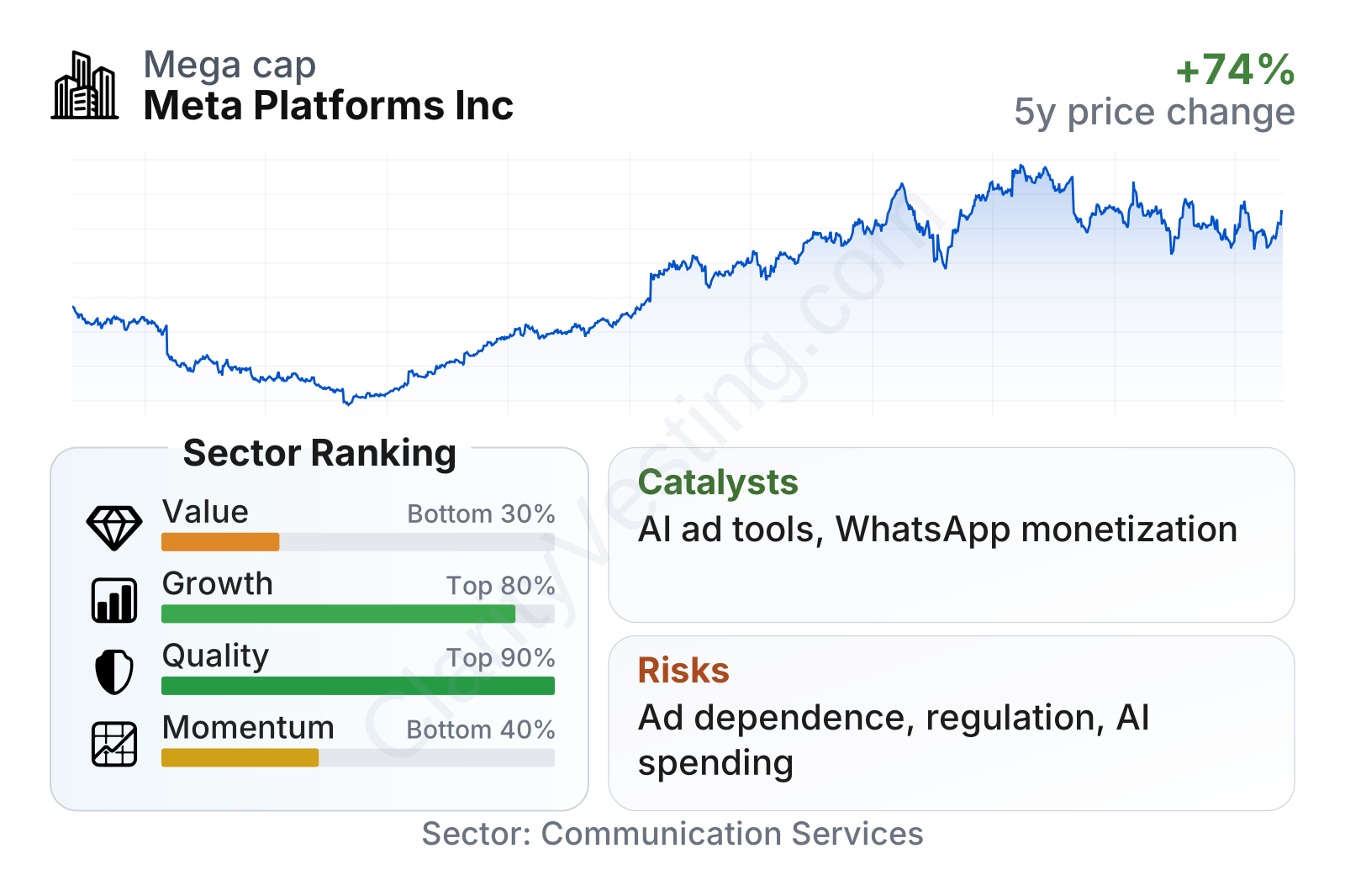
Meta stands out for business quality and growth. Profitability metrics are far above the sector median, with operating margin above 40% and profit margin near 30%, which is unusually strong for a company of this size. Return on invested capital is also well ahead of peers, suggesting that the core ad business remains highly efficient. The weaker point in the table is valuation relative to the sector, as the earnings multiple is above the median and free cash flow yield is lower, reflecting the market’s expectation of continued expansion.
In market behavior, the stock has delivered strong gains over three years, but shorter-term momentum has cooled. That combination often signals a company whose long-term operating performance remains powerful even as expectations have become harder to exceed in the near term.
Growth
Meta operates in a sector that still has attractive long-term growth drivers. Digital advertising continues to take share from traditional media, and within digital, ad tools powered by AI are becoming more valuable because they can improve targeting, measurement, and conversion. At the same time, global online video, creator-driven commerce, and business messaging are still expanding. These trends fit Meta well because the company already has a massive installed user base and can layer new monetization tools on top of existing engagement.
The company’s current strategy also makes sense for future growth. Management has been pushing three connected themes: stronger AI-driven recommendation engines, better ad technology, and a broader ecosystem around messaging, creators, and devices. Better recommendation systems can increase time spent on Instagram and Facebook. Better ad ranking can raise the price advertisers are willing to pay. Messaging tools on WhatsApp and Messenger can open a larger commercial opportunity beyond pure feed advertising.
Revenue growth shows a clear rebound from the contraction period in 2022. Growth reaccelerated through 2023, stayed solid in 2024 and 2025, and remained strong into 2026, with year-over-year expansion running well above the sector median. That matters because it suggests Meta is not just benefiting from a cyclical ad recovery; it is also executing well in product engagement and monetization.
Cash generation remains one of the company’s strongest traits. Free cash flow dipped during the heavier spending period, then recovered sharply and stayed at a very high level even while Meta continued to invest aggressively. That gives the company unusual flexibility: it can fund AI infrastructure, support Reality Labs, repurchase shares, and still maintain a strong balance sheet.
A major catalyst is the AI buildout. Meta has been integrating AI across ad creation, ranking, recommendations, and developer tools, while also spending heavily on chips, data centers, and large models. If these efforts continue to improve ad conversion and user engagement, the effect can be meaningful because even small efficiency gains applied across Meta’s scale can produce very large revenue and profit impacts. Another important opportunity is wearables. Ray-Ban Meta smart glasses have helped Meta establish a real presence in consumer AI hardware, which is strategically different from the longer-dated virtual reality effort.
Recent company communications have also emphasized capital spending to support AI capacity. That is significant because it signals management sees enough demand and enough practical use cases to justify very large infrastructure commitments. For a long-term business case, this is important: Meta is not merely experimenting with AI features, it is building them into the economic engine of the company.
Risks
This article is for informational purposes only and does not constitute financial advice. Some content is AI-generated. See Disclaimer


