Stock Analysis · MercadoLibre Inc (MELI)
Overview
MercadoLibre is one of the largest digital commerce companies in Latin America. It operates an online marketplace where merchants and consumers can buy and sell goods, but the business is much broader than a typical e-commerce website. Over time, the company has built a connected ecosystem that includes payments, shipping and fulfillment, consumer and merchant credit, advertising, and software tools for sellers. This matters because each new service makes the platform more useful, which can attract more buyers, more merchants, and more transaction volume.
The company reports two main business segments: commerce and fintech. Commerce includes the marketplace and the services that help transactions happen efficiently. Fintech is centered on Mercado Pago, which started as a payment tool for marketplace purchases and has grown into a broader digital financial platform used both inside and outside MercadoLibre’s shopping ecosystem.
Based on recent company reporting, MercadoLibre’s revenue mix is approximately:
- Fintech services: about 57% to 60% — mainly payment processing, merchant services, consumer financial services, credit-related income, and other Mercado Pago activities.
- Commerce services: about 40% to 43% — mainly marketplace fees, shipping and fulfillment services, advertising, and related seller tools.
Within those areas, the biggest underlying drivers are usually payment services, marketplace commissions, shipping solutions, credit operations, and advertising. Advertising is still smaller than payments and marketplace activity, but it has been gaining relevance because it tends to carry attractive margins and benefits from high traffic on the platform.
Geographically, Brazil is the largest market, followed by Mexico and Argentina. That concentration makes sense because these are among the biggest e-commerce and digital payments markets in the region, and MercadoLibre already has strong brand recognition, logistics capabilities, and a large installed user base there.
The financial flow over the last several years shows a business that has expanded rapidly while also scaling profit. Revenue rose from roughly $7 billion in 2021 to nearly $29 billion in 2025, and operating income increased even faster. Research and development spending also climbed materially, which suggests the company has continued investing heavily in technology and product expansion rather than simply harvesting short-term profits.
Key Figures
| Metric | Value | Sector ⓘ |
|---|---|---|
| Date | Sep 12, 2026 | |
| Context | ||
| Sector | Consumer Cyclical | |
| Industry | Internet Retail | |
| Market Cap ⓘ | $96.64B | |
| Beta ⓘ | 1.31 | |
Value (Cheapness) | ||
| P/E Ratio ⓘ | 51.02 | 17.10 |
| FCF Yield ⓘ | 12.89% | 8.53% |
| EBIT / EV ⓘ | 2.39% | 6.46% |
| PEG ⓘ | 0.91 | |
Growth (Business expansion) | ||
| Revenue Growth ⓘ | 49.80% | 5.75% |
| RPS Growth (5Y CAGR) ⓘ | 41.56% | 9.14% |
| EPS Growth (5Y CAGR) ⓘ | 18.79% | -18.21% |
| Margin Growth (5Y Trend) ⓘ | 3.70% | -0.23% |
| FCF Growth (5Y CAGR) ⓘ | 134.62% | 4.91% |
Quality (Business durability) | ||
| ROIC (Latest) ⓘ | 14.20% | 12.61% |
| ROIC (5Y Median) ⓘ | 15.63% | 10.72% |
| Net Debt / EBIT (Latest) ⓘ | 3.48 | 2.10 |
| Net Debt / EBIT (5Y Median) ⓘ | 2.58 | 2.32 |
| Operating Margin (Latest) ⓘ | 7.84% | 9.25% |
| Operating Margin (5Y Median) ⓘ | 10.35% | 9.64% |
| Debt to Equity (Latest) ⓘ | 168.19% | 75.78% |
| Profit Margin (Latest) ⓘ | 5.30% | 5.33% |
| Free Cash Flow (Latest) ⓘ | $12.46B | |
Momentum (Price trend) | ||
| 3Y Return ⓘ | +35.61% | +14.53% |
| 12M Return (excl. last month) ⓘ | -22.23% | +3.08% |
| 6M Return ⓘ | +12.94% | +0.55% |
| Price vs. 200-Day MA ⓘ | +2.10% | -0.54% |
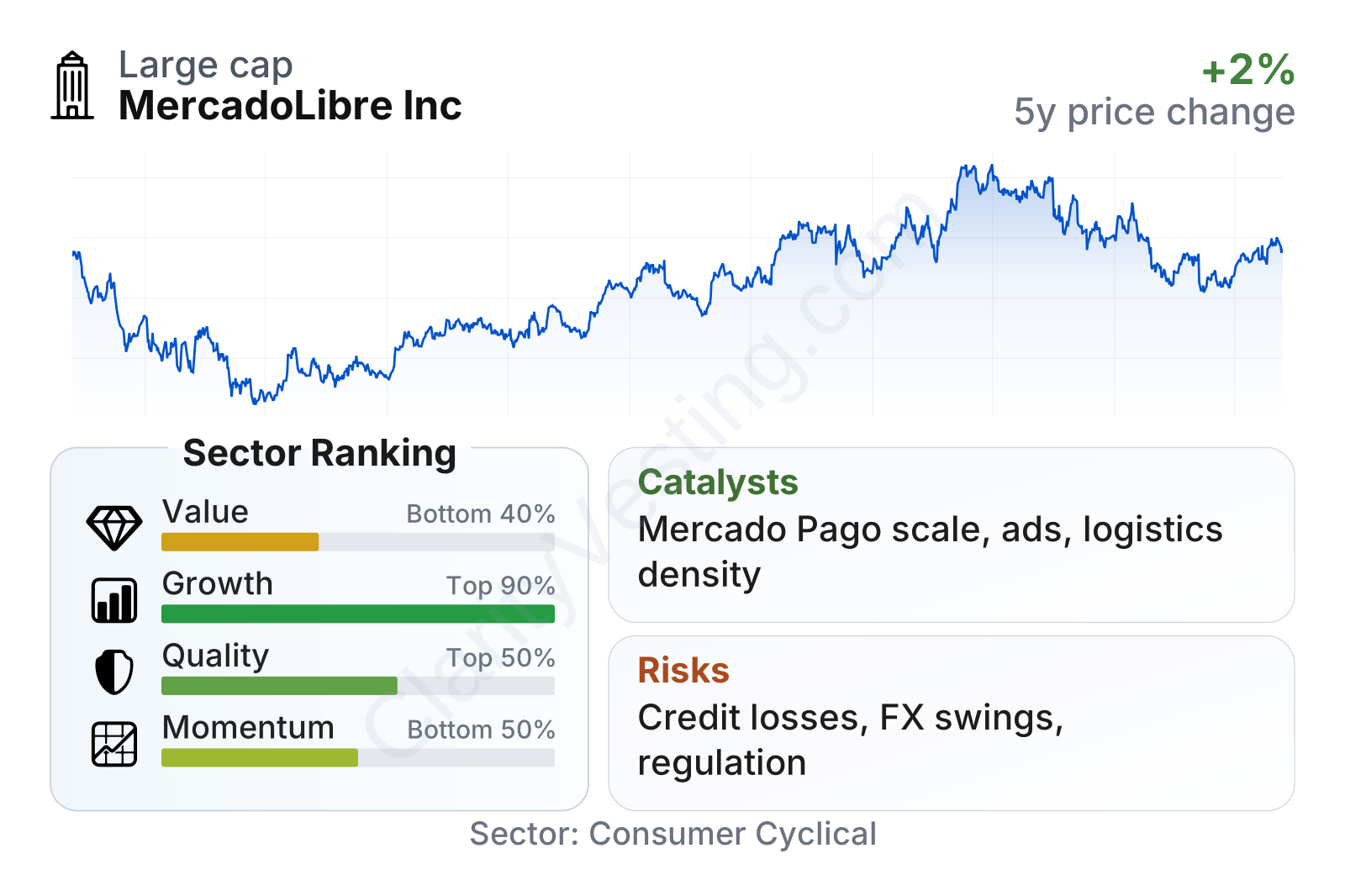
MercadoLibre stands out most clearly on growth. Revenue growth is close to 50% year over year, far above the sector median near 6%, and five-year growth in revenue per share and free cash flow is also much stronger than most peers. Quality is more mixed: returns on invested capital are solid, but debt-related measures are heavier than the typical company in the sector. On valuation, the stock trades at a much higher earnings multiple than the sector median, which means the market is still assigning a premium to its expansion potential despite weaker recent price momentum.
The share price history also highlights how volatile the stock can be. After a deep drawdown in 2022, the stock recovered strongly through 2024 and early 2025 before pulling back again in 2026. That pattern is common for companies where expectations for future growth play a large role in valuation.
Growth
MercadoLibre operates in two large and still developing markets at the same time: e-commerce and digital financial services in Latin America. Both sectors have room to expand as online shopping penetration, electronic payments, logistics coverage, formal financial inclusion, and merchant digitization continue to improve across the region. In practical terms, the company is not just riding one trend. It is tied to several long-duration shifts in how people shop, pay, borrow, and run small businesses.
Its strategy for future growth is coherent because the different pieces of the platform support one another. A merchant that starts by listing products on the marketplace can later use shipping, advertising, payment processing, working capital loans, and point-of-sale tools. A consumer who first uses Mercado Pago for purchases can later use the wallet for peer-to-peer transfers, bill payments, savings-like features, and credit. This creates cross-selling opportunities and can lower customer acquisition costs over time.
Revenue growth has remained unusually strong for a company of this size. Even after the pandemic-era boom, annual growth stayed in the double digits and recently accelerated back toward 50%. That suggests MercadoLibre is still gaining share and deepening usage rather than merely benefiting from a one-time adoption wave.
Cash generation is another important growth signal. Free cash flow has moved from under $1 billion a few years ago to well above $10 billion on a trailing basis. That gives the company more flexibility to fund logistics, technology, credit products, and market expansion without relying as heavily on outside financing.
Recent company updates have also pointed to continued strength in key operating metrics such as gross merchandise volume, total payment volume, fintech monthly active users, and credit portfolio growth. Another relevant opportunity is advertising: as marketplace traffic scales, ad products can become a larger monetization layer with relatively attractive economics. In addition, logistics density in Brazil and Mexico can improve delivery speed and unit economics, making the platform more competitive and more convenient for buyers.
Risks
This article is for informational purposes only and does not constitute financial advice. Some content is AI-generated. See Disclaimer


