Stock Analysis · Melco International Development Limited (MDEVY)
Overview
Melco International Development Limited is a Hong Kong-listed leisure and hospitality group whose U.S. over-the-counter symbol is MDEVY. For long-term analysis, the key point is that Melco is not a broadly diversified consumer company. Its economics are driven mainly by casino resort ownership and operation through its controlling stake in Melco Resorts & Entertainment, the operator behind properties such as City of Dreams, Studio City, Altira Macau, and City of Dreams Manila, with a developing presence in Cyprus and Sri Lanka.
The business model is centered on integrated resorts: gaming floors attract visitors, while hotel rooms, food and beverage, entertainment, retail, and other services add spending per guest. That makes Melco heavily exposed to tourism flows, consumer confidence among higher-spending travelers, and gaming regulation in the places where it operates.
Based on company reporting, revenue is overwhelmingly tied to gaming and gaming-related resort activity, with non-gaming contributing a smaller but still meaningful share. A simple way to think about its revenue mix is:
- Casino and gaming operations: approximately 75% to 85% of revenue in a normal recovery environment. This includes mass-market table games, slot machines, and other casino play, which are the core earnings driver.
- Rooms: approximately 5% to 10% of revenue, depending on occupancy and room rates at flagship resorts.
- Food, beverage, entertainment, retail, and other resort services: approximately 10% to 20% of revenue combined, supported by integrated resort traffic.
The broad pattern is more important than the exact split: Melco remains primarily a casino operator, and its long-term outcome depends much more on gaming volumes and property utilization than on ancillary hospitality businesses.
The operating path since the pandemic has been clear. Revenue and operating income recovered strongly from 2022 through 2025, reflecting the reopening of Macau and normalization in travel demand. The business has moved from deep operating losses to positive operating profit and, more recently, positive net income, but interest expense is still large enough to remain a major constraint on bottom-line earnings.
The business mix shows a clear recovery in scale and profitability after the pandemic disruption. Revenue and operating income improved sharply through 2024 and 2025, and the company moved back into positive net income. The main drag that still stands out is financing cost: interest expense remains very large relative to earnings, which helps explain why stronger operations have not translated into equally strong bottom-line resilience.
Key Figures
| Metric | Value | Sector ⓘ |
|---|---|---|
| Date | Nov 14, 2026 | |
| Context | ||
| Sector | Consumer Cyclical | |
| Industry | Resorts & Casinos | |
| Market Cap ⓘ | $1.09B | |
| Beta ⓘ | 0.74 | |
Value (Cheapness) | ||
| P/E Ratio ⓘ | 8.57 | 17.68 |
| P/B Ratio ⓘ | 0.57 | 2.77 |
| FCF Yield ⓘ | 1133.89% | 7.36% |
| Dividend Yield ⓘ | N/A | 2.55% |
| EBIT / EV ⓘ | N/A | 7.05% |
| PEG ⓘ | N/A | |
Growth (Business expansion) | ||
| Revenue Growth ⓘ | 2.70% | 5.20% |
| RPS Growth (5Y CAGR) ⓘ | 2.23% | 8.97% |
| EPS Growth (5Y CAGR) ⓘ | N/A | -12.17% |
| BVPS Growth (5Y CAGR) ⓘ | -33.67% | 5.63% |
| Margin Growth (5Y Trend) ⓘ | 55.40% | -0.17% |
| FCF Growth (5Y CAGR) ⓘ | N/A | 5.89% |
| DPS Growth (5Y CAGR) ⓘ | -41.38% | 10.17% |
Quality (Business durability) | ||
| ROIC (Latest) ⓘ | 11.36% | 11.44% |
| ROA (Latest) ⓘ | 1.00% | 5.57% |
| ROIC (5Y Median) ⓘ | 0.84% | 10.52% |
| ROA (5Y Median) ⓘ | -1.87% | 5.37% |
| Net Debt / EBIT (Latest) ⓘ | 6.13 | 2.06 |
| Net Debt / EBIT (5Y Median) ⓘ | 22.28 | 2.24 |
| Net Debt / EBITDA (Latest) ⓘ | 2.99 | 1.45 |
| Net Debt / Assets ⓘ | 63.23% | 21.26% |
| EBITDA / Interest ⓘ | 2.78 | 9.63 |
| Operating Margin (Latest) ⓘ | 13.36% | 9.14% |
| Operating Margin (5Y Median) ⓘ | 2.51% | 9.64% |
| Debt to Equity (Latest) ⓘ | 3034.66% | 73.06% |
| Profit Margin (Latest) ⓘ | 2.49% | 5.35% |
| Free Cash Flow (Latest) ⓘ | $12.38B | |
Momentum (Price trend) | ||
| 3Y Return ⓘ | +25.05% | +20.92% |
| 12M Return (excl. last month) ⓘ | -22.58% | 0.00% |
| 6M Return ⓘ | -12.73% | +1.89% |
| Price vs. 200-Day MA ⓘ | -5.53% | +1.11% |
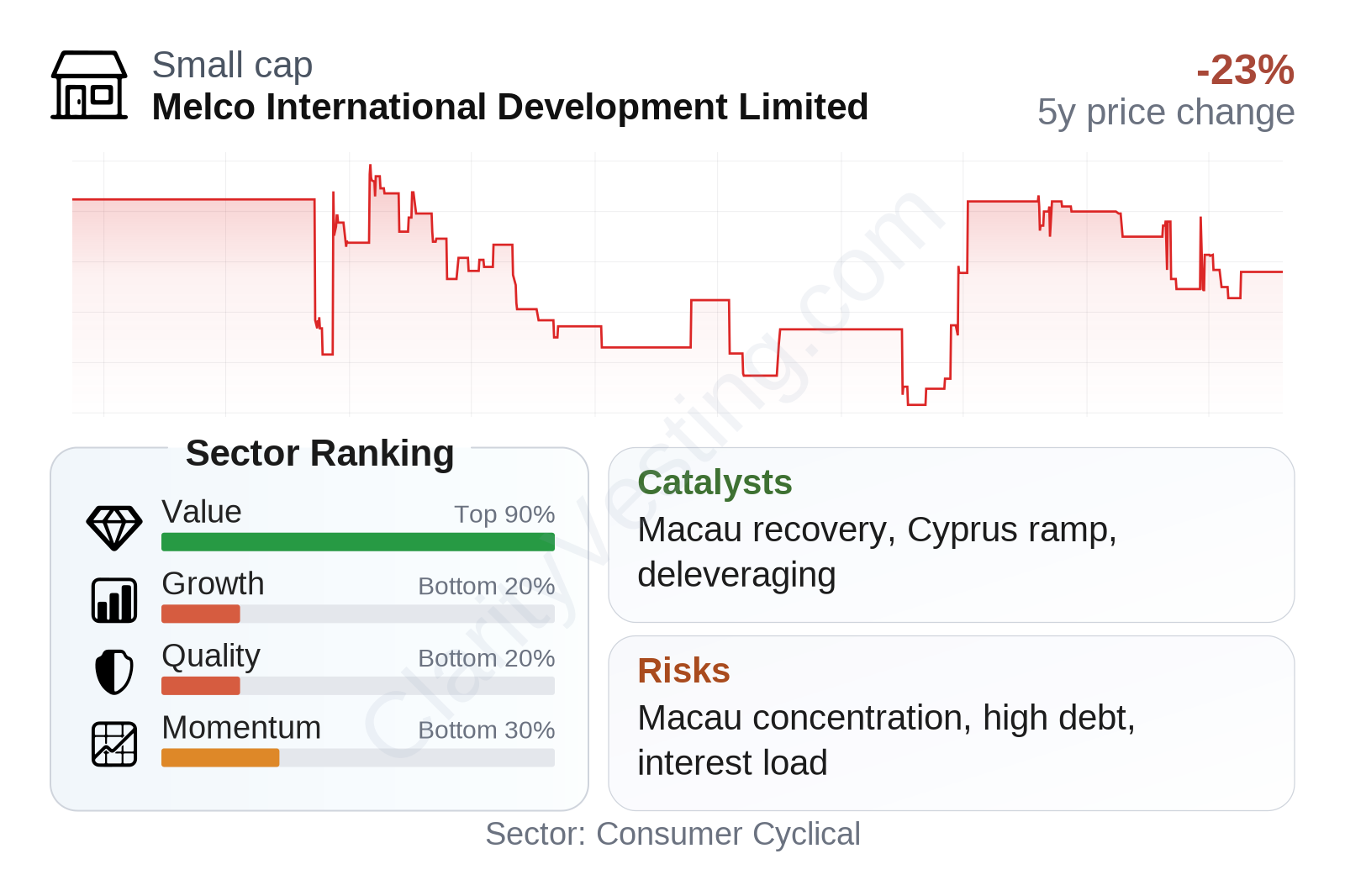
Melco sits in the small-cap range and has shown lower share-price volatility than the broader market based on beta. The valuation profile looks inexpensive on the surface: the earnings multiple is well below the sector median, the price-to-book ratio is also far lower, and free cash flow yield is unusually high. Those are the kinds of numbers that often appear when the market is discounting balance-sheet pressure, cyclical uncertainty, or doubts about how sustainable current profits are.
That caution is visible in the rest of the metrics. Growth ranks poorly versus the sector, with recent revenue growth modest and five-year per-share growth lagging most peers. Quality measures are also weak overall. Current operating margin is better than the sector median, showing that resort operations have recovered, but returns on assets remain low and leverage is elevated. Net debt relative to earnings is high, debt compared with assets is heavy, and interest coverage is thin for a cyclical business. Share-price momentum is also soft, with the stock down over the last six to twelve months even though the longer three-year record is less severe.
Growth
Melco operates in a sector that can grow over long periods, but not in a smooth way. Integrated resorts benefit from rising tourism, premium travel spending, convention activity, and the tendency of major casino destinations to concentrate entertainment, hospitality, and gaming in a few licensed operators. Macau remains one of the most important casino markets in the world, so any company with scaled exposure there has meaningful upside when visitation, hotel occupancy, and player spending recover.
Melco’s strategy broadly makes sense for future growth because it is focused on premium integrated resorts rather than on stand-alone casinos. That format creates more ways to monetize each visitor and can support stronger returns when travel demand is healthy. The group also has assets outside Macau, which provides at least some geographic diversification, even if Macau still dominates the investment case.
A notable catalyst is the continued normalization of Macau after the pandemic-era disruption. As visitation patterns improve and property utilization rises, fixed-cost absorption gets better, which can lift margins materially. Another positive factor is that the company has already shown a strong rebound in operating income since the trough period, suggesting that demand recovery can flow through meaningfully to earnings before financing costs.
There is also a project pipeline angle. Melco has continued to discuss development opportunities beyond its existing core portfolio, including progress tied to City of Dreams Mediterranean and other destination projects associated with its broader resort platform. If these assets ramp successfully, they can add non-Macau earnings streams over time and reduce concentration risk.
Still, growth is not purely about demand returning. For Melco, the more important question is whether improving operating performance can outpace financing costs and eventually strengthen the balance sheet. That is the bridge between cyclical recovery and durable long-term compounding.
Risks
This article is for informational purposes only and does not constitute financial advice. Some content is AI-generated. See Disclaimer