Stock Analysis · MongoDB (MDB)
Overview
MongoDB is a software company focused on databases, which are the systems businesses use to store, organize, and retrieve information. Its core product was built as a more flexible alternative to traditional relational databases, making it easier for developers to work with modern applications that handle varied and fast-changing data. Over time, MongoDB expanded from a self-managed database product into a broader developer data platform offered both as software and as a cloud service.
The business is increasingly centered on MongoDB Atlas, the company’s fully managed cloud database platform. Atlas runs on major public clouds and lets customers avoid managing infrastructure themselves. MongoDB also sells its Enterprise Advanced offering for customers that want more control, security, and support in self-managed environments, plus a smaller services line tied to consulting and training.
Based on recent company filings, MongoDB’s revenue mix is heavily weighted toward subscriptions, with services contributing only a small portion.
- Subscription revenue: about 95% to 96% of total revenue. This includes Atlas and Enterprise Advanced. Atlas is the largest piece and the main growth engine, while Enterprise Advanced covers self-managed commercial deployments.
- Services revenue: about 4% to 5% of total revenue. This mainly includes professional services such as consulting, onboarding, and training.
Within subscriptions, Atlas has become the dominant contributor. In recent years, it has represented roughly around 70% of total company revenue, according to management commentary and annual reporting trends, with the remainder of subscription revenue coming largely from Enterprise Advanced.
Financially, MongoDB combines high gross margins with heavy spending on research, product development, and sales. That profile is common among software firms still pushing for scale. Revenue has climbed from under $1 billion a few years ago to nearly $2.5 billion, while losses have narrowed substantially. The business model is therefore easier to understand today: recurring software revenue, strong cloud adoption, and improving cash generation, but profitability is still a work in progress.
The broad trend is encouraging: revenue and gross profit have risen steadily, and operating losses have narrowed sharply over the last several years. Research and development remains a major expense, showing that MongoDB is still investing aggressively to defend its technology and expand its platform.
Key Figures
| Metric | Value | Sector ⓘ |
|---|---|---|
| Date | Sep 12, 2026 | |
| Context | ||
| Sector | Technology | |
| Industry | Software - Infrastructure | |
| Market Cap ⓘ | $29.46B | |
| Beta ⓘ | 1.58 | |
Value (Cheapness) | ||
| P/E Ratio ⓘ | N/A | 29.51 |
| FCF Yield ⓘ | 2.26% | 4.25% |
| EBIT / EV ⓘ | 0.28% | 2.85% |
| PEG ⓘ | 1.67 | |
Growth (Business expansion) | ||
| Revenue Growth ⓘ | 30.50% | 15.40% |
| RPS Growth (5Y CAGR) ⓘ | 22.35% | 8.56% |
| EPS Growth (5Y CAGR) ⓘ | -45.88% | -11.88% |
| Margin Growth (5Y Trend) ⓘ | N/A | 0.46% |
| FCF Growth (5Y CAGR) ⓘ | N/A | 9.80% |
Quality (Business durability) | ||
| ROIC (Latest) ⓘ | 2.05% | 9.44% |
| ROIC (5Y Median) ⓘ | -5.89% | 8.30% |
| Net Debt / EBIT (Latest) ⓘ | -12.60 | 0.54 |
| Net Debt / EBIT (5Y Median) ⓘ | N/A | 0.44 |
| Operating Margin (Latest) ⓘ | 2.78% | 9.58% |
| Operating Margin (5Y Median) ⓘ | -9.18% | 8.25% |
| Debt to Equity (Latest) ⓘ | 0.96% | 33.33% |
| Profit Margin (Latest) ⓘ | 2.12% | 7.14% |
| Free Cash Flow (Latest) ⓘ | $667.34M | |
Momentum (Price trend) | ||
| 3Y Return ⓘ | -3.30% | +45.48% |
| 12M Return (excl. last month) ⓘ | +110.68% | +23.48% |
| 6M Return ⓘ | +38.95% | +20.93% |
| Price vs. 200-Day MA ⓘ | +5.58% | +7.43% |
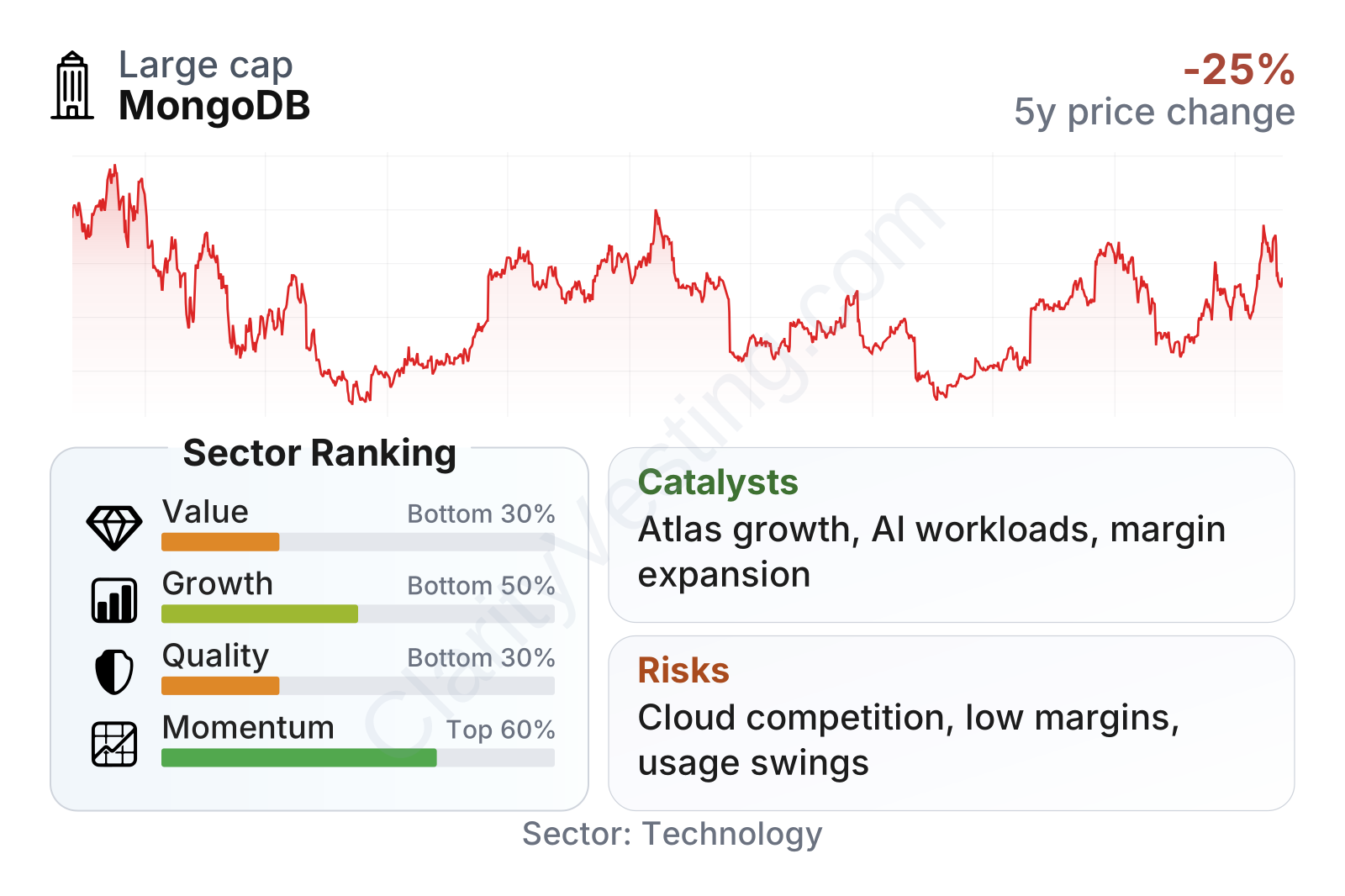
MongoDB is now a large software company, but its market behavior still looks more like a growth stock than a mature infrastructure business. Share-price swings have been significant over the last few years, reflecting changing expectations around cloud growth, profitability, and the broader software valuation environment.
The metrics table points to a mixed profile. Growth remains stronger than the sector median on revenue-based measures, especially over multi-year periods, while quality and value measures still lag many software peers. The balance sheet stands out positively: leverage is extremely low and net cash remains a meaningful strength. Momentum has improved recently, but the company is not yet showing the kind of profitability profile that would place it among the stronger-quality names in the sector.
Growth
MongoDB operates in a growing part of enterprise software. Data volumes continue to expand, more applications are being built in the cloud, and developers increasingly want tools that are flexible, scalable, and easier to deploy globally. These trends support demand for modern database platforms, especially managed services that reduce operational complexity.
MongoDB’s strategy is coherent for that environment. Atlas gives the company a recurring, usage-based cloud engine, while the broader platform approach helps it move beyond being just a single database product. The company has also been investing in capabilities tied to search, analytics, application development, and AI-related workloads. For customers, this can reduce the need to stitch together many separate tools. For MongoDB, it can increase retention and expand spending per customer over time.
Revenue growth has moderated from the very high levels seen earlier in the decade, but it remains solid. The latest pace is still around 30%, which is well above the sector median. That matters because it shows MongoDB is still taking share even after reaching multibillion-dollar annual revenue. The longer-term record is also strong, with revenue per share growth over five years far ahead of many software peers.
Cash generation has improved meaningfully. Free cash flow was negative or close to break-even a few years ago, then turned positive and has scaled rapidly, reaching well above $500 million on a trailing basis. That shift is important because it suggests the business is moving from “growth at any cost” toward a model where expansion increasingly produces real cash.
A major catalyst is the continued mix shift toward Atlas. Cloud-based consumption can be more scalable than traditional licensing and support contracts, and Atlas also benefits from broader enterprise migration to public cloud infrastructure. Another catalyst is AI adoption: modern applications often need database systems that can handle varied data structures and support rapid development cycles. MongoDB has been positioning its platform to serve these newer workloads, which could widen its relevance beyond its original use cases.
Recent company updates have also highlighted ongoing product expansion around developer tools and application data services. If MongoDB succeeds in becoming a broader platform rather than only a database vendor, that could support both faster customer expansion and stronger long-term retention.
Risks
This article is for informational purposes only and does not constitute financial advice. Some content is AI-generated. See Disclaimer


