Stock Analysis · Microchip Technology Inc (MCHP)
Stock Analysis · Microchip Technology Inc (MCHP)

Overview

Microchip Technology is a semiconductor company that designs and sells the small but essential chips used to control, sense, connect, and power electronic devices. Its products are often not the flashy “brains” found in high-end AI servers; instead, they are the dependable components that make cars, factory equipment, industrial systems, communications gear, and thousands of embedded devices work properly. This makes Microchip an important supplier in the broad market for embedded electronics.

The company’s business is built around microcontrollers, analog chips, connectivity products, and other specialized semiconductors. A key feature of Microchip’s model is product longevity: many customers keep using the same chip family for years because redesigning hardware is costly and time-consuming. That can support sticky customer relationships and a long tail of repeat demand.

Based on the company’s recent annual reporting structure, revenue is mainly generated from the following product groups, with microcontrollers clearly the largest contributor.

  • Microcontrollers: roughly half of revenue, around 50% to 55%
  • Analog products: about 25% to 30%
  • Other products such as FPGA, timing, connectivity, memory, and aerospace/defense-related solutions: about 15% to 20%
  • Licensing and miscellaneous: a small residual share

End-market exposure is also diversified. Industrial is typically the largest segment, followed by automotive, with communications, consumer, aerospace and defense, and computing making up the rest. That broad mix helps reduce dependence on any single device category, although it does not eliminate the industry’s normal ups and downs.

The recent financial flow also shows a business that still converts a large share of sales into gross profit, even after a downturn. Profitability, however, has compressed sharply from the peak cycle as lower revenue now has to absorb substantial research, operating, and interest costs.

Key Figures

MetricValueSector
DateJul 18, 2026
Context
SectorTechnology
IndustrySemiconductors
Market Cap $44.35B
Beta 1.73
Value
(Cheapness)
P/E Ratio 388.9531.76
FCF Yield 1.96%4.18%
EBIT / EV 1.36%2.56%
PEG 0.31
Growth
(Business expansion)
Revenue Growth 35.10%13.50%
RPS Growth (5Y CAGR) -8.09%8.57%
EPS Growth (5Y CAGR) -29.02%-21.87%
Margin Growth (5Y Trend) -10.24%0.41%
FCF Growth (5Y CAGR) -22.96%9.76%
Quality
(Business durability)
ROIC (Latest) 5.20%8.54%
ROIC (5Y Median) 18.06%8.12%
Net Debt / EBIT (Latest) 7.440.38
Net Debt / EBIT (5Y Median) 4.270.38
Operating Margin (Latest) 15.09%9.58%
Operating Margin (5Y Median) 25.33%8.25%
Debt to Equity (Latest) 86.05%33.52%
Profit Margin (Latest) 4.88%6.96%
Free Cash Flow (Latest) $871.00M
Momentum
(Price trend)
3Y Return -6.53%+30.91%
12M Return (excl. last month) +42.80%+28.90%
6M Return +9.93%+5.38%
Price vs. 200-Day MA +9.12%+7.61%
Better than sector median
Slightly worse than sector median
More than 20% worse than sector median

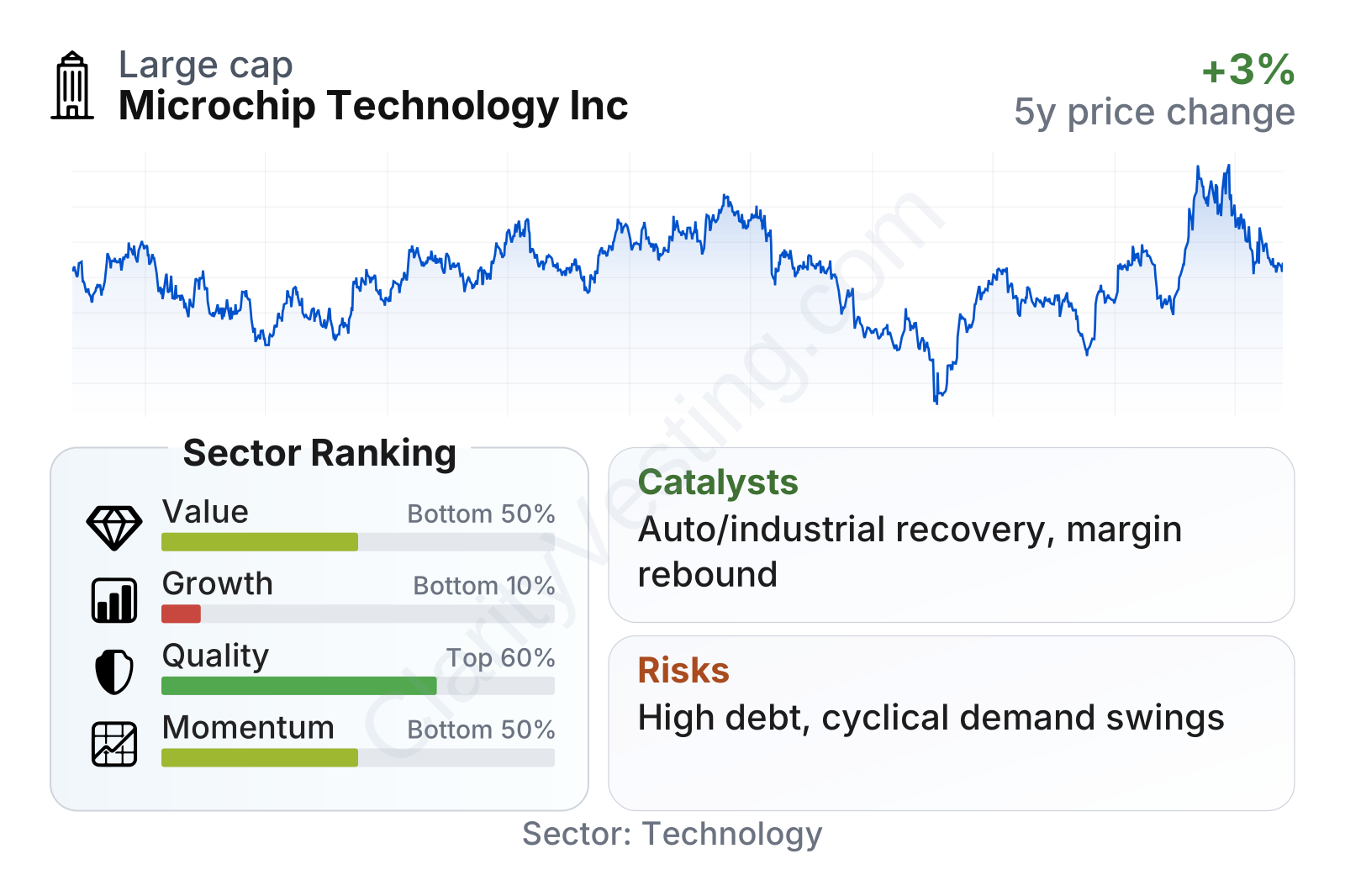
Microchip remains a large semiconductor company with a market value of roughly $54 billion, but its risk profile is not low. The stock has been volatile, which fits its beta above 1.7, meaning it has tended to move more than the broader market. The share price also reflects a classic cyclical pattern: a strong run into 2024, a sharp correction during the inventory downturn, and then a partial recovery.

The broader scorecard is mixed. Quality measures are still supported by a historically strong margin structure and solid long-term returns on invested capital, but current growth metrics look weak because recent years include a major slowdown. Value metrics appear unattractive on trailing earnings and cash flow, while price momentum has improved meaningfully over the last several months. In simple terms, the business has a respectable underlying franchise, but the recent financial picture is still in recovery mode rather than full strength.

Growth

Microchip operates in a sector with strong long-term demand drivers. Semiconductor content continues to rise in vehicles, factory automation, power management, connected devices, aerospace systems, and communications equipment. These are not short-lived themes. Over time, more products need sensors, controllers, connectivity, and efficient power handling, which directly supports the kinds of chips Microchip sells.

Its strategy also makes sense for that environment. Microchip focuses on embedded control and analog products, areas where customers often care more about reliability, qualification, software tools, and long-term supply than about owning the absolute fastest chip. That tends to create longer product cycles and higher switching costs than in some consumer-oriented chip categories. The company also emphasizes a broad catalog and close customer support, which can help it win designs across many industries.

The near-term growth story is more about recovery than explosive expansion. Revenue growth turned deeply negative during the inventory correction, when customers worked through excess stock after the post-pandemic semiconductor boom. More recently, year-over-year growth has swung back into positive territory, suggesting that the worst phase of the reset may be passing.

That rebound matters because it shows Microchip is not facing only a company-specific problem; it is also moving through a familiar semiconductor cycle. The latest trend points to improving demand comparisons, though the business is still well below its prior peak revenue and earnings levels.

Cash generation tells a similar story. Free cash flow was very strong at the top of the cycle, then fell sharply as revenue dropped and profitability compressed. It remains positive, which is important, but the current level is much lower than it was a few years ago.

A meaningful catalyst is any continued normalization in industrial and automotive demand, especially if customers move from inventory digestion back to new ordering. Another potential tailwind is the company’s exposure to aerospace and defense, data center connectivity, and power-management needs, all of which can support demand for specialized components. Recent company communications have also emphasized sequential improvement and efforts to align production with demand, which could help margins recover if the cycle continues to stabilize.

Risks

The main risk is cyclical exposure. Microchip’s products are tied to capital spending, manufacturing activity, vehicle production, and broader electronics demand. When customers cut orders or reduce inventories, revenue can fall quickly. That is exactly what happened in the recent downturn, and it hit earnings much harder than sales because fixed costs remained substantial.

Another major issue is leverage. Microchip has reduced debt over time, but debt levels remain high relative to much of the semiconductor sector. Debt to equity has improved significantly from the elevated levels seen several years ago, yet it is still far above the sector median.

This matters because higher leverage leaves less room for error during weak operating periods. Interest expense remains meaningful, and when profits are under pressure, debt can amplify the effect on net income and valuation.

Profitability is another point to watch. Microchip historically posted excellent margins, often better than many peers, but the recent cycle pushed net margin down dramatically and even briefly into negative territory before a modest rebound.

That margin pattern is important for long-term analysis. It suggests the company still has a strong business model at normal demand levels, but it also shows that earnings can be highly sensitive when utilization drops and customers pause purchases.

On competition, Microchip has real advantages but is not the overall leader across semiconductors. Its strengths include a broad installed base in microcontrollers and analog, long product life cycles, deep engineering relationships, and a large catalog of compatible tools and components. Those are useful competitive defenses. However, it operates against powerful rivals including Texas Instruments in analog and embedded processing, NXP Semiconductors in automotive and industrial, STMicroelectronics in microcontrollers and power, Infineon in automotive and industrial semiconductors, onsemi in automotive and power, and Renesas in microcontrollers and embedded systems.

Compared with those peers, Microchip is generally viewed as a strong niche-scale operator rather than the dominant industry standard-setter. It has historically delivered attractive operating margins and good design-win stickiness, but some competitors are larger, more diversified, or better positioned in faster-growing categories such as power semiconductors for electrification or premium automotive platforms.

There does not appear to be any major public scandal or reputation event overshadowing the company at this stage. The more relevant risk is execution through a difficult cycle: inventory correction, weaker utilization, pricing discipline, and debt management are the issues that deserve the most attention.

Valuation

Valuation is the hardest part of the Microchip story right now because the usual headline multiple gives a distorted picture. The trailing P/E is extremely high, not because the market is assigning a huge premium to a booming business, but largely because recent earnings were depressed. When profit falls sharply, the P/E ratio can become misleading.

Looking at the longer history, Microchip often traded at valuation levels that were not unusual for a quality semiconductor company. The recent spike in P/E mainly reflects the earnings trough rather than a dramatic re-rating of the business. That said, other measures still suggest the shares are not obviously cheap relative to current cash generation. Free cash flow yield is on the low side, and enterprise-value-based operating earnings metrics are weaker than the sector median.

There is also a split between short-term and medium-term valuation signals. On one hand, the stock has regained momentum as the market appears to be pricing in a recovery. On the other hand, current fundamentals still show a company earning well below its peak level, carrying above-average leverage, and generating less cash than it did during stronger years. In practical terms, the current price seems to already reflect a meaningful improvement scenario rather than a distressed view of the business.

That makes the valuation context less about whether Microchip is statistically cheap on recent earnings and more about whether a reader believes margins, revenue, and cash flow can move materially closer to prior cycle norms over time. The stock does not look inexpensive on present conditions, but it can look more understandable if one assumes the current period is still part of a rebound phase.

Conclusion

Microchip Technology stands out as a proven embedded semiconductor supplier with durable positions in microcontrollers, analog chips, and other specialized components that often stay designed into customer products for many years. That gives the company a more resilient business foundation than a simple reading of its recent earnings slump might suggest. The underlying end markets—industrial automation, automotive electronics, connectivity, and aerospace systems—remain attractive over the long run, and the recent return to positive revenue growth points to a business moving out of a difficult correction.

The challenge is that the recovery is still incomplete. Margins and free cash flow remain far below their prior highs, leverage is still elevated compared with most semiconductor peers, and the present valuation already assumes a healthier operating backdrop ahead. In that sense, Microchip currently looks more like a quality cyclical franchise in repair than a fully reset undervalued situation. The company’s long-term positioning is credible, but the financial profile still needs clearer normalization before the investment case appears truly compelling on fundamentals alone.

Sources:

  • Microchip Technology Inc. — Form 10-K for the fiscal year ended March 31, 2026
  • Microchip Technology Inc. — SEC EDGAR company filings
  • Microchip Technology Inc. Investor Relations — Earnings release for fiscal fourth quarter and full year 2026
  • Microchip Technology Inc. Investor Relations — Quarterly results presentations published in 2026
  • Wikipedia — Microchip Technology

This article is for informational purposes only and does not constitute financial advice. Some content is AI-generated. See Disclaimer


Sign up for exclusive research and insights.

Unsubscribe anytime.
