Stock Analysis · McDonalds Corporation (MCD)
Overview
McDonald’s is one of the world’s largest restaurant companies, operating and franchising quick-service restaurants centered on burgers, chicken, breakfast, coffee, snacks, and beverages. Its business is less about running every restaurant itself and more about owning a global brand, setting standards, supporting operators, and collecting franchise-related income. That model matters because franchised restaurants typically produce steadier and higher-margin revenue than company-operated locations.
The company’s revenue mainly comes from franchised restaurants, with a smaller share from stores it operates directly. Based on recent annual reporting, the mix is approximately:
- Franchised restaurants: about 60% to 65% of revenue. This includes rent, royalties based on restaurant sales, and initial fees paid by franchisees. Rent is especially important because McDonald’s often controls the real estate tied to restaurant locations.
- Company-operated restaurants: about 35% to 40% of revenue. This reflects direct restaurant sales from locations McDonald’s runs itself.
That revenue mix understates how important franchising is to profit. Company-operated stores generate more sales dollars, but they also carry food, labor, and occupancy costs. Franchise income tends to convert into profit much more efficiently. This helps explain why McDonald’s operating margin is far above most restaurant peers.
Geographically, McDonald’s is broadly diversified across the United States and international markets, with major contributions from large developed markets and a wide group of licensed and developmental markets. This global spread reduces dependence on any one economy, although it also exposes the company to currency swings and different consumer spending patterns.
The financial flow over the past few years shows a business that has expanded revenue gradually while keeping a very large share of each sales dollar as operating income. Profitability dipped in 2022, then recovered strongly in 2023 and stayed high through 2025, which is consistent with a franchise-heavy model and disciplined cost control.
Key Figures
| Metric | Value | Sector ⓘ |
|---|---|---|
| Date | Sep 12, 2026 | |
| Context | ||
| Sector | Consumer Cyclical | |
| Industry | Restaurants | |
| Market Cap ⓘ | $178.70B | |
| Beta ⓘ | 0.41 | |
Value (Cheapness) | ||
| P/E Ratio ⓘ | 20.53 | 17.10 |
| FCF Yield ⓘ | 4.34% | 8.53% |
| EBIT / EV ⓘ | 5.50% | 6.46% |
| PEG ⓘ | 2.18 | |
Growth (Business expansion) | ||
| Revenue Growth ⓘ | 3.70% | 5.75% |
| RPS Growth (5Y CAGR) ⓘ | 4.99% | 9.14% |
| EPS Growth (5Y CAGR) ⓘ | -12.99% | -18.21% |
| Margin Growth (5Y Trend) ⓘ | 2.00% | -0.23% |
| FCF Growth (5Y CAGR) ⓘ | 0.30% | 4.91% |
Quality (Business durability) | ||
| ROIC (Latest) ⓘ | 25.98% | 12.61% |
| ROIC (5Y Median) ⓘ | 26.94% | 10.72% |
| Net Debt / EBIT (Latest) ⓘ | 4.20 | 2.10 |
| Net Debt / EBIT (5Y Median) ⓘ | 4.33 | 2.32 |
| Operating Margin (Latest) ⓘ | 46.24% | 9.25% |
| Operating Margin (5Y Median) ⓘ | 45.72% | 9.64% |
| Debt to Equity (Latest) ⓘ | -5336.46% | 75.78% |
| Profit Margin (Latest) ⓘ | 31.72% | 5.33% |
| Free Cash Flow (Latest) ⓘ | $7.76B | |
Momentum (Price trend) | ||
| 3Y Return ⓘ | -3.28% | +14.53% |
| 12M Return (excl. last month) ⓘ | -6.39% | +3.08% |
| 6M Return ⓘ | -20.95% | +0.55% |
| Price vs. 200-Day MA ⓘ | -13.21% | -0.54% |
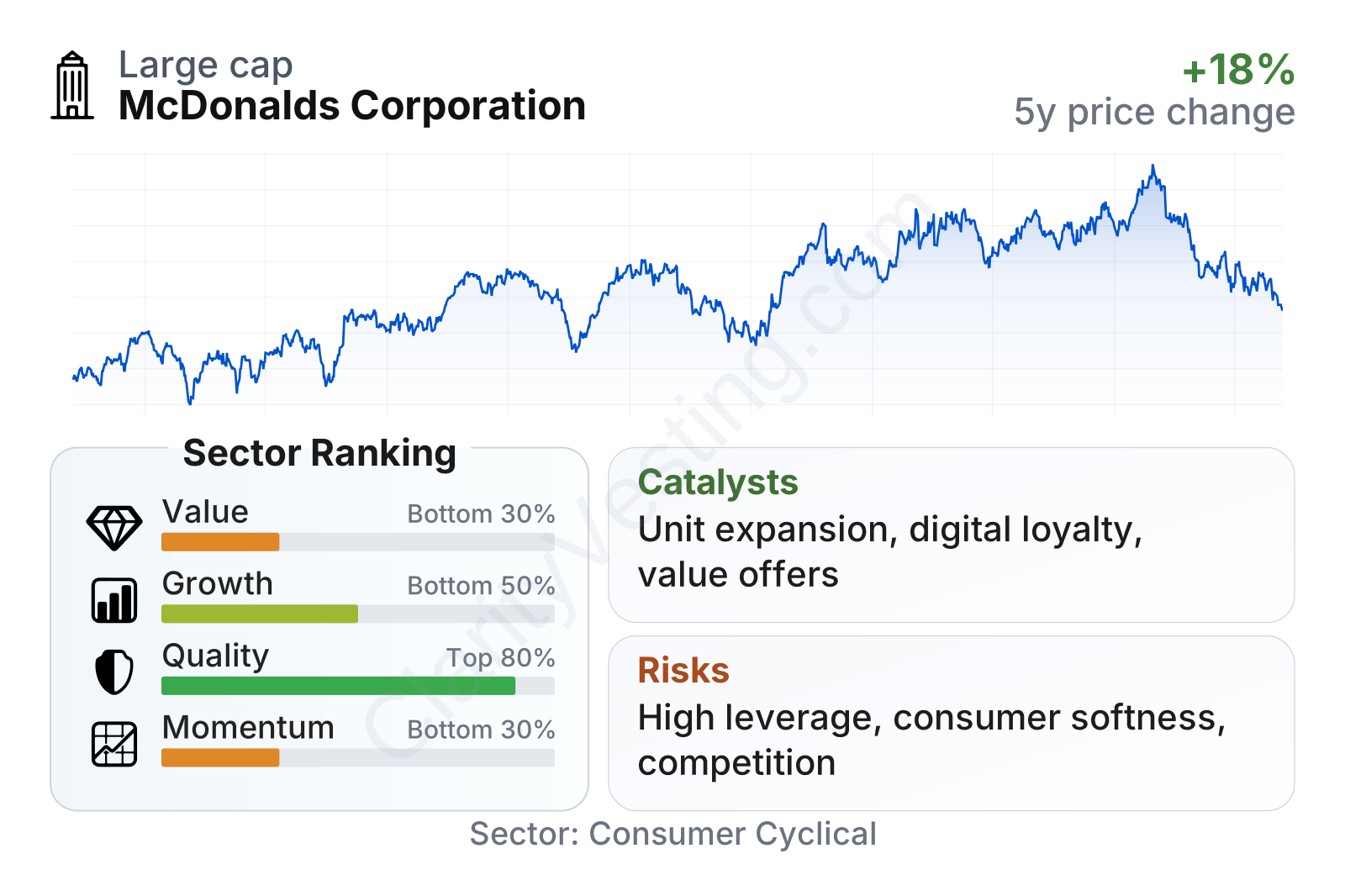
McDonald’s stands out more for business quality than for cheapness or rapid expansion. Profitability and returns on invested capital are well above the sector median, showing that the company converts revenue into earnings much better than most restaurant names. Growth is positive but not exceptional, and valuation metrics place it in the less attractive part of the sector on price-based measures. Price performance has also been softer than the broader restaurant group recently, while the stock’s low beta suggests lower day-to-day volatility than many consumer discretionary stocks.
Growth
Fast food remains a large and durable global category, though it is no longer a high-growth sector in developed markets. Growth tends to come from market share gains, menu innovation, digital ordering, delivery, loyalty programs, new unit expansion, and pricing. McDonald’s is well positioned on several of those drivers because of its scale, marketing reach, and global operating system.
Its strategy for future expansion is logical. Management has been focusing on restaurant development, digital engagement, value offerings, and operational consistency. Digital sales are important because app ordering, loyalty programs, and personalized promotions can increase visit frequency and improve customer retention. Unit expansion also matters: even a mature brand can grow steadily by opening more restaurants in underpenetrated markets and improving throughput at existing stores.
Revenue growth has been uneven quarter to quarter, which is typical for a mature global consumer brand facing inflation, currency effects, and changing traffic patterns. Even so, the recent picture still points to positive underlying expansion rather than contraction. The longer-term challenge is that McDonald’s is growing more slowly than the median company in its sector, so execution needs to remain strong for the business to keep compounding at an attractive pace.
Free cash flow is one of McDonald’s clearest strengths. The business has been producing roughly $7 billion to $8 billion in trailing twelve-month free cash flow, a strong result for a restaurant company. That cash generation supports dividends, share repurchases, debt service, and continued investment in restaurant modernization and technology.
A meaningful catalyst is the company’s continued restaurant expansion plan, especially internationally, combined with digital and loyalty growth. Another supportive factor is its ability to emphasize value while still using its scale to protect margins better than smaller chains. In a pressured consumer environment, that combination can help preserve traffic and reinforce brand relevance.
Recent company updates have also highlighted ongoing menu innovation, marketing campaigns, and value-focused initiatives. Those efforts may seem routine, but for a business at McDonald’s scale, small improvements in traffic, average check, or franchise economics can have a large effect on systemwide sales and royalty income.
Risks
This article is for informational purposes only and does not constitute financial advice. Some content is AI-generated. See Disclaimer


