Stock Analysis · Mobileye Global Inc (MBLY)
Overview
Mobileye Global is an automotive technology company focused on driver-assistance and autonomous driving systems. In simple terms, it builds the hardware and software that help cars see the road, understand what is happening around them, and react more safely. Its products are used in features such as automatic emergency braking, lane keeping, adaptive cruise control, hands-free driving, and, over time, more advanced self-driving capabilities. The company was founded in Israel, later acquired by Intel, and then returned to public markets while Intel remained the controlling shareholder.
Its business is centered on selling systems and software to automakers and their suppliers. Mobileye’s best-known product family is EyeQ, a specialized chip paired with computer vision software. The company also develops mapping technology through Road Experience Management, or REM, and more advanced platforms such as Mobileye Drive and Mobileye Chauffeur for higher levels of automated driving.
Based on company filings, Mobileye’s revenue is overwhelmingly generated by product sales to automotive customers, with a much smaller contribution from services and other items. A simple breakdown is:
- Product revenue: about 98% to 99% — mainly EyeQ system-on-chip solutions, software, and related advanced driver-assistance content shipped into vehicle programs.
- Services and other revenue: about 1% to 2% — includes development services, data-related activities, and smaller non-product items.
Within product revenue, the economic engine is still ADAS, meaning driver-assistance systems that are already being installed in large numbers of cars today. The more ambitious autonomous driving programs matter strategically, but they are not yet the main source of revenue.
One important operating pattern stands out over the last several years: Mobileye keeps gross profit relatively strong, but spends very heavily on research and development. That makes sense for a company trying to defend its lead in vision-based automotive intelligence, but it also explains why accounting profits have been weak or negative.
The long-term picture shows a business with meaningful revenue scale and strong gross profit generation, but with research spending regularly absorbing a very large share of that gross profit. In 2024 the income statement was hit especially hard, while 2025 showed some stabilization in revenue and expenses, though profitability remained negative.
Key Figures
| Metric | Value | Sector ⓘ |
|---|---|---|
| Date | Sep 12, 2026 | |
| Context | ||
| Sector | Consumer Cyclical | |
| Industry | Auto Parts | |
| Market Cap ⓘ | $7.01B | |
| Beta ⓘ | 1.21 | |
Value (Cheapness) | ||
| P/E Ratio ⓘ | N/A | 17.10 |
| FCF Yield ⓘ | 5.61% | 8.53% |
| EBIT / EV ⓘ | -66.98% | 6.46% |
| PEG ⓘ | 0.25 | |
Growth (Business expansion) | ||
| Revenue Growth ⓘ | 0.40% | 5.75% |
| RPS Growth (5Y CAGR) ⓘ | 7.56% | 9.14% |
| EPS Growth (5Y CAGR) ⓘ | -19.12% | -18.21% |
| Margin Growth (5Y Trend) ⓘ | N/A | -0.23% |
| FCF Growth (5Y CAGR) ⓘ | 3.49% | 4.91% |
Quality (Business durability) | ||
| ROIC (Latest) ⓘ | -29.47% | 12.61% |
| ROIC (5Y Median) ⓘ | -1.25% | 10.72% |
| Net Debt / EBIT (Latest) ⓘ | N/A | 2.10 |
| Net Debt / EBIT (5Y Median) ⓘ | N/A | 2.32 |
| Operating Margin (Latest) ⓘ | -206.55% | 9.25% |
| Operating Margin (5Y Median) ⓘ | -4.11% | 9.64% |
| Debt to Equity (Latest) ⓘ | N/A | 75.78% |
| Profit Margin (Latest) ⓘ | -201.49% | 5.33% |
| Free Cash Flow (Latest) ⓘ | $393.20M | |
Momentum (Price trend) | ||
| 3Y Return ⓘ | -76.73% | +14.53% |
| 12M Return (excl. last month) ⓘ | -36.92% | +3.08% |
| 6M Return ⓘ | +8.70% | +0.55% |
| Price vs. 200-Day MA ⓘ | -10.22% | -0.54% |
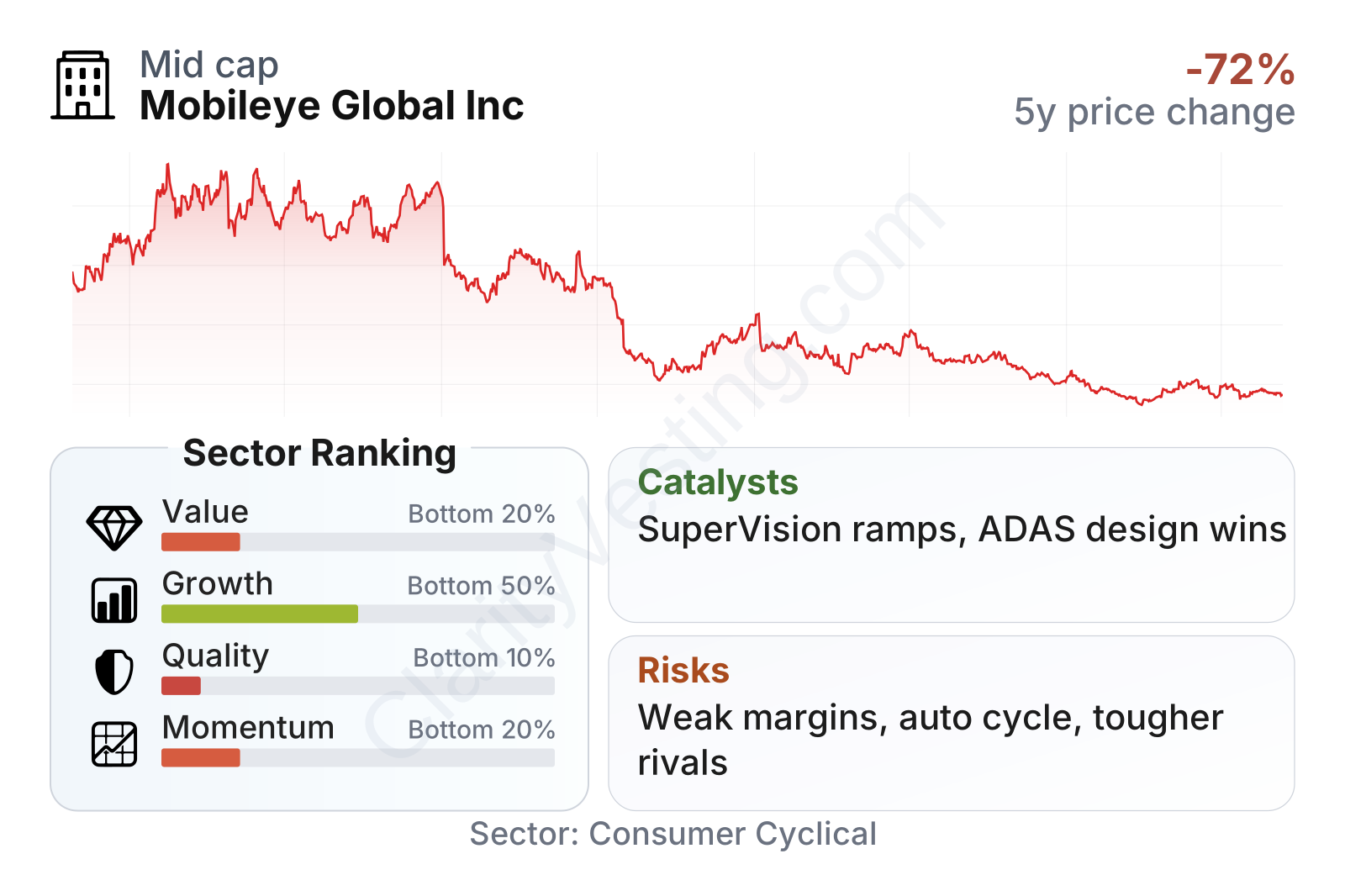
Mobileye currently looks mixed on headline metrics. On one hand, it has unusually strong free cash flow relative to its market value and an almost debt-free balance sheet. On the other hand, its quality, growth, and momentum rankings sit near the lower end of the sector because margins and returns on capital are deeply negative, recent revenue growth has been modest, and the stock has fallen sharply from earlier levels. This combination usually signals a company with valuable technology and financial flexibility, but also one still working through a difficult operating reset.
Growth
Mobileye operates in a sector with a credible long-term growth runway. Cars are steadily adding more sensing, computing, and safety software, and regulation in many regions continues to push automakers toward broader adoption of advanced driver-assistance features. Even before fully autonomous driving becomes mainstream, the content per vehicle can keep rising as more models move from basic safety packages to more capable systems.
For Mobileye, the strategic logic is clear. The company already has a large installed base in ADAS, and it is trying to use that position to move customers up the value chain toward more capable hands-free and eventually autonomous systems. That matters because more advanced systems can increase revenue per vehicle, deepen customer relationships, and make Mobileye harder to replace once a car platform is designed around its technology.
Recent growth has not been smooth. Revenue growth swung from strong expansion to a sharp contraction in 2024, then rebounded in 2025 and into early 2026 before flattening again. That pattern reflects the cyclicality of auto production, inventory corrections at customers, and the fact that vehicle programs do not ramp in a straight line. For long-term analysis, this means the addressable market is growing, but quarterly results can remain uneven.
There are still several meaningful catalysts. Mobileye continues to push SuperVision, Chauffeur, and Drive, which are aimed at more advanced automated driving use cases. If these programs scale across more vehicle launches, they could lift average content per vehicle well above traditional ADAS programs. The company also benefits from its mapping and data assets, because a larger installed base can improve the usefulness of its road intelligence platform over time.
Cash generation is an important counterweight to weak accounting earnings. Free cash flow has recovered strongly and recently moved to a level well above prior periods. That does not erase concerns around profitability, but it does show the business is not simply burning cash while it invests. For a company in a capital-light technology model, that flexibility can support product development even during a slower phase in automotive demand.
Recent company updates have also emphasized new design wins and continued engagement with global automakers. In this industry, design wins matter because they often convert into multi-year production revenue once a model enters the market. The delay between winning business and recognizing revenue can be long, but that also gives successful suppliers unusually long visibility once they are selected.
Risks
This article is for informational purposes only and does not constitute financial advice. Some content is AI-generated. See Disclaimer