Stock Analysis · MasterBrand Inc (MBC)
Overview
MasterBrand Inc. is a U.S. manufacturer of residential cabinets. Its products are used mainly in kitchens, bathrooms, and other parts of the home, and the company sells through dealers, retailers, builders, and distributors. Its brand portfolio spans stock, semi-custom, and premium cabinetry, which allows it to serve both new construction and remodeling demand across different price points.
The business is much more concentrated than many consumer companies: cabinetry is essentially the core activity. Based on company filings, revenue is generated primarily from North American residential cabinet sales, with the customer mix spread across several channels rather than several unrelated product categories.
- Dealer channel: approximately 35% to 40% of revenue. This includes independent kitchen and bath dealers and showroom-based sales, often with more design support and more customized projects.
- Retail channel: approximately 30% to 35% of revenue. This mainly includes large home center relationships and other retail partners selling cabinetry to homeowners and contractors.
- Builder channel: approximately 20% to 25% of revenue. This serves single-family and multi-family residential construction projects.
- Distribution and other: approximately 5% to 10% of revenue. This covers distributors and other smaller routes to market.
Recent operating trends show a business that has kept revenue relatively stable since the post-pandemic housing peak, but with much weaker earnings conversion. Revenue stayed in the roughly $2.7 billion range in 2023 through 2025, while operating income and net income fell sharply as selling costs and interest expense consumed a larger share of sales.
The multi-year profit flow highlights an important shift: sales have held up far better than earnings, but cost pressure and higher overhead have reduced what reaches the bottom line. That gap between stable revenue and shrinking profit is one of the central issues for the long-term case.
Key Figures
| Metric | Value | Sector ⓘ |
|---|---|---|
| Date | Sep 12, 2026 | |
| Context | ||
| Sector | Consumer Cyclical | |
| Industry | Furnishings, Fixtures & Appliances | |
| Market Cap ⓘ | $1.51B | |
| Beta ⓘ | 1.43 | |
Value (Cheapness) | ||
| P/E Ratio ⓘ | N/A | 17.10 |
| FCF Yield ⓘ | 4.92% | 8.53% |
| EBIT / EV ⓘ | -1.01% | 6.46% |
| PEG ⓘ | N/A | |
Growth (Business expansion) | ||
| Revenue Growth ⓘ | 11.50% | 5.75% |
| RPS Growth (5Y CAGR) ⓘ | -1.30% | 9.14% |
| EPS Growth (5Y CAGR) ⓘ | -53.33% | -18.21% |
| Margin Growth (5Y Trend) ⓘ | -3.94% | -0.23% |
| FCF Growth (5Y CAGR) ⓘ | 5.02% | 4.91% |
Quality (Business durability) | ||
| ROIC (Latest) ⓘ | -0.90% | 12.61% |
| ROIC (5Y Median) ⓘ | 8.84% | 10.72% |
| Net Debt / EBIT (Latest) ⓘ | 17.30 | 2.10 |
| Net Debt / EBIT (5Y Median) ⓘ | 3.97 | 2.32 |
| Operating Margin (Latest) ⓘ | -1.07% | 9.25% |
| Operating Margin (5Y Median) ⓘ | 8.35% | 9.64% |
| Debt to Equity (Latest) ⓘ | 85.83% | 75.78% |
| Profit Margin (Latest) ⓘ | -3.49% | 5.33% |
| Free Cash Flow (Latest) ⓘ | $74.40M | |
Momentum (Price trend) | ||
| 3Y Return ⓘ | -38.65% | +14.53% |
| 12M Return (excl. last month) ⓘ | -26.14% | +3.08% |
| 6M Return ⓘ | -8.04% | +0.55% |
| Price vs. 200-Day MA ⓘ | -22.98% | -0.54% |
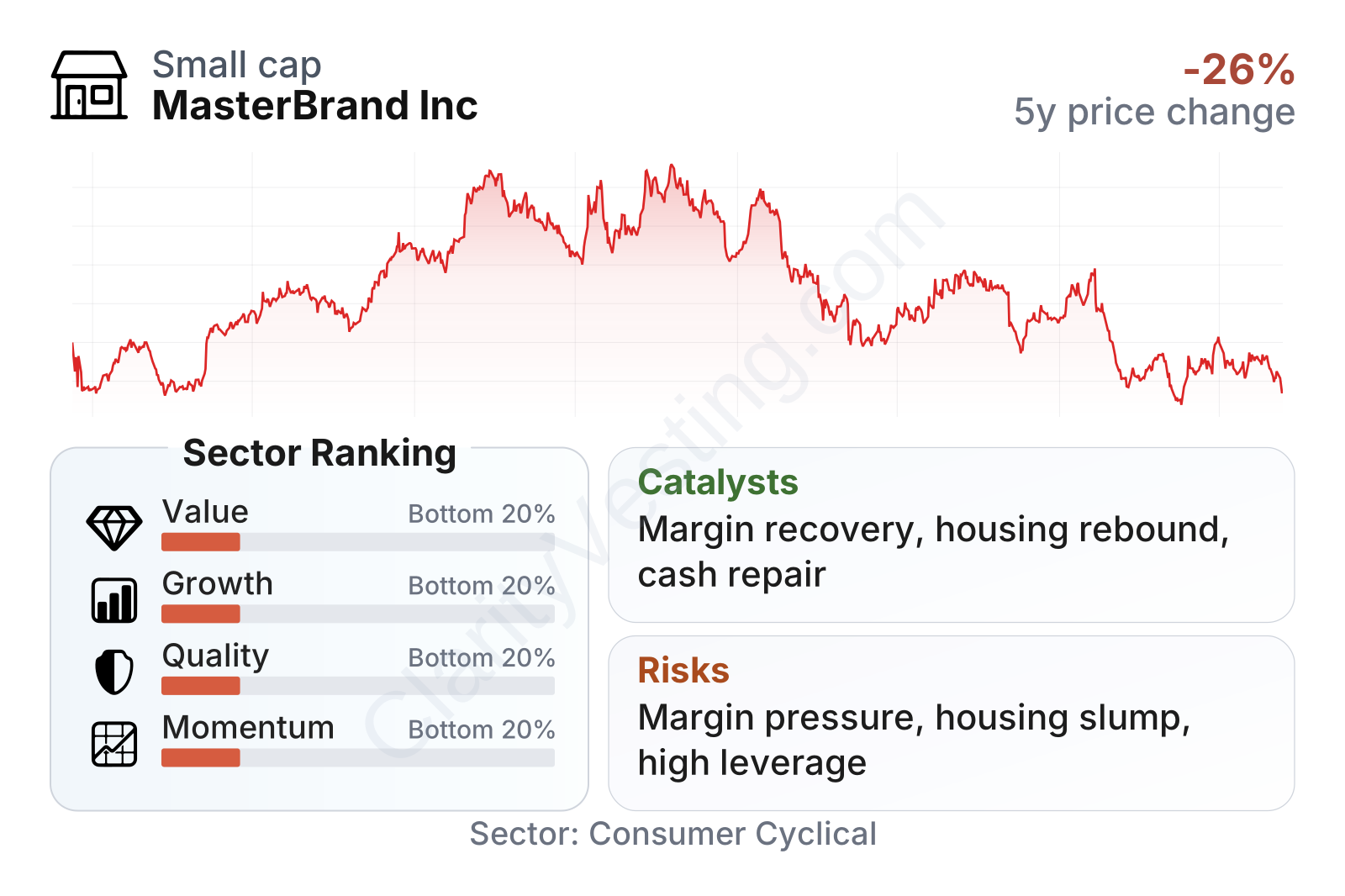
MasterBrand is a mid-sized company within a large consumer cyclical sector, and the current factor profile is weak relative to peers. Value, growth, quality, and momentum all rank in the lower part of the sector. The most notable positives are a return to year-over-year revenue growth and still-positive free cash flow, but these are offset by negative recent profitability, high leverage relative to earnings, and weaker share-price performance than the sector median.
The stock history shows how quickly sentiment has changed. Shares climbed strongly through 2024, then fell sharply into 2026 as margins deteriorated and earnings lost traction. That pattern usually signals that the market is no longer focused on the company’s sales base alone and is demanding evidence that profit recovery is achievable.
Growth
MasterBrand operates in a sector tied closely to housing turnover, repair and remodel spending, household formation, and new home construction. Over the long run, residential remodeling tends to be a durable category because kitchens and bathrooms are high-value projects that homeowners eventually undertake even when timing shifts. That gives the company exposure to a market with long-term relevance, but not one that grows in a straight line.
The strategic logic is understandable. MasterBrand has scale in a fragmented cabinetry market, a broad set of brands, and distribution across dealers, retail partners, and builders. That mix can help it capture demand in different parts of the cycle. The company has also emphasized operational initiatives, category management, and product mix improvement, which matter in cabinetry because small gains in sourcing, manufacturing efficiency, and pricing can meaningfully affect margins.
Recent revenue momentum is somewhat better than the longer-term picture suggests. After a difficult stretch of declining year-over-year sales in 2023 and parts of 2024, growth turned positive in several later periods, with the latest reading running above the sector median. That improvement matters because it suggests the business still has customer relevance and channel reach even in a pressured housing environment. The issue is that sales recovery has not yet translated into healthy earnings.
Free cash flow remains an important support for the long-term case, although it has weakened materially from earlier levels. The company is still generating cash on a trailing basis, but the drop from much stronger levels in 2023 and 2024 shows that operating pressure is real. A meaningful catalyst would be any recovery in free cash flow conversion alongside steadier volumes, because that would improve financial flexibility without requiring rapid top-line growth.
One notable opportunity is the eventual normalization of the U.S. housing and renovation cycle. If mortgage conditions become less restrictive over time, remodeling activity and builder demand could improve. For MasterBrand specifically, margin repair is likely a bigger catalyst than raw revenue growth: the company does not need an exceptional boom to improve its profile, but it does need better execution and cost discipline so that a larger share of revenue becomes profit again.
Recent company communications have also pointed to transformation efforts and portfolio actions intended to sharpen the operating model. For a cabinet manufacturer, this can be significant because simplification, plant efficiency, and channel mix can create tangible earnings improvement even when the broader market remains only moderate.
Risks
This article is for informational purposes only and does not constitute financial advice. Some content is AI-generated. See Disclaimer


