Stock Analysis · Mattel Inc (MAT)
Overview
Mattel is one of the largest toy companies in the world. It designs, manufactures, markets, and licenses toys, games, and family entertainment content. Its best-known brands include Barbie, Hot Wheels, Fisher-Price, American Girl, Thomas & Friends, UNO, and MEGA. In recent years, Mattel has been trying to evolve from a traditional toy maker into a broader intellectual property company, meaning it wants to earn more from movies, TV content, digital games, consumer products, and licensing built around its brands.
The business still depends mainly on selling physical toys, but its brand portfolio is wide and globally distributed. Based on recent annual disclosures, revenue is primarily split between North America and international markets, with North America representing a little more than 50% of sales and international markets making up a little less than 50%. Product-wise, the largest categories are dolls, vehicles, infant/toddler/preschool, action figures and building sets, games, and specialty products.
A practical way to think about Mattel’s revenue base is the following:
- North America toy sales: approximately 55% of revenue. This includes major retail and e-commerce sales in the United States and Canada across brands such as Barbie, Hot Wheels, Fisher-Price, and UNO.
- International toy sales: approximately 45% of revenue. This covers Europe, Latin America, and Asia-Pacific markets, giving Mattel broad geographic reach but also exposure to currency swings and regional consumer demand.
- By product category, the largest contributors are typically:
- Dolls: approximately 25% to 30%, led by Barbie and Disney-related dolls where applicable.
- Vehicles: approximately 20% to 25%, largely driven by Hot Wheels.
- Infant, toddler, and preschool: approximately 15% to 20%, including Fisher-Price and Thomas & Friends products.
- Action figures, building sets, games, and other categories: together approximately 25% to 35%, including MEGA, UNO, and licensed items.
- Licensing and entertainment-related income: still a small share of total revenue, but strategically important because it can carry higher margins and extend brands beyond the toy aisle.
Mattel’s revenue base has been relatively stable over the last several years, staying around the mid-$5 billion range, while profitability has moved more than sales. That matters because the company’s long-term thesis depends less on rapid top-line expansion and more on making its brands more productive across toys, media, and licensing.
The overall picture is a business with steady gross profit generation but uneven earnings conversion. Revenue has stayed fairly consistent, while operating income and net income have moved up and down more noticeably. That suggests the key variable is not only demand, but also cost control, marketing efficiency, and how successfully Mattel turns brand strength into higher-margin revenue.
Key Figures
| Metric | Value | Sector ⓘ |
|---|---|---|
| Date | Sep 12, 2026 | |
| Context | ||
| Sector | Consumer Cyclical | |
| Industry | Leisure | |
| Market Cap ⓘ | $4.00B | |
| Beta ⓘ | 0.73 | |
Value (Cheapness) | ||
| P/E Ratio ⓘ | 10.46 | 17.10 |
| FCF Yield ⓘ | 15.65% | 8.53% |
| EBIT / EV ⓘ | 9.99% | 6.46% |
| PEG ⓘ | 0.95 | |
Growth (Business expansion) | ||
| Revenue Growth ⓘ | 10.50% | 5.75% |
| RPS Growth (5Y CAGR) ⓘ | 2.41% | 9.14% |
| EPS Growth (5Y CAGR) ⓘ | N/A | -18.21% |
| Margin Growth (5Y Trend) ⓘ | -1.94% | -0.23% |
| FCF Growth (5Y CAGR) ⓘ | 5.33% | 4.91% |
Quality (Business durability) | ||
| ROIC (Latest) ⓘ | 12.65% | 12.61% |
| ROIC (5Y Median) ⓘ | 13.67% | 10.72% |
| Net Debt / EBIT (Latest) ⓘ | 3.61 | 2.10 |
| Net Debt / EBIT (5Y Median) ⓘ | 2.50 | 2.32 |
| Operating Margin (Latest) ⓘ | 11.23% | 9.25% |
| Operating Margin (5Y Median) ⓘ | 11.72% | 9.64% |
| Debt to Equity (Latest) ⓘ | 137.45% | 75.78% |
| Profit Margin (Latest) ⓘ | 7.79% | 5.33% |
| Free Cash Flow (Latest) ⓘ | $626.49M | |
Momentum (Price trend) | ||
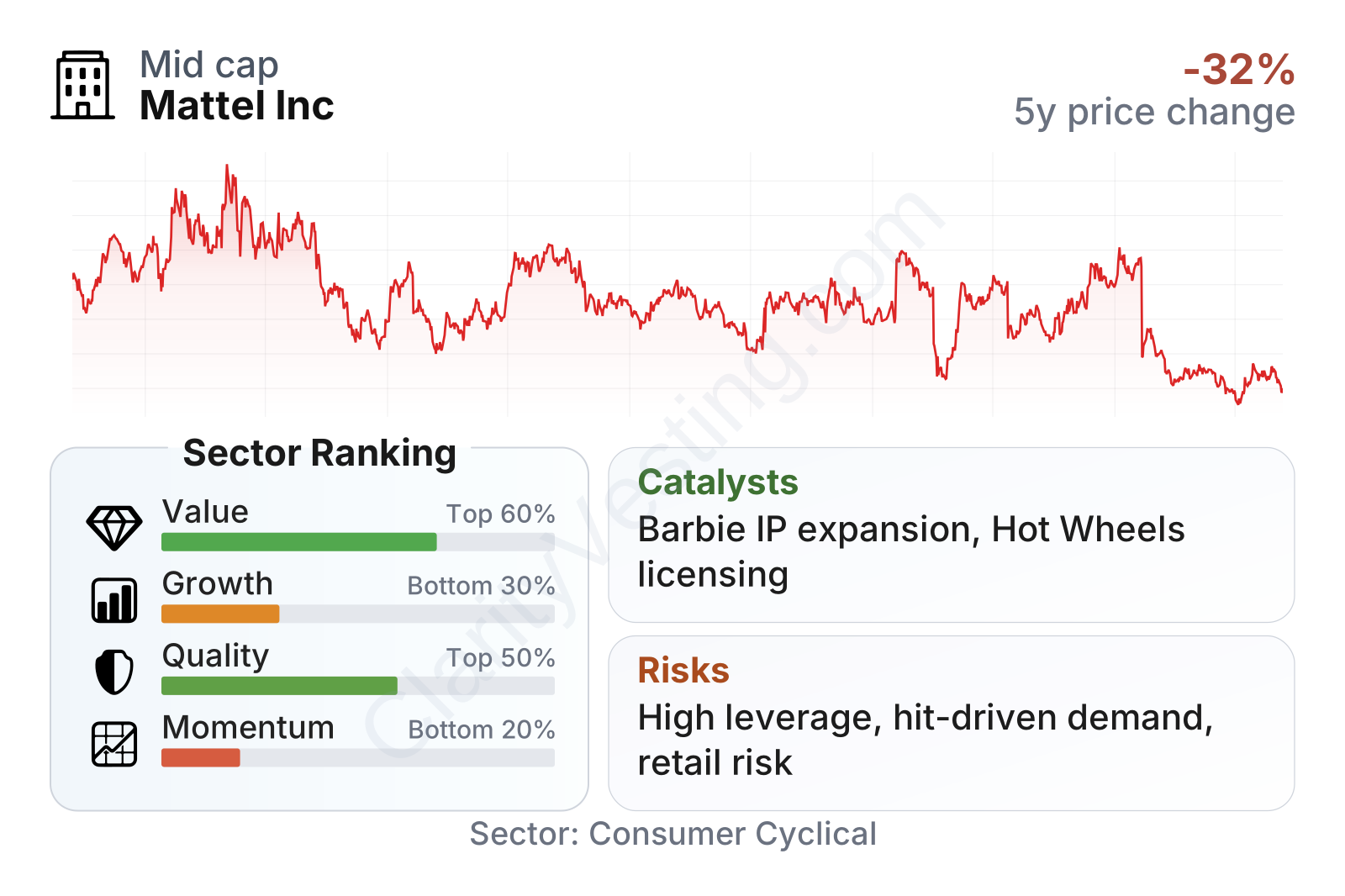
| 3Y Return ⓘ | -34.72% | +14.53% |
| 12M Return (excl. last month) ⓘ | -18.34% | +3.08% |
| 6M Return ⓘ | -13.63% | +0.55% |
| Price vs. 200-Day MA ⓘ | -14.73% | -0.54% |
Mattel sits in the mid-cap range and has shown lower share-price volatility than many consumer discretionary names, with a beta below 1. On valuation, several measures look cheaper than the sector median, including earnings multiple and cash-flow-based metrics. Profitability is respectable, with return on invested capital and operating margin above sector medians, but growth and market momentum are weaker. In short, the company currently looks more like a cash-generating branded business than a fast-growing consumer name.
Growth
The global toy industry is not a high-growth market in the same way as software or semiconductors, but it is large, resilient, and supported by recurring demand from new generations of children and collectors. Growth tends to come from brand power, licensing, entertainment tie-ins, digital expansion, and international reach rather than pure industry tailwinds. That makes Mattel’s strategy logical: use iconic brands to generate revenue across toys, content, partnerships, and experiences.
One of the clearest long-term opportunities is Mattel’s push to become an intellectual property platform. The strong cultural visibility created by Barbie showed that a toy brand can reach far beyond product shelves. If Mattel can repeat even a portion of that success across other franchises such as Hot Wheels, UNO, Polly Pocket, Masters of the Universe, or Fisher-Price-related properties, it could expand licensing income, support toy demand, and improve margins over time.
Revenue growth has been inconsistent. There were periods of contraction followed by recovery, and more recent year-over-year growth has turned positive again, landing around 10% in the latest reading. That is better than the sector median in the near term, but the longer five-year revenue-per-share trend remains modest, which shows that Mattel has not yet established a strong multi-year expansion pattern.
Free cash flow remains one of the more encouraging elements. Even though it has pulled back from a very strong peak, Mattel still produces meaningful cash, and its five-year cash-flow growth trend is slightly ahead of the sector median. For a mature branded company, that matters because cash generation supports debt management, brand investment, and the ability to fund entertainment and licensing initiatives without relying too heavily on external capital.
Recent company updates have continued to emphasize cost savings, supply chain discipline, and franchise management. Those are not flashy catalysts, but they are important in a category where holiday timing, retail inventory, and input costs can distort short-term results. A more significant opportunity would come from successful execution of Mattel’s multi-brand entertainment pipeline and the continued expansion of digital gaming and licensing partnerships.
Risks
This article is for informational purposes only and does not constitute financial advice. Some content is AI-generated. See Disclaimer