Stock Analysis · Lumen Technologies Inc (LUMN)
Overview
Lumen Technologies is a telecom and network infrastructure company. It operates a large fiber network across North America and international routes, and it sells connectivity, data transport, security, voice, cloud-related networking, and infrastructure services to businesses, government agencies, and wholesale customers. In simple terms, Lumen helps organizations move large amounts of data reliably between offices, data centers, cloud platforms, and end users.
The business today is centered much more on enterprise networking than on the traditional phone-company image that still follows the name. Lumen has been shrinking or exiting slower-growth legacy activities while trying to focus on fiber, enterprise connectivity, and services tied to AI-related data traffic. That shift matters because the company serves the “picks and shovels” layer of digital infrastructure: the physical network capacity that large customers need before cloud, cybersecurity, or AI applications can work at scale.
Its revenue is mainly generated from service categories rather than one single product line. Based on recent annual reporting structure, the mix is broadly concentrated in business connectivity and enterprise platform services, with consumer and legacy voice making up a smaller and declining portion.
- Business and enterprise network services: roughly the largest share, around half of revenue or more, including fiber connectivity, IP, VPN, data transport, and related services for large organizations.
- Mass Markets / consumer broadband and voice: a meaningful but smaller share, generally around one-fifth to one-quarter, with legacy voice declining faster than broadband.
- Wholesale and indirect channels: a notable share, often around one-fifth, providing network capacity and communications services to other carriers and partners.
- Other legacy and ancillary services: a smaller remainder, including older products being phased down over time.
The broad pattern is clear even if exact percentages move around: legacy services continue to contract, while the strategic focus is on enterprise fiber, higher-capacity connectivity, and long-duration infrastructure contracts.
Note on the business model: recent annual numbers show a company with lower revenue than a few years ago, but still substantial gross profit. The bigger issue has not been the ability to generate sales at all; it has been the pressure from declining legacy lines, restructuring costs, and the heavy burden of operating and financing a very large network.
The long-term flow of the business shows a striking change: revenue has fallen materially from the 2021 level, gross profit has also narrowed, and operating results have swung from strong profitability to losses and partial recovery, then back into losses. Interest expense remains large throughout, which underlines how important debt and capital structure are in understanding Lumen.
Key Figures
| Metric | Value | Sector ⓘ |
|---|---|---|
| Date | Jul 18, 2026 | |
| Context | ||
| Sector | Communication Services | |
| Industry | Telecom Services | |
| Market Cap ⓘ | $6.47B | |
| Beta ⓘ | 1.77 | |
Value (Cheapness) | ||
| P/E Ratio ⓘ | N/A | 19.52 |
| FCF Yield ⓘ | 6.91% | 12.73% |
| EBIT / EV ⓘ | -6.25% | 4.37% |
| PEG ⓘ | 54.58 | |
Growth (Business expansion) | ||
| Revenue Growth ⓘ | -8.90% | 6.10% |
| RPS Growth (5Y CAGR) ⓘ | -9.33% | 5.02% |
| EPS Growth (5Y CAGR) ⓘ | N/A | -26.68% |
| Margin Growth (5Y Trend) ⓘ | -32.58% | 0.79% |
| FCF Growth (5Y CAGR) ⓘ | -43.35% | 5.18% |
Quality (Business durability) | ||
| ROIC (Latest) ⓘ | -10.69% | 8.74% |
| ROIC (5Y Median) ⓘ | 0.74% | 8.07% |
| Net Debt / EBIT (Latest) ⓘ | N/A | 2.09 |
| Net Debt / EBIT (5Y Median) ⓘ | 15.09 | 3.02 |
| Operating Margin (Latest) ⓘ | -9.34% | 15.46% |
| Operating Margin (5Y Median) ⓘ | 1.95% | 13.17% |
| Debt to Equity (Latest) ⓘ | 113.84% | 59.09% |
| Profit Margin (Latest) ⓘ | -14.34% | 9.11% |
| Free Cash Flow (Latest) ⓘ | $447.00M | |
Momentum (Price trend) | ||
| 3Y Return ⓘ | +287.65% | +36.38% |
| 12M Return (excl. last month) ⓘ | +102.50% | +8.16% |
| 6M Return ⓘ | -27.40% | +2.31% |
| Price vs. 200-Day MA ⓘ | -22.31% | +1.57% |
Lumen’s market value is in the mid-single-digit billions, which makes it a meaningful public telecom operator but much smaller than the largest U.S. telecom and cable groups. The stock has also been volatile, with a beta well above 1, reflecting that the market treats Lumen as a turnaround and execution-sensitive name rather than a stable utility-like telecom.
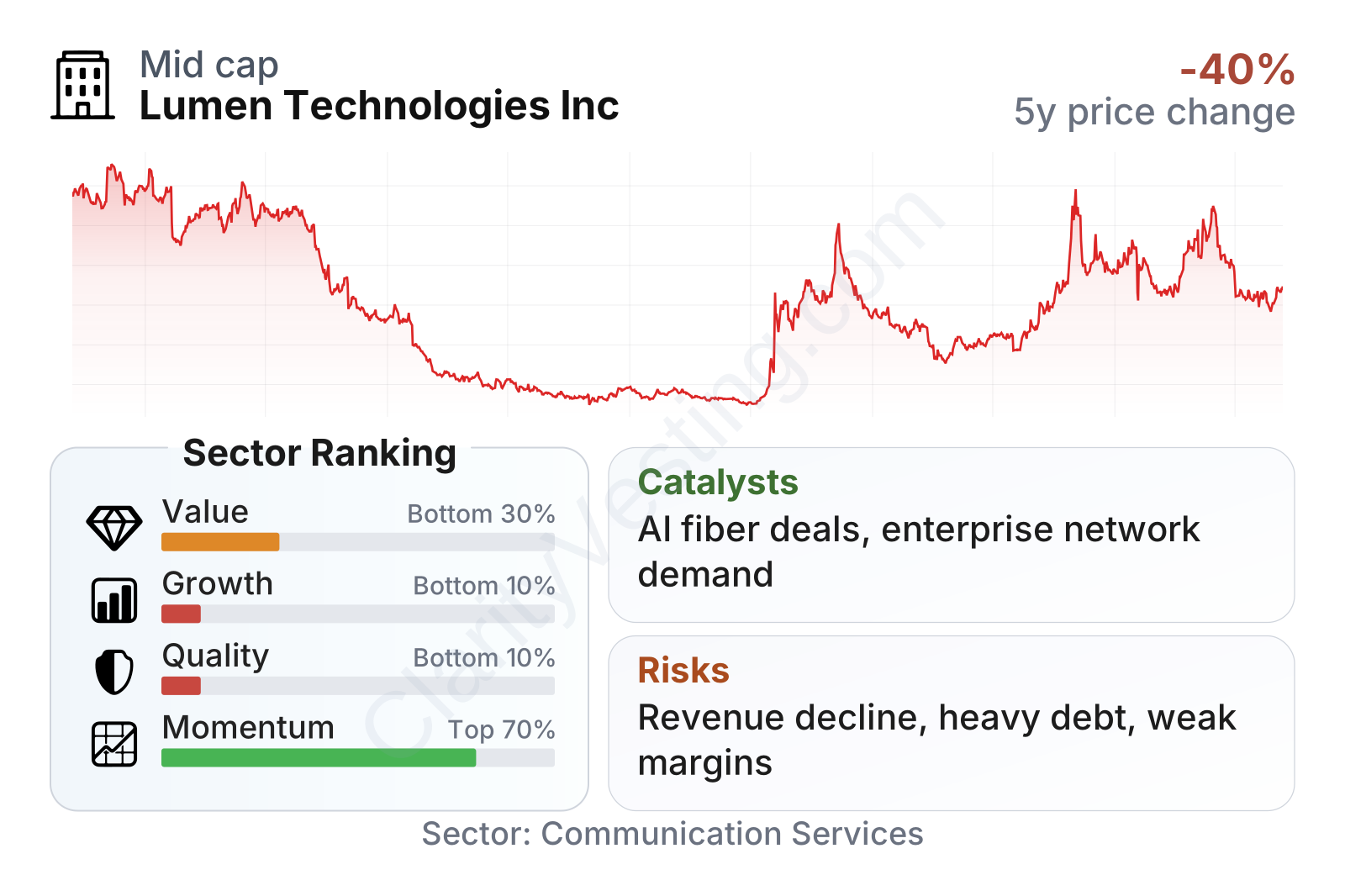
The factor snapshot is weak on value, growth, and quality relative to the broader communication services sector, while momentum stands out as much stronger. That combination usually means the share price has rebounded sharply, but the operating fundamentals have not yet fully caught up. Free cash flow is still positive on a trailing basis, which is important, yet margins, returns on capital, and leverage metrics remain notably weaker than sector norms.
Growth
Lumen operates in a sector that still has long-term relevance. Demand for bandwidth, fiber connections, cloud connectivity, edge computing, cybersecurity support, and AI-related data traffic continues to grow. The attractive part of the market is not traditional landline telecom; it is high-capacity digital infrastructure. On that point, Lumen’s strategic direction makes sense. The company has been emphasizing its fiber network, enterprise relationships, and the ability to connect major data centers and cloud environments.
The challenge is that the company is trying to grow in the right places while much of the legacy base is still shrinking. That has kept total revenue in decline even though the strategic narrative has improved. Recent year-over-year sales trends remain negative, and the longer five-year trend is weaker than the sector median by a wide margin.
The revenue trend suggests that Lumen is still in the middle of a transition rather than at the end of it. The pace of decline has improved from the worst periods, but the business has not yet reached a stable overall growth profile. For a long-term case to strengthen, newer fiber and enterprise wins would need to offset the decline in older services more consistently.
One of the more encouraging signs is that free cash flow has stayed positive again after a very weak 2024 period. That does not remove the risks, but it shows the network can still produce cash despite pressure on accounting earnings.
Free cash flow has been uneven, falling sharply from earlier levels, turning negative for a period, and then recovering before easing again. That pattern fits a business in restructuring mode: still capable of generating cash, but not yet demonstrating a smooth and durable upward path.
The most important growth catalyst in the current setup is Lumen’s push into private connectivity for AI and cloud infrastructure. The company has highlighted major enterprise and hyperscaler-related fiber opportunities, especially for high-capacity links needed by data centers and AI workloads. If those contracts scale from announcements into recurring revenue at meaningful margins, Lumen could become more relevant as a backbone provider for the next phase of data traffic growth.
Another positive element is that telecom infrastructure has high replacement cost. Building dense long-haul and metro fiber networks from scratch is expensive and slow. That does not guarantee growth, but it gives Lumen an asset base that can become more valuable if industry demand for secure, high-bandwidth routes continues to rise.
Risks
The main risk is that Lumen is still a turnaround with a heavy financial burden. Revenue has been declining for years, profitability remains weak, and debt levels are elevated compared with the sector. Even after some improvement from extreme readings, leverage remains a central issue because telecom networks require ongoing capital spending and interest costs absorb a large part of the operating output.
Leverage has been volatile and, even after normalizing from unusual balance-sheet readings, still sits above the sector median. That matters because a capital-intensive company with shrinking legacy revenue has less room for execution mistakes. Debt does not just affect solvency headlines; it can limit strategic flexibility, refinancing options, and the pace of network investment.
Margins show the same tension. Lumen was profitable on a net basis in earlier periods, then suffered very large losses, partially recovered, and has slipped back into negative territory. Current profit margin remains well below the sector norm. This suggests that even if the strategic repositioning has merit, the economic benefit has not yet become reliable in reported results.
Competition is another major risk. Lumen is not the overall leader in U.S. telecom services. It competes against much larger and financially stronger players such as AT&T and Verizon in enterprise networking, against Comcast Business and Charter in business connectivity, against wholesale fiber specialists like Zayo in certain routes, and against cloud providers and network specialists in adjacent infrastructure services. Many of these rivals have stronger balance sheets, larger customer ecosystems, or better scale in targeted segments.
That said, Lumen does have some competitive advantages. Its large installed fiber footprint, long-haul routes, enterprise customer relationships, and role in connecting data centers provide a real infrastructure base that is difficult to replicate quickly. The company is not the category leader overall, but it does have strategic network assets in areas where physical reach matters more than branding.
A further risk is execution credibility. When a company has declining revenue, uneven cash generation, and repeated restructuring efforts, the market tends to demand proof rather than promises. Lumen therefore faces a higher bar than healthier telecom peers: it must show that announced network opportunities turn into sustained contracts, stable margins, and better balance-sheet support.
There has been no single headline scandal defining the recent case, but the business has remained exposed to the usual turnaround risks: asset sales, refinancing needs, pressure from legacy product erosion, and the possibility that AI-related optimism arrives faster in sentiment than in actual earnings.
Valuation
Lumen’s valuation is difficult to judge with simple headline multiples because earnings are currently weak or negative, which makes the traditional price-to-earnings ratio less useful. That is why the stock can appear cheap on narrative and asset value arguments while screening poorly on standard value measures. In the latest factor snapshot, the company ranks in the bottom part of the sector on value despite its depressed earnings profile, largely because cash flow yield is not especially strong relative to peers and operating profitability is weak.
The P/E history also shows why this metric has limited explanatory power here. The ratio was meaningful earlier in the cycle when profits were positive, but it largely disappears in recent periods because net income has turned negative. In practice, Lumen is better viewed through balance-sheet resilience, cash generation, and the credibility of future network monetization than through a normal earnings multiple.
At the current stock price range, the market appears to be assigning meaningful value to the fiber network and the possibility that enterprise and AI-driven connectivity demand improves Lumen’s trajectory. That helps explain why the share price recovered dramatically from its lows even while reported fundamentals stayed mixed. In other words, part of the valuation already reflects expectations of stabilization and strategic relevance.
Whether that price level looks stretched or not depends less on current earnings and more on the probability of a successful transition. If revenue keeps declining near recent rates and margins stay negative, the valuation case becomes harder to defend. If Lumen can turn network contract momentum into steadier cash flow and lower financial pressure, the current market value looks more understandable. Right now, the stock seems to sit in a middle ground: no longer priced like a distressed afterthought, but not supported by strong enough fundamentals to look plainly inexpensive.
Conclusion
Lumen is a real digital infrastructure company with assets that matter: a large fiber footprint, enterprise connectivity capabilities, and exposure to long-term demand drivers such as cloud traffic and AI-related network needs. That makes the company more interesting than its shrinking legacy telecom image suggests.
At the same time, the underlying business remains fragile. Revenue is still contracting, profitability is below sector standards, and leverage continues to weigh heavily on the picture. The recent share-price recovery signals that the market sees a path to relevance, but the operating record has not yet fully validated that optimism.
Overall, Lumen currently looks less like a stable compounder and more like an infrastructure turnaround whose appeal depends on execution. The strategic direction is sensible and the asset base is meaningful, but the gap between potential and demonstrated financial strength remains wide. The company’s long-term positioning is more promising than its recent results, yet the valuation context already assumes at least part of that promise will materialize.
Sources:
- SEC EDGAR — Lumen Technologies, Inc. Annual Report on Form 10-K for fiscal year 2025
- SEC EDGAR — Lumen Technologies, Inc. Quarterly Report on Form 10-Q for quarter ended March 31, 2026
- Lumen Technologies Investor Relations — earnings releases and shareholder materials published in 2026
- Lumen Technologies Investor Relations — company-hosted quarterly earnings presentation materials
- Wikipedia — Lumen Technologies basic company background and history
This article is for informational purposes only and does not constitute financial advice. Some content is AI-generated. See Disclaimer


