Stock Analysis · Lucky Strike Entertainment Corporation (LUCK)
Overview
Lucky Strike Entertainment Corporation operates location-based entertainment venues centered on bowling, dining, arcade games, and group events. The company is best known for combining traditional bowling with food and beverage service, amusement offerings, and corporate or social gatherings. Its portfolio includes Lucky Strike, Bowlero, and related venue concepts, giving it exposure to family outings, league play, nightlife, and event-driven spending.
The business model is built around getting more spending from each guest visit rather than relying only on lane rentals. Based on the company’s recent annual reporting structure, revenue mainly comes from a mix of bowling, food and beverage, amusement and other in-center activities, plus events. The exact mix can move from period to period and by venue type, but the largest sources appear to be:
- Bowling-related revenue: approximately 35% to 45% of revenue. This includes lane reservations, walk-in bowling, league bowling, and shoe rental.
- Food and beverage: approximately 25% to 35%. This covers bar sales, casual dining, snacks, and event catering sold inside venues.
- Amusement and other: approximately 20% to 30%. This generally includes arcade games and other in-center entertainment activities.
- Events and other ancillary revenue: a smaller but important contribution, often embedded across the categories above, tied to birthdays, corporate events, and group bookings.
That mix matters because food, beverage, amusements, and events usually carry better economics than basic bowling alone. Over the last several years, the company has also expanded through acquisitions and venue upgrades, which helped push annual revenue from roughly $395 million in fiscal 2021 to around $1.20 billion by fiscal 2025. At the same time, financing costs have become a bigger part of the picture, which has reduced how much of that revenue reaches the bottom line.
The operating profile has clearly scaled up, with revenue and operating income much higher than a few years ago. The more mixed part of the picture is that interest expense also rose sharply, so stronger venue-level economics have not fully translated into consistent net profit.
Key Figures
| Metric | Value | Sector ⓘ |
|---|---|---|
| Date | Sep 12, 2026 | |
| Context | ||
| Sector | Consumer Cyclical | |
| Industry | Leisure | |
| Market Cap ⓘ | $883.41M | |
| Beta ⓘ | 0.62 | |
Value (Cheapness) | ||
| P/E Ratio ⓘ | N/A | 17.10 |
| FCF Yield ⓘ | 1.54% | 8.53% |
| EBIT / EV ⓘ | 4.41% | 6.46% |
| PEG ⓘ | N/A | |
Growth (Business expansion) | ||
| Revenue Growth ⓘ | 0.90% | 5.75% |
| RPS Growth (5Y CAGR) ⓘ | 37.60% | 9.14% |
| EPS Growth (5Y CAGR) ⓘ | N/A | -18.21% |
| Margin Growth (5Y Trend) ⓘ | 29.58% | -0.23% |
| FCF Growth (5Y CAGR) ⓘ | 24.53% | 4.91% |
Quality (Business durability) | ||
| ROIC (Latest) ⓘ | -9.07% | 12.61% |
| ROIC (5Y Median) ⓘ | N/A | 10.72% |
| Net Debt / EBIT (Latest) ⓘ | 8.79 | 2.10 |
| Net Debt / EBIT (5Y Median) ⓘ | 18.37 | 2.32 |
| Operating Margin (Latest) ⓘ | 13.32% | 9.25% |
| Operating Margin (5Y Median) ⓘ | 7.00% | 9.64% |
| Debt to Equity (Latest) ⓘ | -567.39% | 75.78% |
| Profit Margin (Latest) ⓘ | -2.87% | 5.33% |
| Free Cash Flow (Latest) ⓘ | $13.64M | |
Momentum (Price trend) | ||
| 3Y Return ⓘ | -37.75% | +14.53% |
| 12M Return (excl. last month) ⓘ | -27.96% | +3.08% |
| 6M Return ⓘ | -22.52% | +0.55% |
| Price vs. 200-Day MA ⓘ | -18.13% | -0.54% |
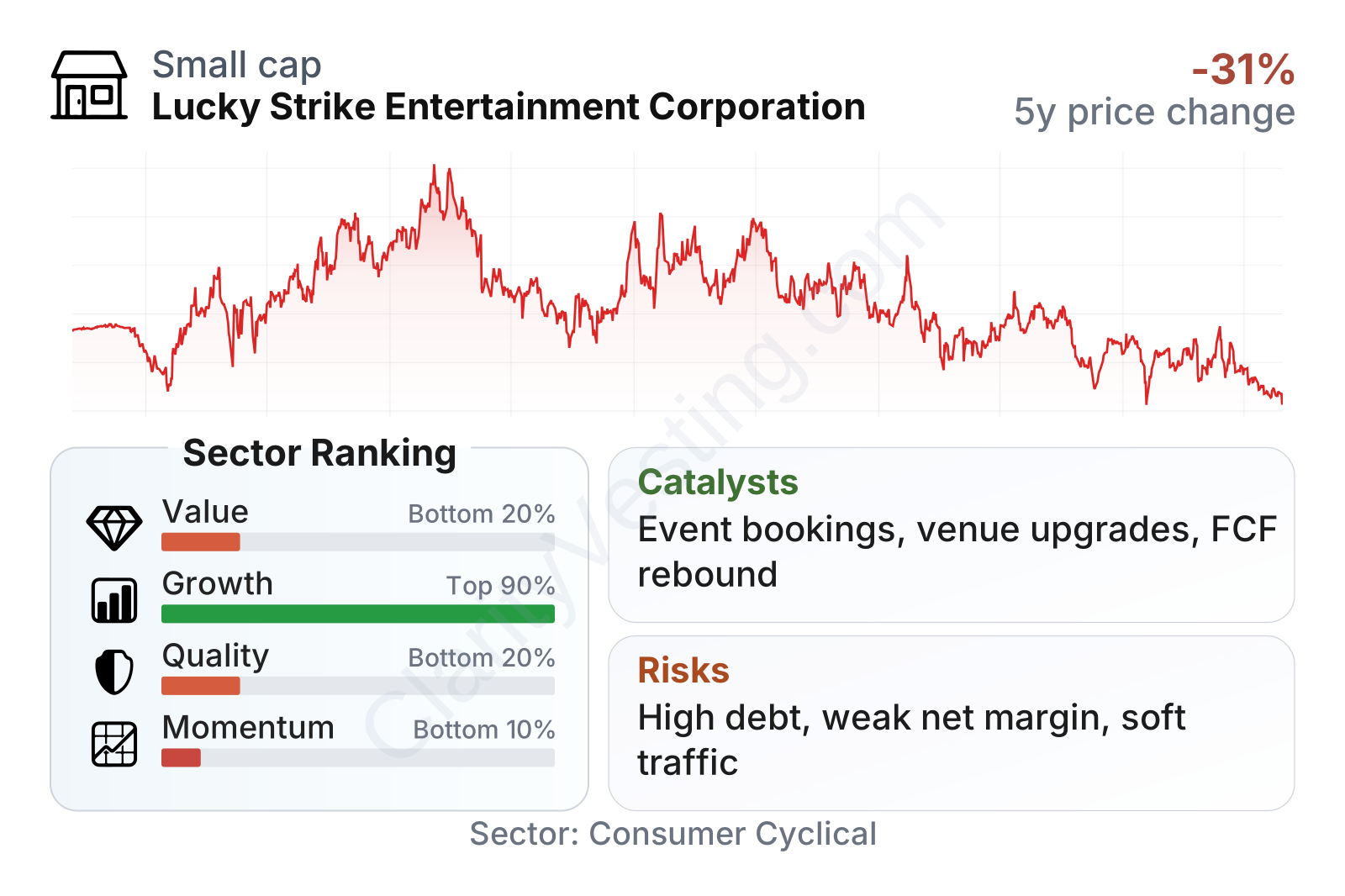
Lucky Strike is a small-cap company with below-average share price momentum and a lower beta than many consumer discretionary names, meaning its stock has been less volatile than the broader market. The factor breakdown is uneven: long-term growth metrics look strong versus the sector, but value, quality, and momentum rank weakly. In simple terms, the company has built scale and improved operating efficiency over time, yet leverage, inconsistent profitability, and a soft stock trend keep the overall financial picture more demanding.
Growth
Lucky Strike operates in the broader out-of-home entertainment market, a segment that can still grow over time because consumers continue to spend on experiences, social activities, and group events. Bowling itself is mature, but the company’s strategy is not just about bowling. It is about turning each venue into a multi-use entertainment destination with food, drinks, arcades, and event bookings. That makes the business more relevant to changing leisure preferences than a traditional bowling-center operator would be.
The company’s strategy has a logical growth foundation. Management has pursued acquisitions, rebranding, pricing optimization, premium formats, and cross-selling across bowling, amusements, and hospitality. The strongest evidence in favor of that strategy is the longer-term revenue trajectory: revenue per share has compounded far faster than the sector median over the past five years, and operating margin trends have also improved significantly over that same span.
Recent revenue growth has slowed sharply compared with the post-pandemic rebound years. The business moved from very high growth in 2022 to low single-digit growth more recently. That does not necessarily signal structural weakness, but it does mean the easy comparison period is over and future progress will likely depend more on same-store execution, event demand, and selective expansion than on rebound effects alone.
Cash generation has also been volatile. Free cash flow turned strongly positive after the pandemic recovery, then fell back into negative territory before recovering again. That pattern suggests the company can produce cash, but not yet with the consistency usually associated with a highly predictable leisure business. A meaningful positive is that free cash flow over a five-year period still shows a much stronger growth rate than the sector median.
One important catalyst is the company’s ability to drive higher spending per visit through premium experiences and group events. Corporate outings, birthday parties, and social gatherings can raise utilization during off-peak times and support food and beverage attachment rates. Another potential opportunity is continued integration and optimization of acquired locations, especially if management can lift margins at those centers without taking on the same level of future acquisition risk.
Recent company communications have also emphasized venue refreshes, brand positioning, and event-driven demand. For a business like this, even modest same-store sales improvement can matter because fixed costs are high. If guest traffic and in-center spending improve together, profit growth can move faster than revenue growth.
Risks
This article is for informational purposes only and does not constitute financial advice. Some content is AI-generated. See Disclaimer


