Stock Analysis · Lightspeed Commerce Inc (LSPD)
Overview
Lightspeed Commerce Inc. is a commerce software company focused mainly on small and mid-sized businesses in retail, hospitality, and golf. Its platform helps merchants run day-to-day operations such as point-of-sale, inventory, payments, e-commerce, staff management, customer engagement, and reporting. In simple terms, Lightspeed sells the digital tools a store, restaurant, or golf business needs to operate both in person and online.
The company’s business model combines subscription software with transaction-based services. That means part of its revenue comes from merchants paying to use the platform, while another part comes from processing payments and other transaction activity that grows as customer sales volumes increase. This creates a mix of recurring software revenue and variable revenue tied to merchant activity.
Based on recent company disclosures, Lightspeed’s revenue mix is centered on transaction-based activity, with software and other services making up the rest.
- Transaction-based revenue: approximately 60% to 65% — mainly payment processing and other commerce-related transaction services. This is the largest segment and has become increasingly important as Lightspeed pushes customers toward its integrated payments offering.
- Subscription revenue: approximately 30% to 35% — recurring fees for using its cloud software products, including point-of-sale, e-commerce, and operational tools.
- Other revenue: approximately 3% to 7% — hardware, professional services, and other smaller items.
This revenue mix matters because transaction revenue can scale quickly when merchants adopt Lightspeed Payments, but it also tends to carry lower gross margins than software subscriptions alone. The broad pattern over recent years shows a larger company by revenue, stronger gross profit in absolute dollars, and much tighter operating spending discipline than during the earlier post-acquisition period.
Revenue has expanded meaningfully over the last several fiscal years, while operating expenses have become far more controlled after a period of heavy acquisition-related costs and restructuring. Gross profit has also risen steadily, but the company is still working toward consistent net profitability.
Key Figures
| Metric | Value | Sector ⓘ |
|---|---|---|
| Date | Sep 12, 2026 | |
| Context | ||
| Sector | Technology | |
| Industry | Software - Application | |
| Market Cap ⓘ | $1.26B | |
| Beta ⓘ | 1.80 | |
Value (Cheapness) | ||
| P/E Ratio ⓘ | N/A | 29.51 |
| FCF Yield ⓘ | 3.02% | 4.25% |
| EBIT / EV ⓘ | -11.60% | 2.85% |
| PEG ⓘ | N/A | |
Growth (Business expansion) | ||
| Revenue Growth ⓘ | 5.80% | 15.40% |
| RPS Growth (5Y CAGR) ⓘ | 22.83% | 8.56% |
| EPS Growth (5Y CAGR) ⓘ | N/A | -11.88% |
| Margin Growth (5Y Trend) ⓘ | N/A | 0.46% |
| FCF Growth (5Y CAGR) ⓘ | N/A | 9.80% |
Quality (Business durability) | ||
| ROIC (Latest) ⓘ | -5.66% | 9.44% |
| ROIC (5Y Median) ⓘ | -9.04% | 8.30% |
| Net Debt / EBIT (Latest) ⓘ | N/A | 0.54 |
| Net Debt / EBIT (5Y Median) ⓘ | N/A | 0.44 |
| Operating Margin (Latest) ⓘ | -8.59% | 9.58% |
| Operating Margin (5Y Median) ⓘ | -56.98% | 8.25% |
| Debt to Equity (Latest) ⓘ | 1.44% | 33.33% |
| Profit Margin (Latest) ⓘ | -7.81% | 7.14% |
| Free Cash Flow (Latest) ⓘ | $38.15M | |
Momentum (Price trend) | ||
| 3Y Return ⓘ | -37.17% | +45.48% |
| 12M Return (excl. last month) ⓘ | -13.05% | +23.48% |
| 6M Return ⓘ | +11.56% | +20.93% |
| Price vs. 200-Day MA ⓘ | -1.68% | +7.43% |
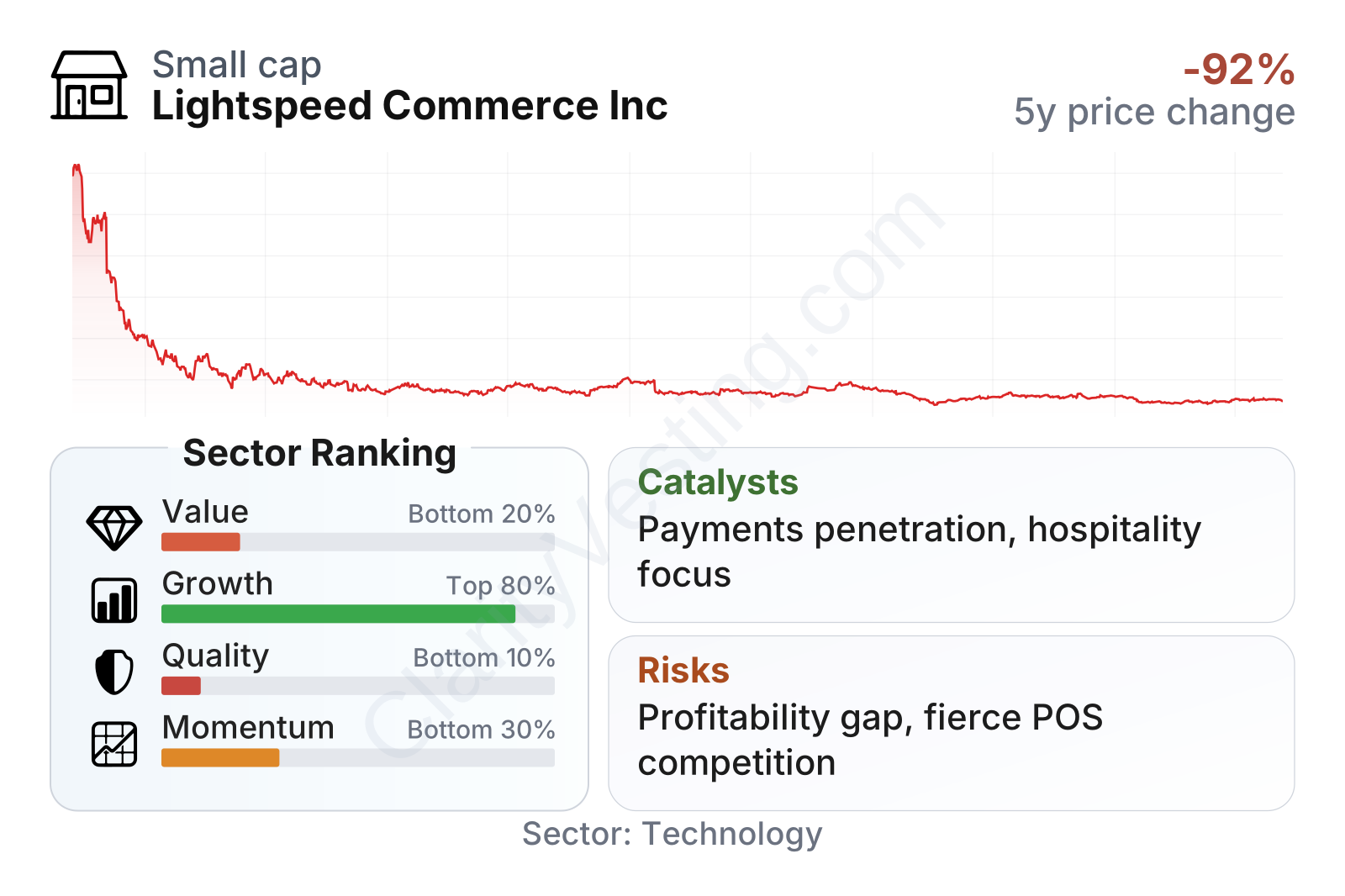
Lightspeed is now a relatively small publicly traded software company by market value, and its share price has been very volatile over the last several years. The stock remains far below its 2021 peak, which reflects both a broad reset in high-growth software valuations and company-specific concerns about profitability and execution.
The overall metrics paint a mixed picture. Growth characteristics remain better than many slower software peers over a multi-year period, especially on revenue per share, but recent year-over-year expansion has cooled. Quality metrics remain weak because returns on capital and operating margins are still negative, even though free cash flow has improved materially. Balance-sheet risk, however, is low: debt is minimal relative to equity, which gives the company more room to keep reshaping the business.
Growth
Lightspeed operates in a sector with durable long-term demand. Small and mid-sized merchants continue shifting from legacy cash registers and fragmented tools to integrated cloud platforms that combine in-store checkout, online sales, payments, and customer data. Restaurants and retailers also want fewer vendors and more automation, which supports the appeal of a unified software-and-payments model.
The company’s strategy is coherent. Management has spent the last few years simplifying the product portfolio, concentrating on core verticals, and increasing adoption of its own payments product. That matters because payments usually deepen customer relationships and raise revenue per customer over time. The tradeoff is that transaction revenue tends to lower gross margin percentage, but if execution is strong, it can improve total gross profit dollars and create a stickier platform.
Growth has clearly slowed from the very high rates seen during the earlier expansion phase. Recent annual growth is now much closer to low-single-digit to low-teens territory rather than the much faster pace reached after acquisitions. Even so, the longer arc still shows a business that has grown substantially over five years. The more important issue now is not pure speed, but whether Lightspeed can produce steadier organic growth with better economics.
One of the most important positive shifts is cash generation. Free cash flow moved from deeply negative territory in prior years to positive territory more recently, a sign that the cost base is becoming more manageable and the business is no longer consuming cash at the same rate. For a company still reporting accounting losses, that is a meaningful operational improvement.
A notable catalyst is the continued rollout and penetration of Lightspeed Payments across its customer base. Another is expansion within hospitality, where restaurants increasingly need integrated ordering, payments, and back-office tools. The company has also emphasized larger and more complex merchants within SMB categories, which can raise average revenue per location if retention stays healthy. Recent company communications have also centered on efficiency, platform simplification, and product integration, all of which can support better future margins if growth remains intact.
Risks
This article is for informational purposes only and does not constitute financial advice. Some content is AI-generated. See Disclaimer