Stock Analysis · Lattice Semiconductor Corporation (LSCC)
Overview
Lattice Semiconductor Corporation is a U.S. chip designer focused on low-power programmable logic devices, mainly field-programmable gate arrays, or FPGAs. These chips can be reconfigured by customers after manufacturing, which makes them useful in products that need flexibility, fast updates, low energy use, and small size. Lattice targets applications such as communications equipment, industrial automation, automotive systems, data centers, security cameras, consumer electronics, and edge artificial intelligence.
The company operates a relatively focused business model. Unlike larger semiconductor companies that cover many chip categories, Lattice is centered on programmable chips, related software tools, intellectual property, and application-specific design solutions. Manufacturing is outsourced to foundry partners, so the company mainly concentrates on product design, software, customer support, and sales.
Based on recent annual filings, revenue is primarily organized by end market rather than by individual product family. Approximate revenue exposure is as follows:
- Communications and computing: about 39% of 2025 revenue. This includes telecom and networking equipment, servers, data center-related uses, and broader computing infrastructure.
- Industrial and automotive: about 37% of 2025 revenue. This includes factory automation, robotics, power and energy systems, advanced driver assistance, in-vehicle electronics, and other embedded control uses.
- Consumer: about 24% of 2025 revenue. This includes consumer electronics, smart home devices, cameras, displays, and similar products.
Geographically, Lattice sells globally through direct customers and distributors, with Asia representing a large share of end demand because much of electronics manufacturing is based there. The business also has a high gross margin profile for a semiconductor company, reflecting its mix of specialized programmable products and software-enabled design tools rather than commodity chips.
The longer view shows a business that expanded strongly through 2023, then went through a downturn in 2024 and 2025 as customer inventories normalized and demand weakened, before growth accelerated again more recently. Over that period, gross profit stayed substantial, but operating income and net income became much more volatile as revenue fell and operating costs remained elevated.
The business mix shows how sensitive earnings can be to revenue swings. Gross profit remained relatively resilient even during the downturn, but higher research and operating spending absorbed much more of that profit in 2024 and especially 2025, which sharply compressed net income.
Key Figures
| Metric | Value | Sector ⓘ |
|---|---|---|
| Date | Sep 12, 2026 | |
| Context | ||
| Sector | Technology | |
| Industry | Semiconductors | |
| Market Cap ⓘ | $17.01B | |
| Beta ⓘ | 1.78 | |
Value (Cheapness) | ||
| P/E Ratio ⓘ | 460.62 | 29.51 |
| FCF Yield ⓘ | 1.24% | 4.25% |
| EBIT / EV ⓘ | 0.28% | 2.85% |
| PEG ⓘ | 0.59 | |
Growth (Business expansion) | ||
| Revenue Growth ⓘ | 62.20% | 15.40% |
| RPS Growth (5Y CAGR) ⓘ | 1.08% | 8.56% |
| EPS Growth (5Y CAGR) ⓘ | -25.46% | -11.88% |
| Margin Growth (5Y Trend) ⓘ | -17.37% | 0.46% |
| FCF Growth (5Y CAGR) ⓘ | -4.27% | 9.80% |
Quality (Business durability) | ||
| ROIC (Latest) ⓘ | 4.46% | 9.44% |
| ROIC (5Y Median) ⓘ | 28.37% | 8.30% |
| Net Debt / EBIT (Latest) ⓘ | -3.01 | 0.54 |
| Net Debt / EBIT (5Y Median) ⓘ | -0.47 | 0.44 |
| Operating Margin (Latest) ⓘ | 6.89% | 9.58% |
| Operating Margin (5Y Median) ⓘ | 19.97% | 8.25% |
| Debt to Equity (Latest) ⓘ | 4.84% | 33.33% |
| Profit Margin (Latest) ⓘ | 5.58% | 7.14% |
| Free Cash Flow (Latest) ⓘ | $211.22M | |
Momentum (Price trend) | ||
| 3Y Return ⓘ | +34.64% | +45.48% |
| 12M Return (excl. last month) ⓘ | +104.12% | +23.48% |
| 6M Return ⓘ | +38.61% | +20.93% |
| Price vs. 200-Day MA ⓘ | +9.83% | +7.43% |
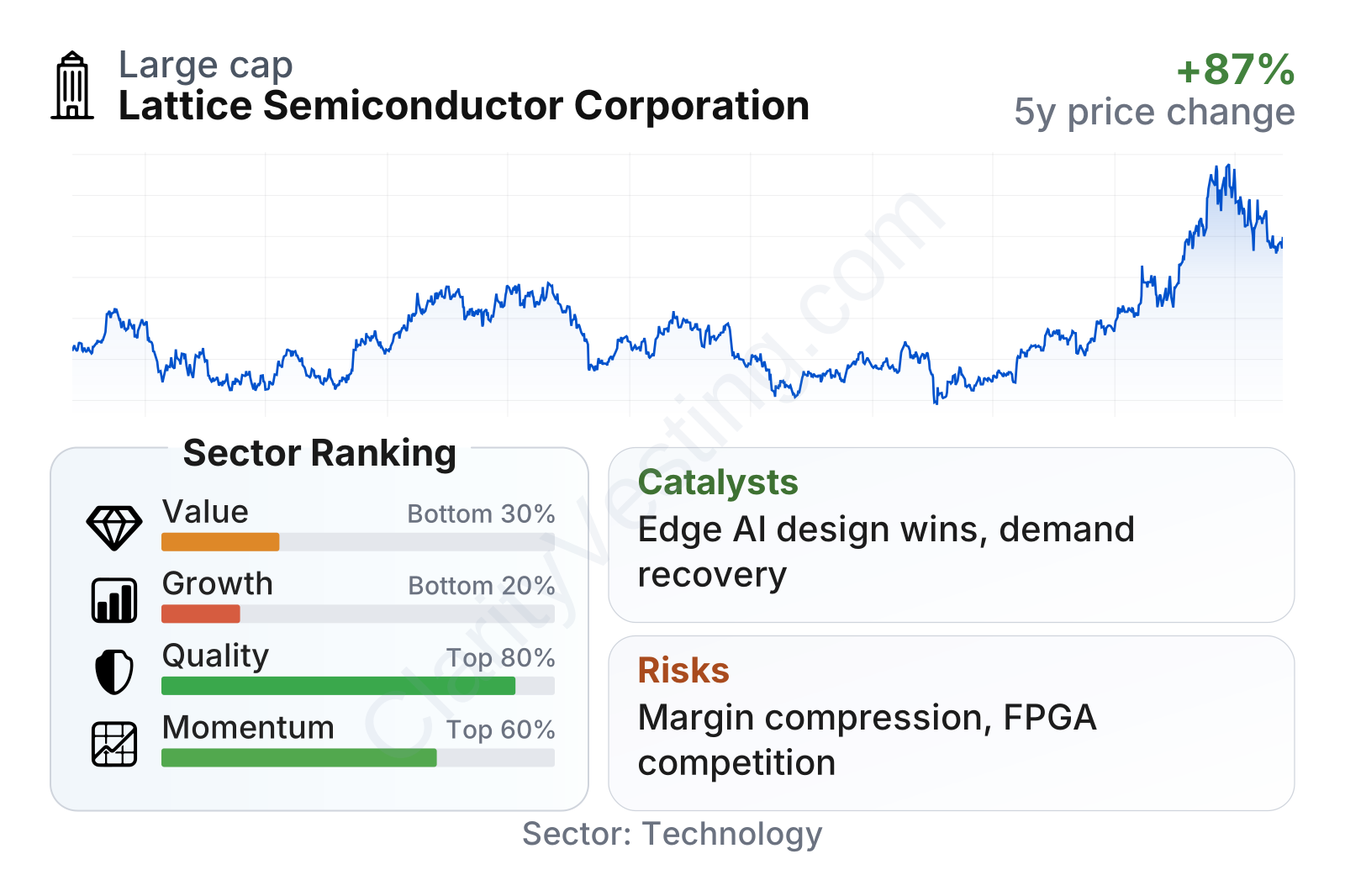
Lattice combines a strong balance sheet with weaker current value and growth rankings. Quality remains supported by very low leverage and a net cash position, while profitability has retreated from earlier highs. Share-price momentum has been strong over the last year, but valuation measures look demanding relative to much of the semiconductor sector, which means the market is already pricing in a meaningful recovery.
The stock history also shows that this is not a slow-moving name. It has experienced large swings across semiconductor cycles, with strong rebounds after weak periods. That pattern matters for long-term readers because the company’s business quality and the market’s valuation can move in very different directions over short periods.
Growth
Lattice operates in a part of the semiconductor industry that benefits from several durable trends: more automation in factories, more electronics in vehicles, expanding communications infrastructure, growing edge computing, and broader use of AI features outside large cloud data centers. Its niche is especially relevant where customers need low power consumption, compact designs, quick start-up, and programmable flexibility rather than the highest raw performance.
The company’s strategy is coherent. It has spent years moving away from lower-end commodity exposure and toward higher-margin, application-focused platforms supported by software stacks. Management has emphasized solutions for edge AI, embedded vision, security, and industrial automation, where smaller programmable chips can act as control, connectivity, and acceleration devices. This positioning does not put Lattice in direct competition with the largest AI training chip vendors; instead, it aims at power-efficient processing and control at the device level.
Recent revenue trends suggest a sharp turn in direction. After a prolonged contraction through most of 2024, growth recovered during 2025 and accelerated strongly into 2026, including year-over-year gains well above the broader sector median. That rebound is important because it indicates that the inventory correction phase may be ending and that customer demand is normalizing across key end markets.
Cash generation remains a useful strength, even though it came down from earlier peaks. Free cash flow weakened materially during the downturn, then began to recover. For a fabless chip company, this matters because cash can fund product development, software tools, go-to-market efforts, and acquisitions without putting pressure on the balance sheet.
A notable catalyst is the company’s push into edge AI and the launch cadence around its low-power FPGA platforms and software environment. Lattice has also highlighted design wins in industrial, automotive, and security applications, where product cycles are often longer and customer relationships can become sticky once a programmable device is designed into a system. If that mix deepens, it could support steadier growth than the company had in earlier cycles.
Recent company communications have also pointed to improving demand conditions and stronger bookings after the correction period. That does not guarantee a straight line upward, but it does suggest a potentially better setup than the one visible during the 2024 slowdown.
Risks
This article is for informational purposes only and does not constitute financial advice. Some content is AI-generated. See Disclaimer


