Stock Analysis · Lam Research Corp (LRCX)
Overview
Lam Research is one of the most important suppliers behind the semiconductor industry. It does not mainly sell chips to consumers. Instead, it sells the highly specialized manufacturing equipment that chipmakers use to build semiconductors on silicon wafers. Its systems are especially critical in steps such as etch, deposition, and wafer cleaning, which are necessary to produce advanced memory and logic chips.
The company’s customers are large semiconductor manufacturers, including memory producers and foundries. In simple terms, when the world needs more advanced chips for artificial intelligence, data centers, smartphones, industrial equipment, and vehicles, chipmakers must expand or upgrade their factories, and that creates demand for Lam’s tools and services.
Lam’s revenue is usually presented in two main buckets: systems revenue and customer support-related revenue. Based on the latest annual disclosures and recent quarterly mix, the business can be summarized as follows:
- Systems revenue: about 70% to 75% of total revenue. This is the sale of new wafer fabrication equipment used in chip production. It includes etch, deposition, and cleaning tools bought for new factories or capacity expansions.
- Customer support-related revenue: about 25% to 30% of total revenue. This includes spare parts, maintenance, upgrades, and other services that help customers keep existing equipment running efficiently.
Within end markets, memory has historically been a major exposure for Lam, often representing a large share of systems demand, while foundry and logic customers make up the rest. The exact split can move meaningfully from year to year depending on where chipmakers are spending. That cyclical mix matters because memory spending can swing more sharply than some other semiconductor segments.
One important financial feature is that Lam converts a large share of revenue into profit. Over the last several years, revenue dipped in the industry downturn and then rebounded strongly, while profitability remained much stronger than the broader sector. The flow from revenue to operating income and net income also shows rising research and development spending, which is a necessary cost in this industry rather than a warning sign on its own.
Key Figures
| Metric | Value | Sector ⓘ |
|---|---|---|
| Date | Sep 12, 2026 | |
| Context | ||
| Sector | Technology | |
| Industry | Semiconductor Equipment & Materials | |
| Market Cap ⓘ | $372.91B | |
| Beta ⓘ | 1.86 | |
Value (Cheapness) | ||
| P/E Ratio ⓘ | 54.98 | 29.51 |
| FCF Yield ⓘ | 1.31% | 4.25% |
| EBIT / EV ⓘ | 2.10% | 2.85% |
| PEG ⓘ | 1.47 | |
Growth (Business expansion) | ||
| Revenue Growth ⓘ | 30.00% | 15.40% |
| RPS Growth (5Y CAGR) ⓘ | 10.74% | 8.56% |
| EPS Growth (5Y CAGR) ⓘ | 15.15% | -11.88% |
| Margin Growth (5Y Trend) ⓘ | 4.35% | 0.46% |
| FCF Growth (5Y CAGR) ⓘ | 17.64% | 9.80% |
Quality (Business durability) | ||
| ROIC (Latest) ⓘ | 48.58% | 9.44% |
| ROIC (5Y Median) ⓘ | 47.60% | 8.30% |
| Net Debt / EBIT (Latest) ⓘ | -0.18 | 0.54 |
| Net Debt / EBIT (5Y Median) ⓘ | -0.18 | 0.44 |
| Operating Margin (Latest) ⓘ | 35.56% | 9.58% |
| Operating Margin (5Y Median) ⓘ | 31.22% | 8.25% |
| Debt to Equity (Latest) ⓘ | 33.05% | 33.33% |
| Profit Margin (Latest) ⓘ | 31.27% | 7.14% |
| Free Cash Flow (Latest) ⓘ | $4.89B | |
Momentum (Price trend) | ||
| 3Y Return ⓘ | +367.94% | +45.48% |
| 12M Return (excl. last month) ⓘ | +211.47% | +23.48% |
| 6M Return ⓘ | +42.46% | +20.93% |
| Price vs. 200-Day MA ⓘ | +12.97% | +7.43% |
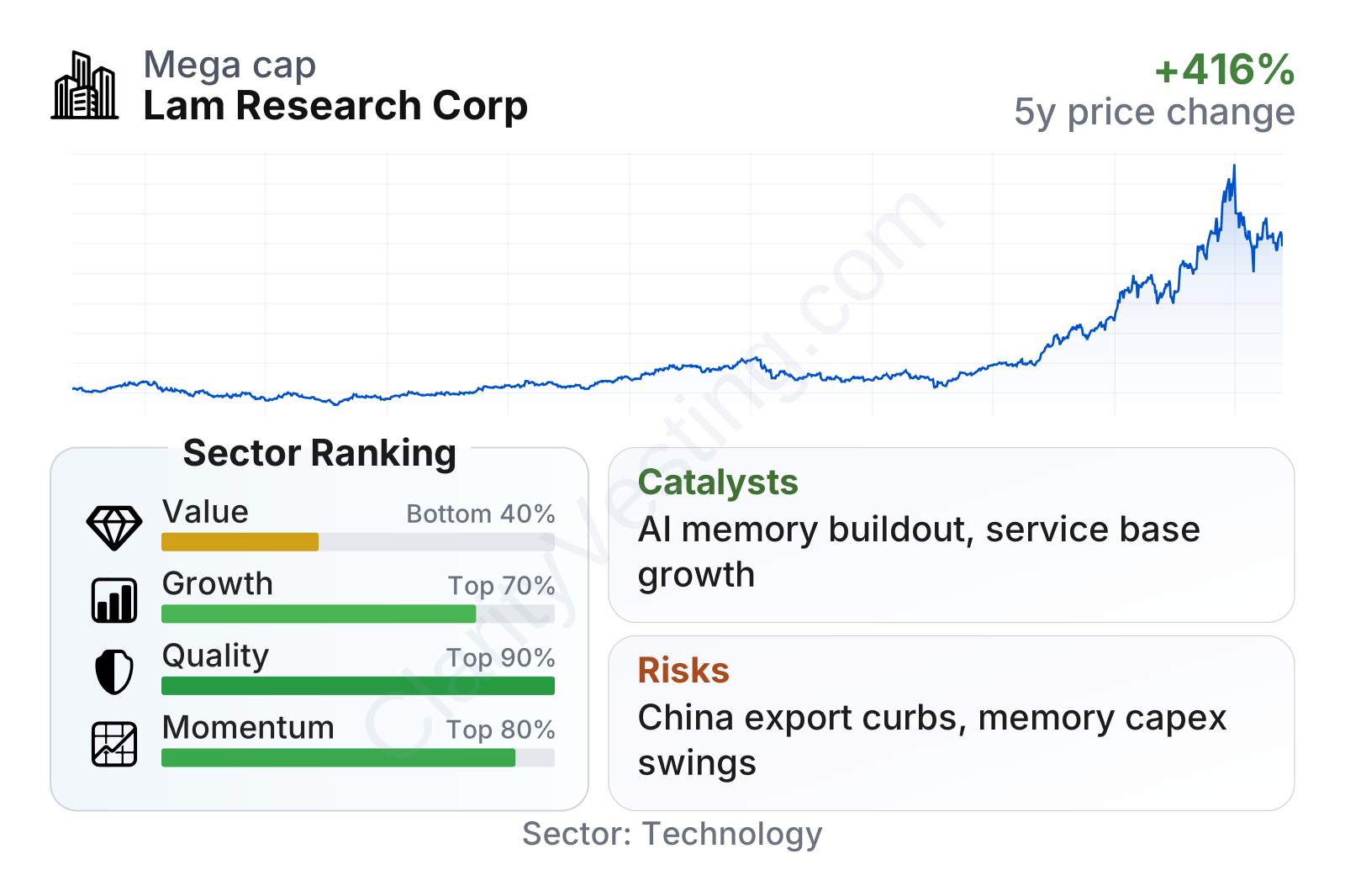
Lam Research is a very large semiconductor equipment company with above-average share price volatility, which is typical for a business tied to chip investment cycles. The quality profile stands out most clearly: returns on invested capital are far above sector norms, operating margins are exceptionally strong, and the balance sheet remains solid with net cash on an earnings basis. Growth metrics are also favorable, with revenue, earnings, and free cash flow compounding faster than the industry median over recent years. The weaker point is valuation: earnings multiples and cash flow yield indicate the market is already pricing in a significant amount of future strength.
Growth
Lam operates in a sector with strong long-term demand drivers. Semiconductor content keeps increasing across cloud infrastructure, AI training and inference, advanced smartphones, electric vehicles, industrial automation, and connected devices. That broad trend supports more wafer fabrication investment over time, even if spending moves in cycles from one year to the next.
Its strategy for future growth is coherent. Lam is deeply focused on process steps where performance matters enormously as chip structures become smaller, taller, and more complex. In advanced semiconductors, tiny improvements in etch precision, materials engineering, or cleaning can make a meaningful difference in yield and cost for the customer. That gives Lam room to grow not only from more wafer capacity, but also from greater tool intensity per wafer as manufacturing becomes harder.
The recent revenue pattern also supports the long-term case, while reminding readers that this is a cyclical business. After a clear downturn during the semiconductor equipment correction in 2023, growth turned positive again and accelerated. The latest year-over-year revenue increase is around 30%, well above the sector median, suggesting Lam has participated strongly in the current upcycle rather than merely recovering at an average pace.
Cash generation has strengthened along with revenue. Free cash flow moved from roughly the mid-$3 billion range a few years ago to above $6 billion more recently, despite continued investment in research and development. That matters because strong free cash flow gives the company flexibility to keep funding product development, support manufacturing capacity, and return capital to shareholders without straining the balance sheet.
A major catalyst is the industry buildout linked to AI infrastructure. AI servers and accelerators require advanced memory and leading-edge logic chips, both of which demand increasingly sophisticated fabrication tools. Lam has also highlighted strong positions in high-bandwidth memory-related manufacturing and other advanced memory transitions, which can be especially important as memory makers raise spending to support AI demand. Another growth lever is its installed base: once tools are placed in fabs, service, parts, and upgrade revenue can expand over time and provide a steadier contribution than new equipment sales alone.
Recent company updates have also pointed to healthy demand from both memory recovery and advanced foundry/logic investment. That combination is meaningful because it reduces dependence on a single customer group during the current expansion phase.
Risks
This article is for informational purposes only and does not constitute financial advice. Some content is AI-generated. See Disclaimer


