Stock Analysis · Lowe's Companies Inc (LOW)
Overview
Lowe’s Companies Inc. is one of the largest home improvement retailers in the United States. The company sells products and services used to build, repair, maintain, decorate, and improve homes. Its customers include both do-it-yourself homeowners and professional contractors. Lowe’s operates a large store network, supports e-commerce and in-store pickup, and also provides installation services through third-party providers.
The business is still primarily a retail model centered on home improvement merchandise. In its recent filings, Lowe’s presents revenue mainly through product categories rather than separate operating segments. Based on the company’s latest annual reporting, the main sources of revenue can be approximated as follows:
- Home Décor, Paint, and Flooring: about 33% of sales. This includes interior décor, paint, hardware, flooring, kitchen and bath-related decorative categories.
- Building Products: about 31% of sales. This includes lumber, millwork, roofing, insulation, fencing, and other core construction materials.
- Appliances, Seasonal, and Outdoor Living: about 20% of sales. This includes major appliances, lawn and garden, outdoor power equipment, and seasonal products.
- Hardlines: about 16% of sales. This includes tools, plumbing, electrical, rough hardware, and related repair items.
Lowe’s revenue is also heavily concentrated geographically, with the vast majority generated in the United States and only a limited amount from Canada-related operations and other residual items after the company’s earlier international exit.
The broad financial picture shows a company with very large sales, solid gross profit generation, and meaningful cash production, but with some pressure from operating expenses and interest costs over recent years. Revenue has stabilized after the post-pandemic slowdown, yet net income remains below the peak reached earlier in the cycle.
Over the last several years, sales moved down from the pandemic peak and then recovered modestly, while gross profit remained resilient. The more important shift has been below gross profit: operating income has compressed more noticeably as selling and administrative costs rose, and interest expense is materially higher than it was a few years ago.
Key Figures
| Metric | Value | Sector ⓘ |
|---|---|---|
| Date | Sep 12, 2026 | |
| Context | ||
| Sector | Consumer Cyclical | |
| Industry | Home Improvement Retail | |
| Market Cap ⓘ | $110.43B | |
| Beta ⓘ | 0.85 | |
Value (Cheapness) | ||
| P/E Ratio ⓘ | 16.61 | 17.10 |
| FCF Yield ⓘ | 6.34% | 8.53% |
| EBIT / EV ⓘ | 6.02% | 6.46% |
| PEG ⓘ | 1.33 | |
Growth (Business expansion) | ||
| Revenue Growth ⓘ | 8.30% | 5.75% |
| RPS Growth (5Y CAGR) ⓘ | 2.85% | 9.14% |
| EPS Growth (5Y CAGR) ⓘ | -16.11% | -18.21% |
| Margin Growth (5Y Trend) ⓘ | -0.67% | -0.23% |
| FCF Growth (5Y CAGR) ⓘ | -1.90% | 4.91% |
Quality (Business durability) | ||
| ROIC (Latest) ⓘ | 26.95% | 12.61% |
| ROIC (5Y Median) ⓘ | 38.34% | 10.72% |
| Net Debt / EBIT (Latest) ⓘ | 4.22 | 2.10 |
| Net Debt / EBIT (5Y Median) ⓘ | 3.57 | 2.32 |
| Operating Margin (Latest) ⓘ | 11.19% | 9.25% |
| Operating Margin (5Y Median) ⓘ | 12.58% | 9.64% |
| Debt to Equity (Latest) ⓘ | -565.05% | 75.78% |
| Profit Margin (Latest) ⓘ | 7.35% | 5.33% |
| Free Cash Flow (Latest) ⓘ | $7.00B | |
Momentum (Price trend) | ||
| 3Y Return ⓘ | -9.31% | +14.53% |
| 12M Return (excl. last month) ⓘ | -9.99% | +3.08% |
| 6M Return ⓘ | -16.90% | +0.55% |
| Price vs. 200-Day MA ⓘ | -15.75% | -0.54% |
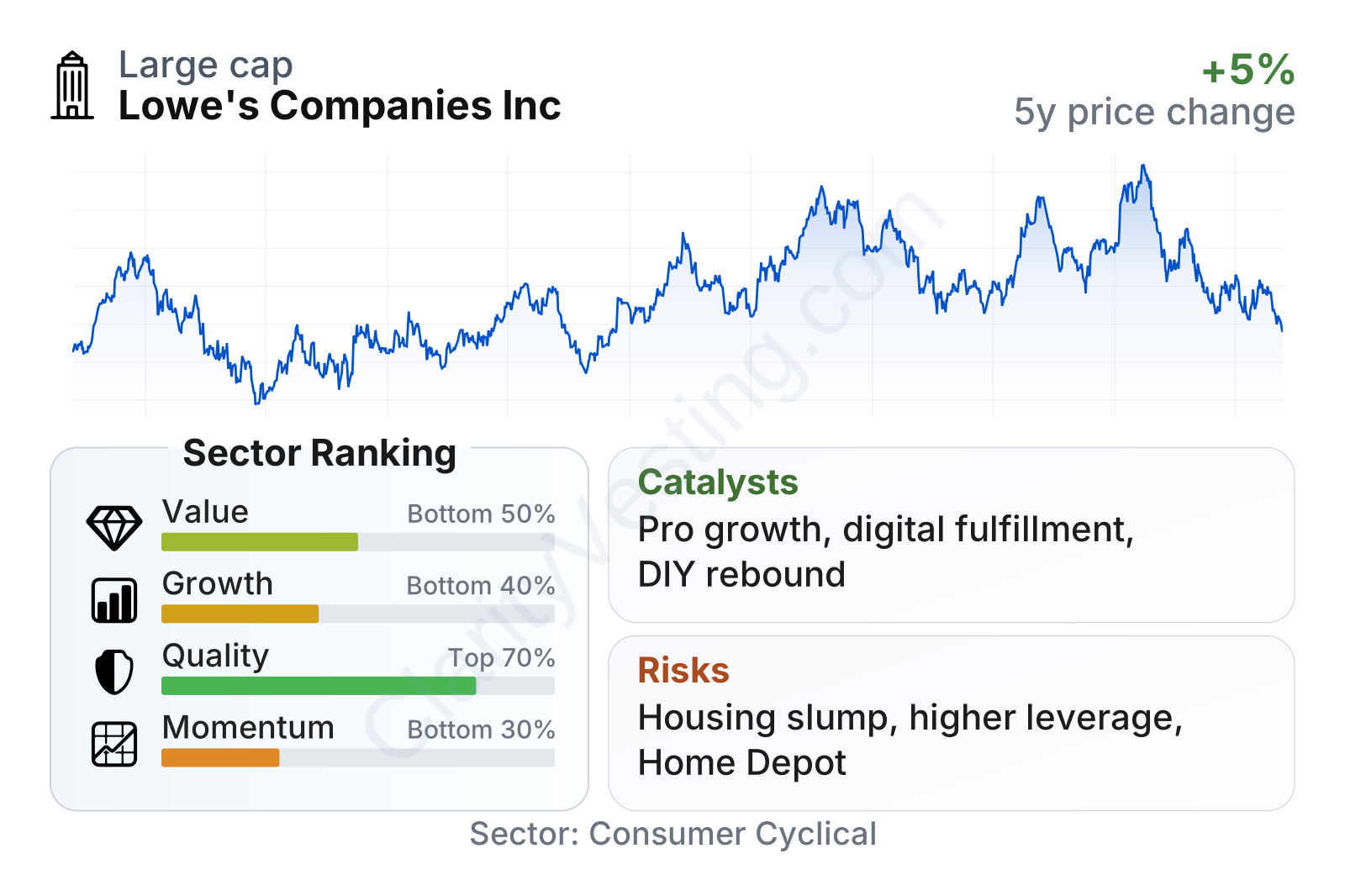
Lowe’s remains a very large company with a market value above $100 billion and a stock that has historically shown somewhat lower volatility than the broader market. The overall profile is mixed: business quality remains strong, especially on returns on invested capital and margins versus the sector, while growth and recent price momentum rank weaker. Valuation metrics sit close to sector norms rather than at a clear discount.
One item deserves context: the negative debt-to-equity ratio does not mean Lowe’s has no debt. It reflects negative shareholder equity, largely influenced by years of share repurchases. A better leverage lens here is net debt relative to earnings, which appears elevated versus the sector median.
Growth
Home improvement retail is a mature sector, but it is supported by durable long-term drivers. In the United States, the housing stock continues to age, which supports repair and maintenance demand. Remodeling activity also tends to benefit from homeowners staying in place longer when housing affordability is stretched and moving becomes less attractive. Those trends can create a steady demand base even when large discretionary projects slow down.
Lowe’s strategy for future growth is centered on execution rather than reinvention. The company has been trying to deepen relationships with professional customers, improve supply chain productivity, strengthen private brands, and connect stores more effectively with digital ordering and fulfillment. This makes strategic sense because professional customers usually buy more frequently, have larger tickets, and can create more recurring demand than occasional do-it-yourself shoppers.
Recent sales trends suggest the downturn that followed the pandemic surge has moderated. Year-over-year revenue was negative for much of 2023 and 2024, then turned positive again into 2025 and 2026. That matters because it indicates Lowe’s is no longer only relying on cost control and buybacks to support results; top-line conditions appear to be improving as well.
Cash generation remains one of Lowe’s more attractive characteristics. Free cash flow has stayed in the multi-billion-dollar range despite softer demand and margin pressure. That gives the company flexibility to invest in stores, technology, distribution, and shareholder returns while still carrying a sizable debt load.
A notable catalyst is Lowe’s continued push in the professional contractor market. Management has emphasized better inventory for job-site needs, dedicated sales support, improved delivery capabilities, and a more tailored digital experience. Another potential growth lever is online penetration tied to store-based fulfillment, which can improve convenience without requiring a radically different business model.
Recent company communications have also highlighted efforts around marketplace expansion, loyalty programs, and technology upgrades. These are not likely to transform the business overnight, but they can gradually improve customer retention, order frequency, and operating efficiency.
Risks
This article is for informational purposes only and does not constitute financial advice. Some content is AI-generated. See Disclaimer