Stock Analysis · Lenovo Group (LNVGF)
Overview
Lenovo Group is a global technology hardware company best known for personal computers, but its business is broader than that. The company sells laptops, desktops, workstations, tablets, smartphones, infrastructure equipment for data centers, and a growing range of services and solutions. It operates at very large scale across commercial customers, governments, small businesses, and consumers, with a footprint that spans the Americas, Europe, Asia-Pacific, and China.
Its revenue mix is still led by PCs and related smart devices, which means Lenovo remains closely tied to global demand for personal computing. Based on the company’s segment reporting in its latest annual materials, the main sources of revenue are approximately the following:
- Intelligent Devices Group: about four-fifths of revenue. This includes PCs, tablets, smartphones, and other smart devices, with PCs as the dominant contributor.
- Infrastructure Solutions Group: about one-tenth to one-seventh of revenue. This segment covers servers, storage, and related infrastructure used in enterprise and cloud environments.
- Solutions and Services Group: about high single digits of revenue. This includes support, managed services, device lifecycle services, and solution offerings that tend to be steadier and higher margin than hardware sales.
That structure matters because Lenovo is trying to evolve from a largely PC-centered manufacturer into a more balanced technology platform, where enterprise infrastructure and recurring services help reduce dependence on the cyclical PC market. The broad direction is sensible, but the company still earns most of its money from a business where pricing pressure is intense and margins are naturally thin.
The business flow also shows a familiar pattern for hardware manufacturers: very high cost of revenue, modest operating margins, and profit that depends heavily on scale and disciplined expense control. Recent annual figures indicate that revenue and gross profit have both rebounded strongly after the industry downturn, while operating income and net income have also recovered.
Over the past few years, the business first contracted with the post-pandemic PC slowdown and then recovered. The latest annual picture points to stronger revenue, better operating profit, and improved net income, which is encouraging, but it also confirms that Lenovo remains a scale-driven operator rather than a high-margin software-like business.
Key Figures
| Metric | Value | Sector ⓘ |
|---|---|---|
| Date | Jul 18, 2026 | |
| Context | ||
| Sector | Technology | |
| Industry | Computer Hardware | |
| Market Cap ⓘ | $34.98B | |
| Beta ⓘ | 1.12 | |
Value (Cheapness) | ||
| P/E Ratio ⓘ | 20.14 | 31.76 |
| FCF Yield ⓘ | 8.22% | 4.18% |
| EBIT / EV ⓘ | 9.06% | 2.56% |
| PEG ⓘ | 0.76 | |
Growth (Business expansion) | ||
| Revenue Growth ⓘ | 27.10% | 13.50% |
| RPS Growth (5Y CAGR) ⓘ | 0.62% | 8.57% |
| EPS Growth (5Y CAGR) ⓘ | -11.61% | -21.87% |
| Margin Growth (5Y Trend) ⓘ | -0.49% | 0.41% |
| FCF Growth (5Y CAGR) ⓘ | 0.62% | 9.76% |
Quality (Business durability) | ||
| ROIC (Latest) ⓘ | N/A | 8.54% |
| ROIC (5Y Median) ⓘ | 24.26% | 8.12% |
| Net Debt / EBIT (Latest) ⓘ | 0.08 | 0.38 |
| Net Debt / EBIT (5Y Median) ⓘ | 0.09 | 0.38 |
| Operating Margin (Latest) ⓘ | 3.87% | 9.58% |
| Operating Margin (5Y Median) ⓘ | 3.83% | 8.25% |
| Debt to Equity (Latest) ⓘ | 67.54% | 33.52% |
| Profit Margin (Latest) ⓘ | 2.30% | 6.96% |
| Free Cash Flow (Latest) ⓘ | $2.87B | |
Momentum (Price trend) | ||
| 3Y Return ⓘ | +195.81% | +30.91% |
| 12M Return (excl. last month) ⓘ | +180.37% | +28.90% |
| 6M Return ⓘ | +135.00% | +5.38% |
| Price vs. 200-Day MA ⓘ | +74.61% | +7.61% |
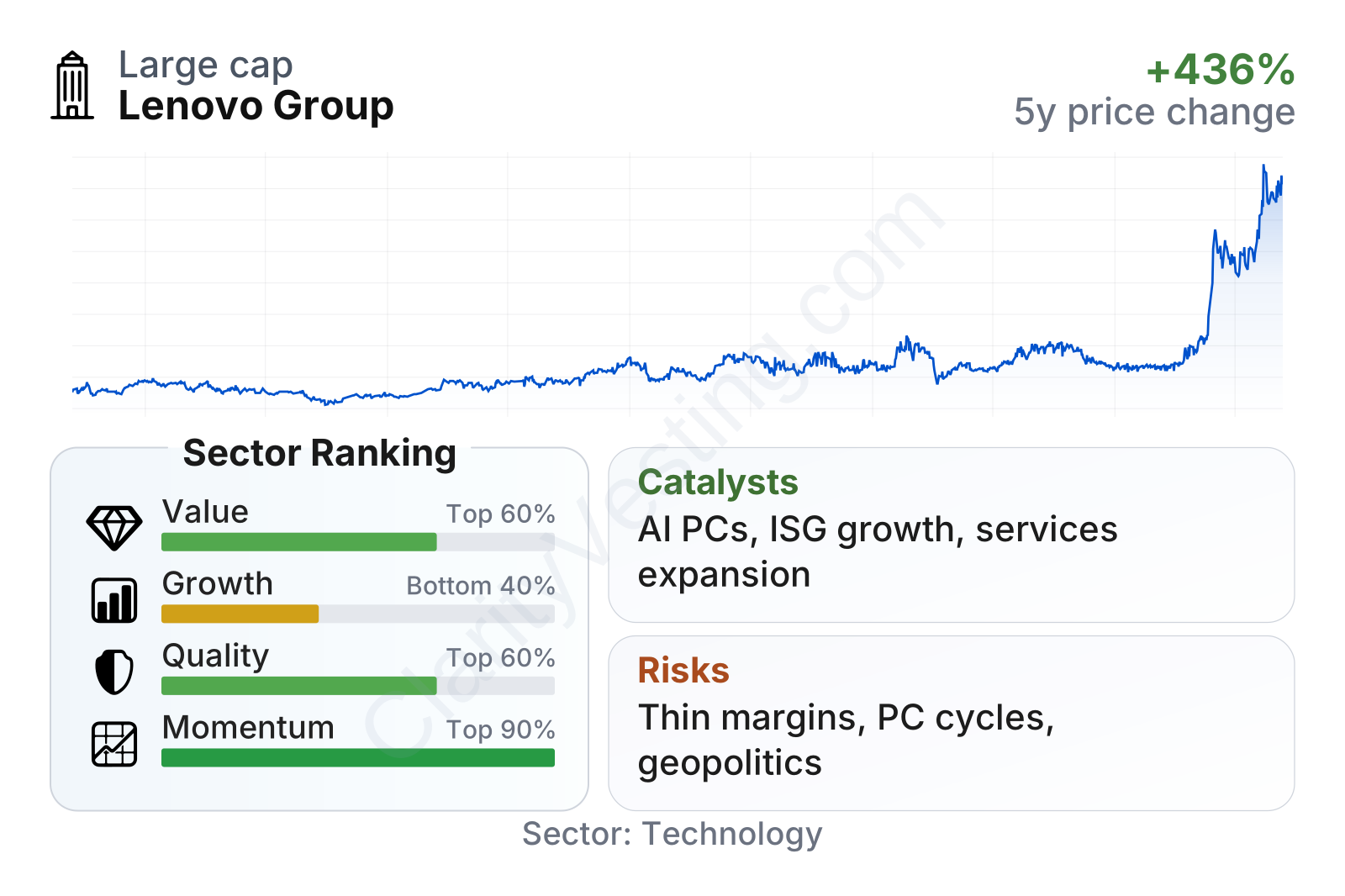
Lenovo currently sits in an interesting position across the main financial categories. Its market value is around the large-cap range for hardware, and its share price has shown strong momentum over the last several years, clearly outperforming many peers in the technology sector. On valuation and cash generation, the company looks relatively solid: earnings multiple below the sector median, free cash flow yield above the median, and enterprise-value-based earnings metrics that compare favorably with many technology names.
Where the picture is less flattering is long-term growth quality. Recent year-over-year revenue growth has been strong, but the longer five-year trends in revenue per share, free cash flow growth, and margin progression are weaker than many sector peers. Quality is mixed rather than poor: returns on invested capital over a multiyear period appear strong, and net debt relative to EBIT remains low, but profitability margins are still thin for the sector.
Growth
Lenovo operates in several markets that still have real long-term relevance: personal computing, enterprise infrastructure, edge computing, hybrid work tools, and AI-enabled devices. None of these markets is disappearing. The key question is not whether demand exists, but whether Lenovo can capture profitable demand rather than simply shipping more units at low margins.
The recent growth trend has improved materially. After a sharp downturn during the post-pandemic inventory correction, revenue growth turned positive again and then accelerated into strong double digits. That rebound suggests the company benefited from a healthier PC replacement cycle, easing channel conditions, and better demand across parts of its portfolio.
The pattern here looks more like a cyclical recovery than a straight-line growth story. That does not make it unimportant. For a company of Lenovo’s size, returning from double-digit declines to sustained positive growth is a meaningful change in operating backdrop. The challenge is proving that this rebound can extend beyond a normal hardware cycle and translate into better profitability over time.
One of the more credible parts of Lenovo’s strategy is the push into services and infrastructure. Services can create recurring revenue, deeper customer relationships, and higher margins than device sales alone. Infrastructure adds exposure to AI servers, enterprise refresh spending, and data center demand. If those businesses continue expanding faster than PCs, Lenovo’s mix could gradually improve.
Another growth angle is the company’s focus on AI PCs and on-device AI features. Management has been positioning Lenovo as an early mover in AI-capable personal computers, which could support premium pricing and a replacement cycle if enterprises and consumers see practical benefits. In infrastructure, AI server demand is another potential tailwind, especially as businesses build out computing capacity for AI workloads.
Cash generation is worth watching closely because it helps separate a temporary revenue rebound from a stronger business recovery. Lenovo has produced meaningful free cash flow in absolute terms, although the trend has been uneven over the last few years.
The recent cash flow pattern shows that Lenovo can generate substantial cash, but not always consistently through the cycle. For a hardware company, that is not unusual. It does mean that future growth will be judged not only by sales expansion, but by whether cash conversion improves as the cycle normalizes.
Recent company updates have also highlighted stronger momentum in infrastructure and continued progress in solutions and services. Those areas are important because they represent the clearest path toward a business mix that is less dependent on the traditional PC market.
Risks
The biggest risk is still business mix. Lenovo is a global leader in PCs, but PCs are highly competitive, cyclical, and margin-constrained. Even if unit demand improves, pricing pressure can quickly absorb much of the benefit. This makes revenue growth easier to achieve than durable margin expansion.
A second risk is profitability. Lenovo’s net margin is only around the low single digits, and its operating margin is also well below the broader technology sector median. That leaves relatively little room for execution errors, cost spikes, supply disruptions, or weaker pricing.
The margin trend shows some recovery from the trough, but profitability remains structurally modest compared with many technology companies. This is one reason Lenovo often looks cheaper than software or semiconductor peers: its earnings base is more exposed to manufacturing economics and competitive pricing.
Balance sheet interpretation requires nuance. Net debt relative to EBIT looks conservative, which is a positive sign, but debt-to-equity remains above the sector median. For Lenovo, this does not point to obvious distress, yet it does reinforce that the company is not operating with the same financial profile as a cash-rich, high-margin tech platform.
The debt-to-equity trend has improved significantly from the much higher levels seen several years ago, but it still runs above the sector median. In practical terms, leverage looks manageable, though not especially light for the industry.
Competition is intense across all major segments. In PCs, Lenovo competes with HP and Dell most directly, while Apple dominates a premium part of the market with a different ecosystem model. In infrastructure, Lenovo faces Dell, Hewlett Packard Enterprise, Super Micro Computer, and large original design manufacturers, among others. In services, it competes against a wide range of global IT service and lifecycle management providers.
Lenovo’s competitive advantages are scale, procurement power, manufacturing reach, distribution, and a strong commercial PC position. It has frequently ranked among the top global PC vendors by shipments, often near or at the industry lead. That scale is real, but it is not an impregnable moat. The PC market does not reward leadership with especially high margins, so being a leader is helpful without fully solving the profitability problem.
Geopolitical and supply chain risk also remain relevant. Lenovo operates globally and depends on complex sourcing, manufacturing, logistics, and cross-border trade. Tariffs, export controls, regional political tensions, and currency swings can all affect costs, demand, or investor sentiment. There is no obvious single recent scandal dominating the company narrative, but the operating environment itself is a standing risk for globally integrated hardware businesses.
Valuation
Lenovo’s valuation looks lower than the broader technology sector on earnings, while its cash flow yield and EBIT relative to enterprise value compare well. On that basis, the shares do not appear stretched in the way many higher-growth technology names can be. Part of that discount is structural: the market typically assigns lower multiples to hardware businesses with thin margins and cyclical demand.
The earnings multiple has generally remained below the sector median, even after the stock’s strong run. More recently, the multiple has moved up from very low historical levels, which suggests the market has become more optimistic about recovery and AI-related opportunities. Even so, the valuation still reflects caution rather than exuberance.
The central valuation question is whether Lenovo deserves to trade closer to a traditional hardware company or closer to a more diversified technology provider. If services and infrastructure continue to gain weight, and if margins improve even modestly, the current valuation framework could look conservative. If the company remains primarily a low-margin PC leader, the present multiple already captures much of the business quality.
In other words, the current price seems easier to justify on operating recovery and relative cheapness than on any assumption of dramatic transformation. The market appears to be recognizing better conditions, but not fully pricing Lenovo as a high-growth or high-margin technology platform.
Conclusion
Lenovo stands out as a global technology manufacturer with genuine scale, a leading PC position, improving revenue momentum, and a credible effort to broaden into infrastructure and services. The latest business trend is clearly better than the slump period, and the company’s ability to produce solid cash flow and maintain manageable net leverage adds resilience.
At the same time, the core limitation has not disappeared: Lenovo remains a low-margin hardware company operating in fiercely competitive markets. Its leadership position is meaningful, but it does not automatically translate into the kind of profitability or durable moat seen in stronger software or platform businesses. That is why the company can look financially efficient and relatively inexpensive while still carrying clear strategic and earnings-quality constraints.
Overall, Lenovo currently looks more like a disciplined large-scale operator benefiting from a cyclical rebound and AI-related product refresh opportunities than a fundamentally transformed technology franchise. The positive case rests on mix improvement, infrastructure growth, and steadier services expansion. The more cautious reading is that the valuation discount is rooted in real business economics, not simple market neglect.
Sources:
- Lenovo Group — Annual Report 2025/26
- Lenovo Group — Full Year Results and Investor Presentation 2025/26
- Lenovo Group — Investor Relations Press Releases on annual and interim results
- Lenovo Group — Company Investor Relations website, business segment descriptions
- Wikipedia — Lenovo, company background and operating overview
This article is for informational purposes only and does not constitute financial advice. Some content is AI-generated. See Disclaimer


