Stock Analysis · Lindblad Expeditions Holdings Inc (LIND)
Overview
Lindblad Expeditions Holdings Inc is a specialized travel company focused on expedition cruising and adventure travel. Rather than competing in mass-market vacations, it operates small-ship experiences built around nature, wildlife, remote destinations, and educational travel. The company is best known for the Lindblad Expeditions brand and its long-standing collaboration with National Geographic, which helps position its trips as premium, expert-led experiences rather than standard cruises.
Its business model is fairly straightforward: it sells expedition travel packages, mainly on owned or chartered vessels, and earns revenue from guest ticket sales and related onboard or trip services. Public filings show that the company operates as a single reportable segment, so revenue is not broken out in great detail by business line in the way some diversified travel companies do. In practical terms, the main sources of revenue are approximately:
- Expedition cruise and land package sales: by far the largest source, likely the overwhelming majority of revenue.
- Air and travel-related services: supplemental revenue tied to guest itineraries.
- Onboard and other guest-related revenue: a smaller contribution from extensions, services, and ancillary spending.
Lindblad’s appeal comes from a niche that is harder to copy than ordinary leisure travel. Its ships are smaller, its routes are more specialized, and its product depends heavily on brand trust, destination access, and expedition expertise. Over the last several years, revenue has recovered strongly from the pandemic-era collapse in travel demand, but profitability has improved more slowly because the company still carries a meaningful financing burden and a cost structure tied to running vessels.
The long-term financial picture shows a business that has rebuilt scale impressively: revenue rose from roughly $150 million in 2021 to more than $770 million in 2025. Operating results also turned positive, but net income remained negative, showing that the company has not yet fully converted demand strength into bottom-line earnings.
The broad trend is encouraging on the operating side: revenue expanded sharply, gross profit improved, and operating income moved from deep losses into positive territory. The weaker point is that interest expense has stayed high, which helps explain why stronger sales have not yet translated into consistent net profitability.
Key Figures
| Metric | Value | Sector ⓘ |
|---|---|---|
| Date | Jul 18, 2026 | |
| Context | ||
| Sector | Consumer Cyclical | |
| Industry | Travel Services | |
| Market Cap ⓘ | $1.80B | |
| Beta ⓘ | 2.23 | |
Value (Cheapness) | ||
| P/E Ratio ⓘ | N/A | 18.58 |
| FCF Yield ⓘ | 4.61% | 7.99% |
| EBIT / EV ⓘ | 1.26% | 5.91% |
| PEG ⓘ | N/A | |
Growth (Business expansion) | ||
| Revenue Growth ⓘ | 15.70% | 5.50% |
| RPS Growth (5Y CAGR) ⓘ | 47.84% | 9.20% |
| EPS Growth (5Y CAGR) ⓘ | N/A | -26.43% |
| Margin Growth (5Y Trend) ⓘ | 68.72% | -0.18% |
| FCF Growth (5Y CAGR) ⓘ | N/A | 5.02% |
Quality (Business durability) | ||
| ROIC (Latest) ⓘ | 12.03% | 12.03% |
| ROIC (5Y Median) ⓘ | 1.48% | 10.82% |
| Net Debt / EBIT (Latest) ⓘ | 12.39 | 2.12 |
| Net Debt / EBIT (5Y Median) ⓘ | 21.47 | 2.25 |
| Operating Margin (Latest) ⓘ | 3.47% | 9.28% |
| Operating Margin (5Y Median) ⓘ | 1.28% | 9.64% |
| Debt to Equity (Latest) ⓘ | -349.61% | 75.23% |
| Profit Margin (Latest) ⓘ | -3.05% | 5.28% |
| Free Cash Flow (Latest) ⓘ | $83.10M | |
Momentum (Price trend) | ||
| 3Y Return ⓘ | +162.52% | +10.68% |
| 12M Return (excl. last month) ⓘ | +120.22% | +5.26% |
| 6M Return ⓘ | +65.89% | -2.41% |
| Price vs. 200-Day MA ⓘ | +56.78% | +1.55% |
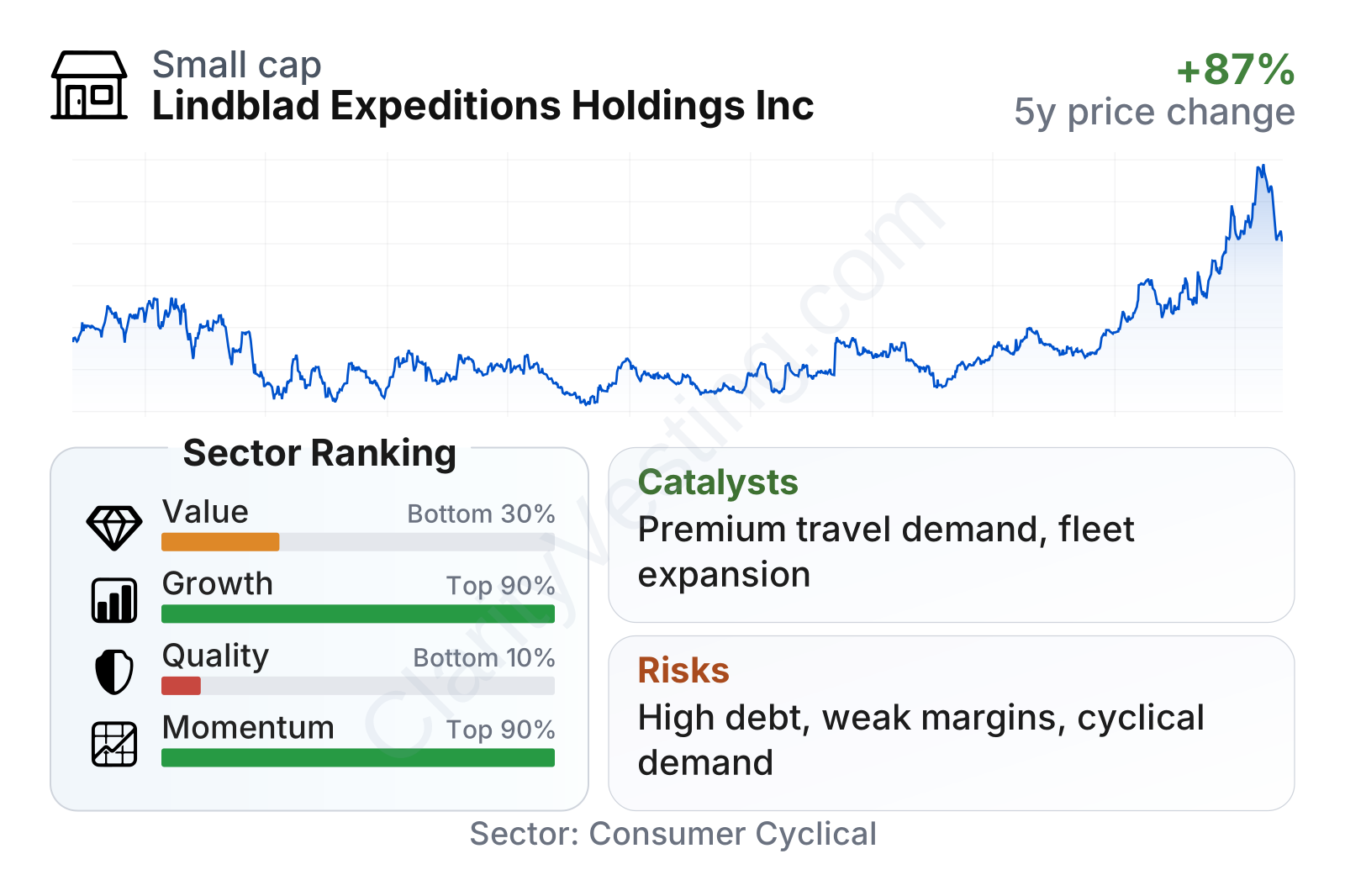
The market is treating Lindblad as a recovery-and-growth company rather than a mature travel operator. Share performance has been very strong over the last year and over the last three years, far ahead of the broader sector, but the stock also carries high volatility, with a beta above 2. In other words, the upside in sentiment has been powerful, yet price swings can be much larger than for an average stock.
The summary metrics point to a mixed profile. Growth and momentum rank near the top of the sector, reflecting strong revenue expansion and a sharp stock rebound. Value and quality look much weaker. Free cash flow has turned positive and improved, but margins remain below sector norms and leverage is still heavy relative to operating earnings. That combination usually fits a company in transition: stronger demand and better execution are visible, but the balance sheet and earnings profile still need work.
Growth
Expedition travel is a small but attractive corner of the broader travel industry. It benefits from several long-term themes: rising interest in experiential spending, demand for premium travel, and a willingness among affluent travelers to pay for unique destinations rather than standardized tourism. Lindblad is exposed to all three. Its offering is not centered on volume; it is centered on exclusivity, educational content, and access to places that are difficult to reach through ordinary travel products.
The company’s strategy appears logical for that market. It focuses on premium pricing, brand differentiation, and fleet expansion or optimization rather than chasing the mass market. That matters because niche travel businesses can often protect pricing better when their product is distinctive. The National Geographic connection is especially valuable here because it supports brand credibility, guest acquisition, and the educational identity of the trips.
Revenue growth has remained well above the sector median, even after the post-pandemic rebound phase faded. That suggests the business is not just normalizing from a weak base anymore; it is still expanding at a pace that stands out within travel services. The five-year revenue-per-share trend is particularly strong, which indicates that the company has materially rebuilt scale.
Cash generation is one of the most important improvements in the current profile. Free cash flow has moved from deeply negative territory a few years ago to clearly positive levels, and the trend has continued upward. That does not erase the company’s financial constraints, but it does strengthen the case that operations are becoming healthier and more self-funding.
A meaningful catalyst is the continued normalization and premiumization of travel demand. Lindblad’s itineraries tend to attract higher-income customers, which can make demand somewhat more resilient than in budget travel. Another catalyst is fleet utilization: when occupancy and pricing improve together, a vessel operator can see a strong incremental benefit because many ship-related costs are fixed or semi-fixed. The company has also highlighted demand trends, booked occupancy, and itinerary expansion in its public communications, all of which support the idea that the brand remains relevant in a competitive leisure market.
Recent company updates have also pointed to ongoing demand strength and capacity development, which matter because this is a business where future bookings provide unusually useful visibility. For a long-term lens, that makes reservation trends, pricing, and guest deposits especially important indicators of momentum.
Risks
The biggest risk is leverage. Lindblad’s net debt relative to EBIT remains very high, far above typical sector levels. That means even if demand stays solid, a meaningful portion of the company’s economic progress can continue to be absorbed by interest costs rather than flowing through to shareholders. This is the clearest reason the business still looks financially fragile compared with stronger travel operators.
The debt-to-equity line is distorted by negative equity, which is usually a sign that past losses and balance sheet pressure have been significant. That does not automatically mean near-term distress, but it does underline that this is not a conservatively financed company. Balance sheet repair remains an important part of the long-term picture.
Profitability is another weak point. Net margin has improved markedly from the worst post-pandemic years, but it is still negative while the sector median remains positive. Operating margin has also improved, yet it stays below industry norms. In plain language, Lindblad is selling much more travel than it used to, but it still is not converting enough of that revenue into bottom-line profit.
There are also business-model risks specific to expedition travel. The company is exposed to fuel prices, weather disruptions, geopolitical events, and destination-specific regulatory changes. Because its voyages often involve remote or environmentally sensitive regions, itinerary disruptions can matter more than for mainstream travel companies. A recession or sharp slowdown in high-end discretionary spending would also be relevant, since these trips are expensive and easier for customers to postpone than everyday consumer purchases.
Competition is real, though Lindblad occupies a distinctive niche. Its main competitors include other expedition and adventure travel operators such as Hurtigruten Expeditions, Quark Expeditions, Viking’s expedition offerings, and travel companies with premium small-ship or specialty cruise exposure. Compared with much larger cruise groups, Lindblad does not have the same scale or financial flexibility. Its advantage lies instead in brand identity, expedition heritage, scientific and educational positioning, and long experience in destinations like the Galápagos, Antarctica, and the Arctic. It is not the overall leader in global cruise travel, but it is one of the better-known names in the expedition niche.
There is no widely visible recent public controversy suggesting an unusual governance or reputation shock on the scale of a major scandal. The more important risk signals are financial rather than reputational: leverage, still-negative net earnings, and sensitivity to travel conditions.
Valuation
Lindblad is not easy to judge with a simple price-to-earnings approach because earnings remain negative on a trailing basis, which is why a meaningful P/E figure is absent even while the broader sector trades around more conventional earnings multiples. That alone says a lot: the stock is being valued on recovery, future earnings power, and cash generation rather than on established current profitability.
Traditional value measures suggest a demanding setup. The company ranks in the lower end of the sector on value metrics, and its free cash flow yield and EBIT-to-enterprise-value ratio are both weaker than sector medians. In other words, the market is already giving significant credit for future improvement. That is not unusual for a niche travel company showing fast growth and strong momentum, but it does reduce the margin for disappointment.
At the same time, the current valuation context is not purely speculative. Revenue growth has materially outpaced the sector, free cash flow has turned positive, and the stock’s rerating has followed visible operational progress. The key question is whether future margin improvement and debt reduction can catch up with the market’s optimism. If operating gains continue while financing pressure eases, today’s valuation can look more understandable. If margins stall or travel demand softens, the stock can look stretched because it lacks the protection of established earnings.
So the valuation picture is best described as growth-supported but not cheap. The price appears to reflect confidence in continued recovery and stronger future economics, while leaving less room for execution setbacks than a lower-multiple stock would.
Conclusion
Lindblad Expeditions stands out as a specialized travel company with a real niche, a recognized premium brand, and a business that has recovered strongly in scale. Revenue growth, improving operating results, and a clear swing into positive free cash flow show that the underlying business has moved a long way from the disruption of the early 2020s. The company’s positioning around expedition travel and its National Geographic association give it a differentiated identity that many travel operators do not have.
The challenge is that the financial recovery is still incomplete. Net margins remain negative, leverage is high, and interest expense continues to absorb a large part of the progress made at the operating level. That creates a split profile: strategically, the company looks appealing and aligned with favorable long-term travel trends; financially, it still carries the marks of a harder past and needs continued execution to fully stabilize.
In valuation terms, the market already recognizes much of the improvement. This is not a deeply discounted situation built on low expectations. It is a company with visible momentum, but also with limited tolerance for operational missteps because profitability and balance sheet strength still trail the enthusiasm reflected in the share price. Overall, Lindblad appears more compelling as a differentiated growth recovery business than as a fully mature, financially settled one.
Sources:
- U.S. Securities and Exchange Commission (SEC) — Lindblad Expeditions Holdings, Inc. latest 10-Q filings in 2026
- U.S. Securities and Exchange Commission (SEC) — Lindblad Expeditions Holdings, Inc. latest 8-K filings in 2026
- Lindblad Expeditions Investor Relations — company press releases and investor presentations
- Lindblad Expeditions Investor Relations — earnings call materials hosted by the company
- Wikipedia — Lindblad Expeditions basic company background
This article is for informational purposes only and does not constitute financial advice. Some content is AI-generated. See Disclaimer


