Stock Analysis · Liberty Latin America Ltd (LILAK)
Overview
Liberty Latin America Ltd is a telecommunications and connectivity company focused on Latin America and the Caribbean. Through consumer and business brands such as Liberty, Flow, Más Móvil, BTC, and C&W Business, it provides mobile phone service, broadband internet, pay TV, fixed-line voice, enterprise connectivity, data center and IT solutions, and subsea network capacity. In simple terms, it owns and operates communications infrastructure in markets where reliable internet and mobile access are becoming increasingly essential for households, companies, and governments.
The business is geographically diversified, but it is still a regional telecom operator rather than a global giant. That matters because telecom revenue tends to be recurring and relatively predictable, yet it also requires heavy network spending and usually comes with significant debt. Liberty Latin America’s markets include Panama, Puerto Rico, Jamaica, Chile, the Caribbean, and several other countries and territories, giving it exposure to economies with different growth profiles and currencies.
Based on company reporting, revenue mainly comes from subscription-like connectivity services, with mobile and broadband carrying the largest weight. A practical way to think about the mix is:
- Mobile services and handset-related revenue — the largest contributor, roughly around one-third of total revenue.
- Residential fixed services such as broadband, video, and fixed voice — also around one-third, with broadband generally the most strategically important part of this group.
- B2B / enterprise, wholesale, and infrastructure services — roughly one-quarter to one-third, including connectivity, managed services, and network capacity for business and institutional customers.
- Other revenue — a smaller share, including installation, equipment, and miscellaneous service revenue.
This mix is important because broadband, mobile, and enterprise connectivity are usually more durable than legacy voice and traditional pay TV. The company has gradually been leaning toward services tied to data usage and digital infrastructure rather than older communications products.
The financial flow also shows a business with resilient gross profit but meaningful pressure lower down the income statement. Revenue has drifted down from earlier years, while interest expense has remained high, which helps explain why cash generation can still look solid even when reported earnings stay weak.
Key Figures
| Metric | Value | Sector ⓘ |
|---|---|---|
| Date | Aug 22, 2026 | |
| Context | ||
| Sector | Communication Services | |
| Industry | Telecom Services | |
| Market Cap ⓘ | $1.61B | |
| Beta ⓘ | 0.73 | |
Value (Cheapness) | ||
| P/E Ratio ⓘ | N/A | 18.56 |
| FCF Yield ⓘ | 22.25% | 12.89% |
| EBIT / EV ⓘ | 4.31% | 4.84% |
| PEG ⓘ | 0.83 | |
Growth (Business expansion) | ||
| Revenue Growth ⓘ | 1.50% | 5.50% |
| RPS Growth (5Y CAGR) ⓘ | 1.81% | 4.59% |
| EPS Growth (5Y CAGR) ⓘ | -28.35% | -18.25% |
| Margin Growth (5Y Trend) ⓘ | -4.27% | 0.60% |
| FCF Growth (5Y CAGR) ⓘ | 2.25% | 5.47% |
Quality (Business durability) | ||
| ROIC (Latest) ⓘ | 1.80% | 8.59% |
| ROIC (5Y Median) ⓘ | 1.56% | 8.11% |
| Net Debt / EBIT (Latest) ⓘ | 19.26 | 1.70 |
| Net Debt / EBIT (5Y Median) ⓘ | 24.25 | 2.74 |
| Operating Margin (Latest) ⓘ | 9.12% | 14.91% |
| Operating Margin (5Y Median) ⓘ | 4.35% | 13.15% |
| Debt to Equity (Latest) ⓘ | 1617.97% | 58.36% |
| Profit Margin (Latest) ⓘ | -2.20% | 8.93% |
| Free Cash Flow (Latest) ⓘ | $357.90M | |
Momentum (Price trend) | ||
| 3Y Return ⓘ | +42.61% | +44.85% |
| 12M Return (excl. last month) ⓘ | +61.83% | +2.33% |
| 6M Return ⓘ | +52.85% | +4.05% |
| Price vs. 200-Day MA ⓘ | +40.78% | +3.35% |
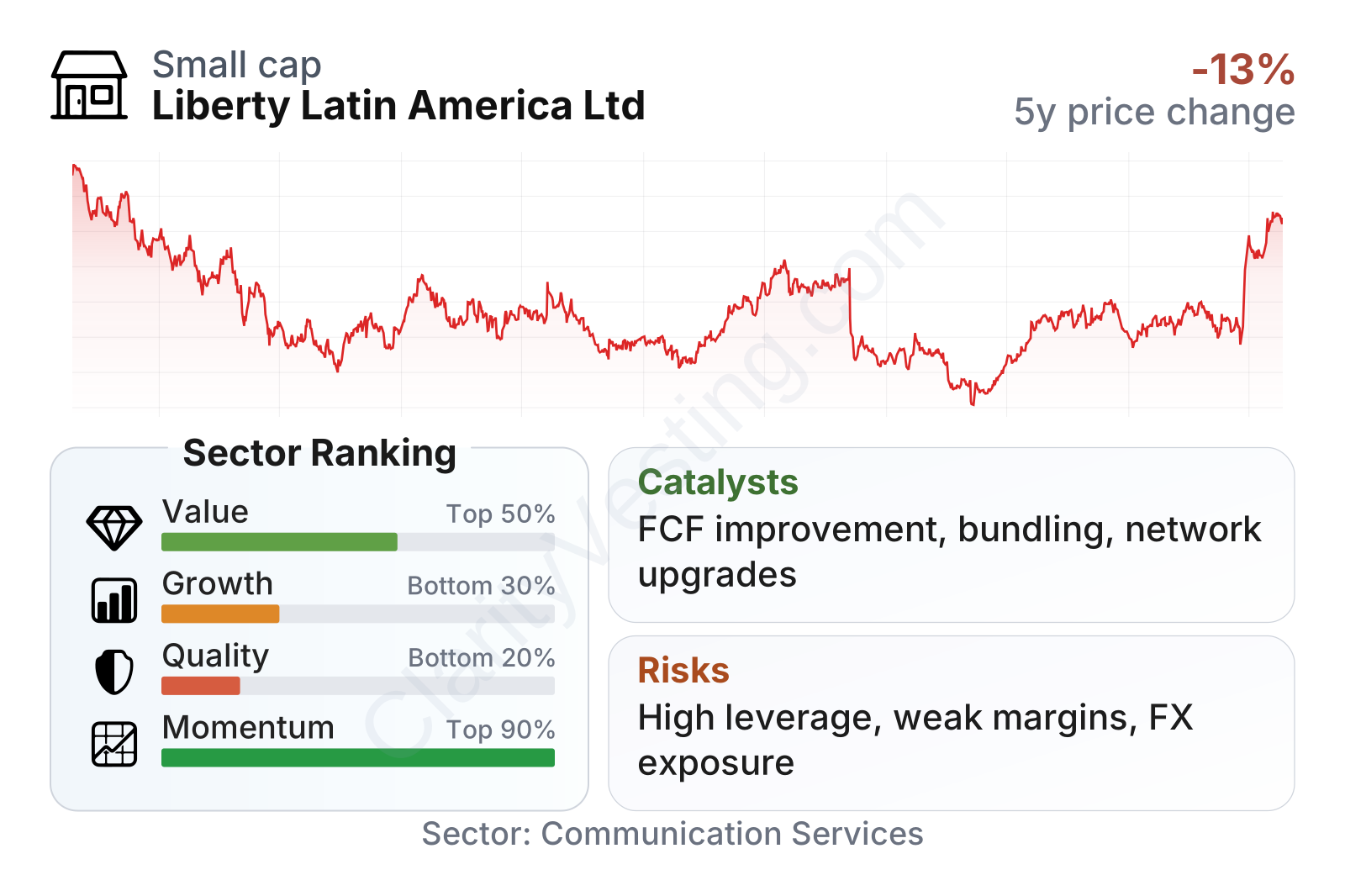
At a high level, the company sits in a mixed position. Its market value is relatively modest for a telecom operator, at about $1.5 billion, and its share-price volatility has been lower than the broader market. Recent price momentum has been strong, clearly ahead of much of the sector over the last several months, but the underlying business quality and growth rankings remain weak relative to peers. The most notable positive is cash generation: free cash flow yield stands well above the sector median, suggesting the market is placing a cautious value on the cash the company produces. The weaker side is profitability, returns on capital, and leverage, all of which rank near the lower end of the sector.
Growth
Telecom and digital connectivity remain long-term growth areas, especially in Latin America and the Caribbean where mobile data demand, fiber broadband penetration, enterprise digitization, and cloud-connected infrastructure still have room to expand. That does not automatically mean every telecom operator grows quickly, but it does mean Liberty Latin America operates in a sector with structural relevance. People and businesses continue to need faster internet, more mobile data, and more reliable network access, and these trends tend to persist over many years.
Liberty Latin America’s strategy broadly fits that environment. Management has focused on upgrading networks, expanding fixed-mobile bundles, improving customer mix, and strengthening enterprise capabilities. The logic is straightforward: a customer using several services at once is usually harder to lose, and enterprise connectivity can deepen relationships beyond household subscriptions. The company has also been active in portfolio shaping and operational simplification, which matters in a region where scale and execution can make a large difference.
That said, recent top-line growth has been muted. After stronger post-pandemic comparisons earlier in the cycle, revenue growth turned flat to slightly negative across much of the last few years. This suggests that Liberty Latin America is currently relying more on pricing, efficiency, and customer quality than on broad-based expansion. For a telecom operator, that is not unusual, but it does limit how much of the investment case can rest on rapid sales growth.
A more encouraging signal is free cash flow. Over the last several years, cash generation has generally improved despite uneven revenue trends and pressure on accounting earnings. That matters because telecom businesses are often judged not only by profit on paper, but by how much cash remains after network investment. If that pattern continues, it could support balance-sheet improvement, refinancing flexibility, and more room for strategic execution.
Recent company communications have also pointed to continuing efforts around network investment, customer convergence, and business service development. The strongest potential catalysts appear to be better monetization of broadband and mobile bundles, stabilization in key markets, and a gradual conversion of operating improvements into stronger reported earnings rather than only free cash flow.
Risks
This article is for informational purposes only and does not constitute financial advice. Some content is AI-generated. See Disclaimer


