Stock Analysis · Liberty Latin America Ltd (LILAB)
Overview
Liberty Latin America Ltd is a telecommunications and connectivity company focused on Latin America and the Caribbean. In simple terms, it provides the essential digital infrastructure that households and businesses use every day: mobile service, broadband internet, pay TV, fixed-line voice, enterprise connectivity, data center services, and subsea network capacity. Its brands include well-known local operators such as C&W Communications, Liberty Puerto Rico, and VTR in Chile. The business spans consumer services and business-to-business services, which gives it exposure to both household demand and corporate or government communications needs.
The company’s revenue mix is driven mainly by recurring subscription services, which is a useful feature for understanding the business over the long term. Based on recent company reporting, the largest revenue sources are broadly the following:
- Mobile services: roughly one-third of revenue, supported by postpaid and prepaid subscribers across several markets.
- Broadband internet: around one-quarter of revenue, coming from fixed-line internet connections to homes and businesses.
- B2B and wholesale connectivity: roughly one-fifth of revenue, including enterprise networking, data, IT solutions, and carrier services.
- Video / pay TV: about one-tenth of revenue, a mature category that remains meaningful but is generally under pressure across the industry.
- Fixed voice and other services: the remaining share, typically in the high single digits, including legacy voice and related services.
Geographically, Liberty Latin America is diversified across multiple island and mainland markets rather than being dependent on a single country. That diversification helps reduce the impact of weakness in any one economy, but it also makes the company operationally complex. One notable pattern over the past several years is that revenue has been relatively stable in the mid-$4 billion range, while interest expense has remained heavy and has absorbed much of the operating improvement.
Key Figures
| Metric | Value | Sector ⓘ |
|---|---|---|
| Date | Jun 24, 2026 | |
| Context | ||
| Sector | Communication Services | |
| Industry | Telecom Services | |
| Market Cap ⓘ | $1.46B | |
| Beta ⓘ | 0.74 | |
Value (Cheapness) | ||
| P/E Ratio ⓘ | N/A | 18.53 |
| FCF Yield ⓘ | 21.98% | 12.78% |
| EBIT / EV ⓘ | -2.13% | 4.68% |
| PEG ⓘ | N/A | |
Growth (Business expansion) | ||
| Revenue Growth ⓘ | -0.10% | 6.10% |
| RPS Growth (5Y CAGR) ⓘ | 1.81% | 5.02% |
| EPS Growth (5Y CAGR) ⓘ | -44.60% | -30.69% |
| Margin Growth (5Y Trend) ⓘ | -4.27% | 1.41% |
| FCF Growth (5Y CAGR) ⓘ | 2.25% | 5.63% |
Quality (Business durability) | ||
| ROIC (Latest) ⓘ | -0.80% | 8.93% |
| ROIC (5Y Median) ⓘ | 1.56% | 8.02% |
| Net Debt / EBIT (Latest) ⓘ | N/A | 1.94 |
| Net Debt / EBIT (5Y Median) ⓘ | 24.25 | 2.94 |
| Operating Margin (Latest) ⓘ | -4.30% | 15.80% |
| Operating Margin (5Y Median) ⓘ | 4.35% | 13.53% |
| Debt to Equity (Latest) ⓘ | 1642.64% | 53.17% |
| Profit Margin (Latest) ⓘ | -11.20% | 9.56% |
| Free Cash Flow (Latest) ⓘ | $320.90M | |
Momentum (Price trend) | ||
| 3Y Return ⓘ | +1.97% | +36.98% |
| 12M Return (excl. last month) ⓘ | +30.63% | +7.86% |
| 6M Return ⓘ | -32.50% | 0.00% |
| Price vs. 200-Day MA ⓘ | -23.66% | +3.18% |
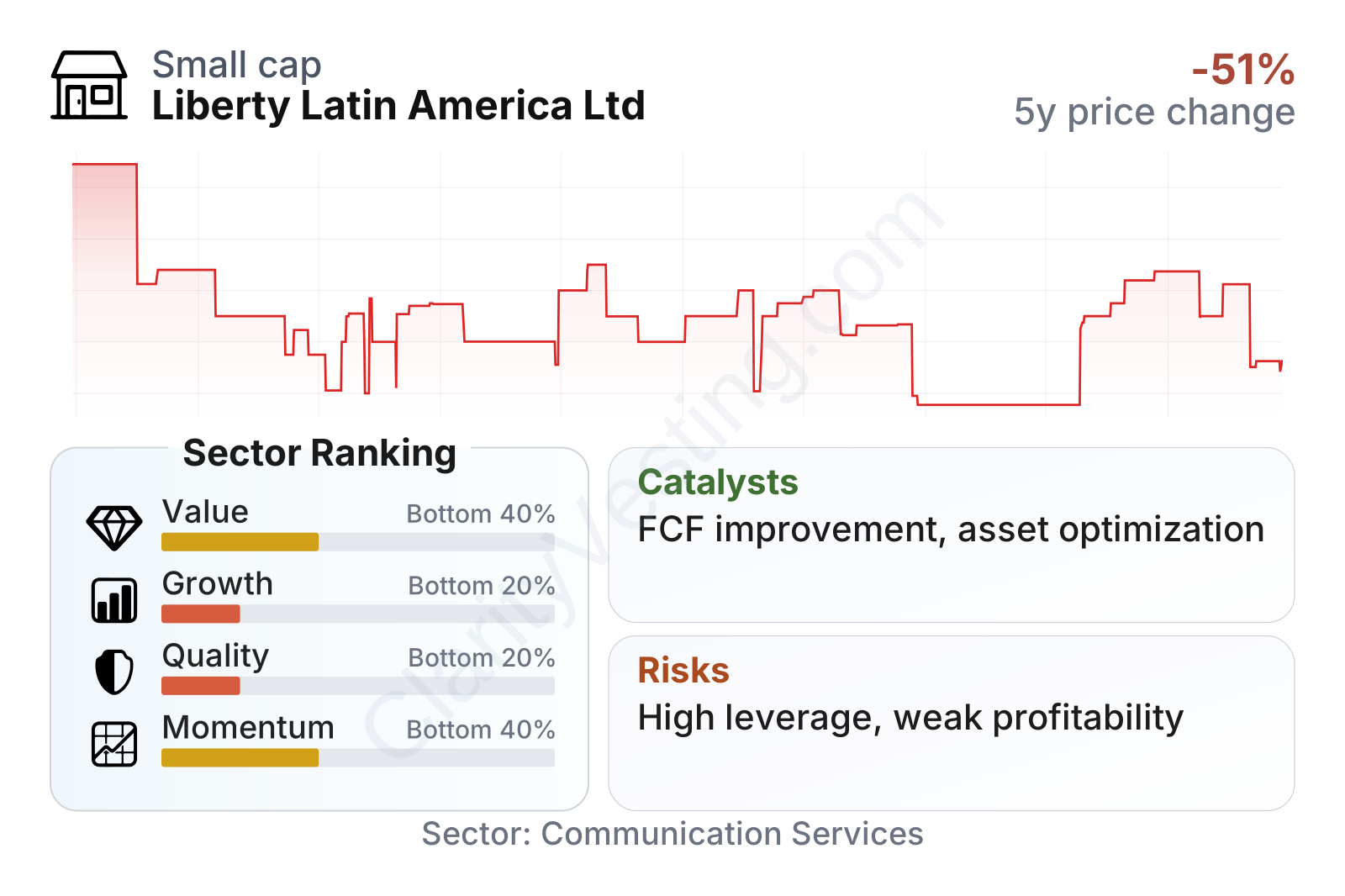
The market value is relatively modest at about $1.5 billion, which places Liberty Latin America in the smaller end of listed telecom groups. The stock’s beta is below 1, suggesting it has not moved as sharply as the broader market on average, although company-specific swings have still been meaningful. The overall factor picture is mixed to weak: value metrics look more favorable than growth metrics, but quality indicators remain under pressure because profitability and returns on capital have been poor compared with the broader communication services sector. Momentum has also been inconsistent, with a rebound over parts of the last year followed by renewed weakness more recently.
The stock chart reflects that uneven profile. Shares have fallen sharply from 2021 levels, then experienced a partial recovery before another pullback in 2026. That pattern usually signals a market that sees operational potential but continues to worry about balance-sheet strain, earnings volatility, and limited visibility on a sustained turnaround.
Growth
Telecom and broadband remain structurally important sectors. Demand for mobile data, home internet speed, business connectivity, and digital infrastructure continues to grow over time, especially in markets where network quality and penetration can still improve. That gives Liberty Latin America a presence in a sector with durable long-term relevance, even if it is not a fast-growth industry in the traditional sense.
The company’s strategy is logical for that backdrop. Management has focused on upgrading networks, expanding fiber and mobile capabilities, deepening convergence between fixed and wireless offerings, and emphasizing B2B, subsea connectivity, and infrastructure-heavy assets that are harder to replicate. In Puerto Rico, Panama, the Caribbean, and parts of South America, this approach can support customer retention and higher-value service bundles. The company has also highlighted cost discipline, asset optimization, and monetization of infrastructure as ways to improve cash generation.
Recent revenue growth has been weak, hovering around flat to slightly negative after stronger post-pandemic comparisons faded. That is an important limitation. It suggests Liberty Latin America is currently operating more as a stabilization and efficiency case than a straightforward top-line growth company. The business is not showing the kind of broad-based sales expansion seen in faster-growing communications segments.
The brighter spot is cash generation. Free cash flow has improved meaningfully over the last few years and is now well above where it stood in 2022. That matters because telecom networks require heavy investment, and cash flow often tells more about financial flexibility than accounting earnings do. For Liberty Latin America, the recent improvement suggests that network investments, cost controls, and operating discipline are producing some tangible financial benefits even though reported profits remain weak.
A key catalyst is the company’s ability to keep converting stable service revenue into stronger free cash flow while simplifying operations and reducing leverage pressure over time. Another opportunity comes from enterprise and wholesale connectivity, where demand for data transport, cloud connectivity, and infrastructure services can expand faster than traditional pay TV or voice. Recent company updates have also continued to emphasize strategic transactions, portfolio optimization, and partnerships, which could help unlock value from assets that public markets may not fully credit today.
Risks
This article is for informational purposes only and does not constitute financial advice. Some content is AI-generated. See Disclaimer


