Stock Analysis · Life360 Inc (LIF)
Stock Analysis · Life360 Inc (LIF)

Overview

Life360 Inc operates a family-focused mobile platform built around location sharing, safety, and coordination. Its app helps households stay connected through features such as real-time location, driving reports, crash detection, emergency dispatch support in certain plans, and digital tools designed to simplify daily family logistics. Over time, the company has expanded beyond a single app into a broader “family safety” ecosystem that combines software subscriptions, advertising, and connected hardware.

The business is increasingly centered on recurring subscription revenue. Life360 has also added complementary products through acquisitions, including pet tracking and item-tracking capabilities, which aim to deepen engagement and increase the number of reasons a household stays within the platform. That strategy matters because a service used frequently by multiple family members can be more resilient than a single-purpose app.

Based on company disclosures, revenue is mainly generated from three areas, with subscriptions clearly leading the mix.

  • Subscription revenue: roughly three-quarters of total revenue, driven by paid membership plans for premium safety and coordination features.
  • Advertising and other non-subscription app revenue: roughly one-fifth of revenue, supported by the company’s large base of active users on free plans.
  • Hardware and related revenue: a smaller but growing share, likely in the mid-single digits, tied to products such as Tile and Jiobit.

The broader financial pattern has been improving: revenue has climbed strongly over the last several years, gross profit has expanded meaningfully, and the company moved from operating losses to operating profit in 2025. Research and development remains a large expense, which is typical for a software platform still investing for scale, but the gap between growth and spending has narrowed considerably.

What stands out most is the operating leverage beginning to appear in the model. Revenue has risen from a little above $100 million in 2021 to nearly $500 million in 2025, while gross profit has scaled even faster. The business still spends heavily on product development and customer acquisition, but it is no longer purely a growth-at-any-cost profile.

Key Figures

MetricValueSector
DateJul 18, 2026
Context
SectorTechnology
IndustrySoftware - Application
Market Cap $4.47B
Beta 1.11
Value
(Cheapness)
P/E Ratio 31.5331.76
FCF Yield 1.92%4.18%
EBIT / EV 0.45%2.56%
PEG N/A
Growth
(Business expansion)
Revenue Growth 38.10%13.50%
RPS Growth (5Y CAGR) 27.41%8.57%
EPS Growth (5Y CAGR) 57.75%-21.87%
Margin Growth (5Y Trend) N/A0.41%
FCF Growth (5Y CAGR) N/A9.76%
Quality
(Business durability)
ROIC (Latest) 17.75%8.54%
ROIC (5Y Median) N/A8.12%
Net Debt / EBIT (Latest) -2.060.38
Net Debt / EBIT (5Y Median) N/A0.38
Operating Margin (Latest) 3.70%9.58%
Operating Margin (5Y Median) -9.05%8.25%
Debt to Equity (Latest) 52.03%33.52%
Profit Margin (Latest) 28.21%6.96%
Free Cash Flow (Latest) $85.98M
Momentum
(Price trend)
3Y Return N/A+30.91%
12M Return (excl. last month) -24.40%+28.90%
6M Return -10.04%+5.38%
Price vs. 200-Day MA -10.31%+7.61%
Better than sector median
Slightly worse than sector median
More than 20% worse than sector median

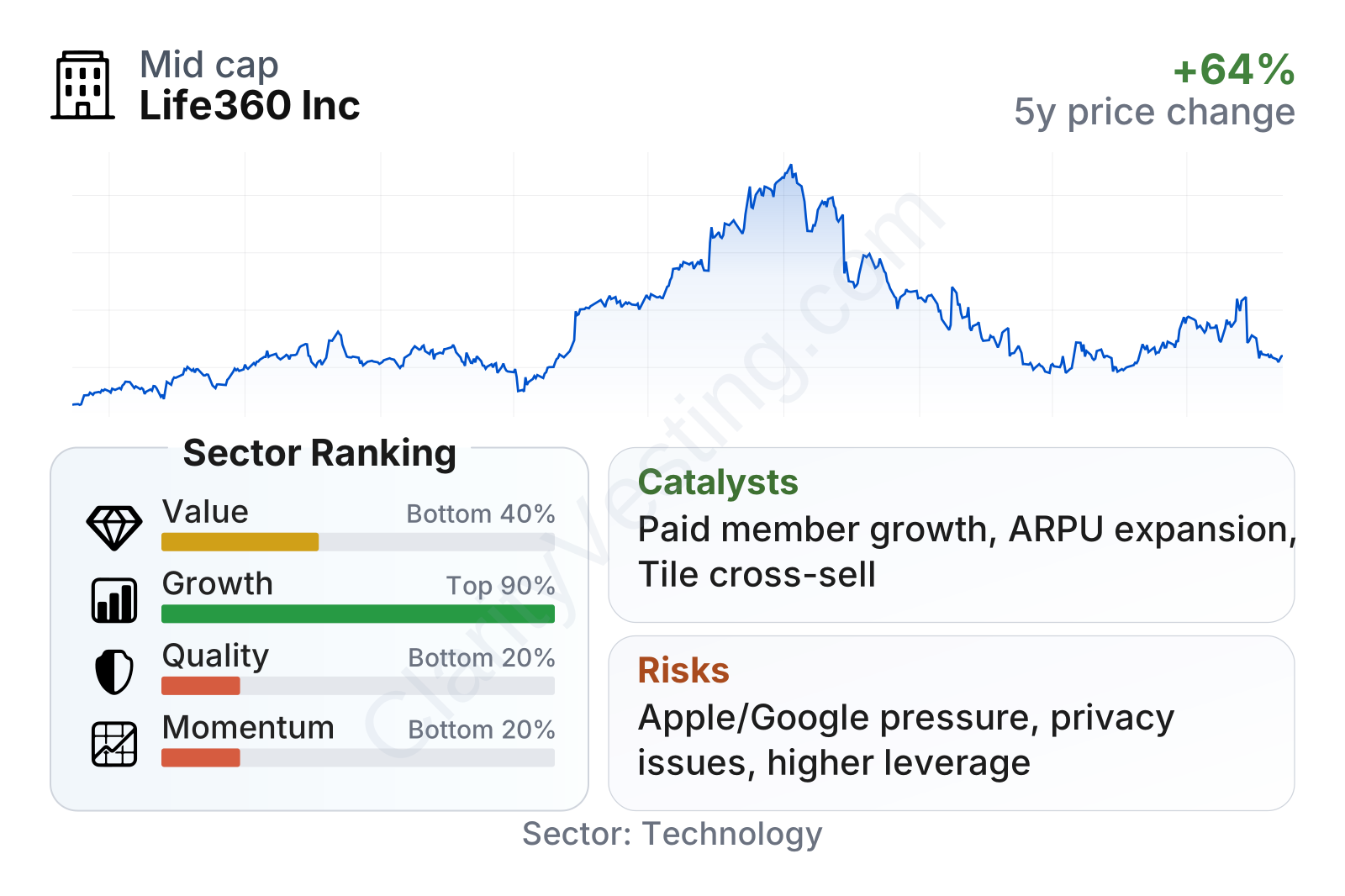
Life360 sits at around a $4 billion market value, which places it in the small-to-mid-cap range for a public software company. The company’s overall profile is unusual: growth ranks near the top of the sector, while momentum is weak and value metrics are not especially cheap relative to current cash generation. Quality is mixed. Returns on invested capital appear solid and the balance sheet still carries net cash relative to EBIT, but operating margins remain below the software sector median even after recent improvement.

The stock’s path has also been volatile. After a powerful run through 2025, shares fell sharply before stabilizing in 2026. That kind of move usually signals that the market is reassessing how much future success was already reflected in the price.

Growth

Life360 operates in a category with favorable long-term demand drivers. Families are spending more time coordinating through smartphones, digital safety features are becoming more mainstream, and connected-device ecosystems continue to expand. The company is positioned at the intersection of consumer subscriptions, mobile engagement, and location-based services, which gives it several ways to grow if execution remains strong.

A major attraction is that Life360’s strategy is internally consistent. The free app helps attract users at scale, premium plans convert part of that audience into recurring revenue, and hardware adds additional use cases that can strengthen retention. This “platform” approach can work well when the product is embedded in everyday routines, since customers are less likely to leave a service that other family members also rely on.

Recent revenue growth has been well above the software sector median, with year-over-year expansion running around the mid-30% to high-30% range in the latest periods. That is a strong pace for a company already approaching half a billion dollars in annual revenue. It suggests the core service is still gaining traction rather than merely benefiting from a temporary rebound.

Cash generation has improved sharply as well. Trailing free cash flow has moved from modest positive territory to a much more meaningful level, which is important because it shows the business is not just growing on paper. Stronger free cash flow gives management more flexibility to invest in product features, acquisitions, and marketing without relying as heavily on outside capital.

There are also visible catalysts. Management has emphasized international expansion, higher paid-member penetration, and deeper integration of acquired products such as Tile and Jiobit. If the company can cross-sell more effectively across safety, pet, and item-tracking use cases, it may increase revenue per household over time. Another opportunity is advertising monetization from the free user base, although this is strategically less durable than subscriptions and must be handled carefully to avoid hurting user experience.

Recent company updates have pointed to continued subscriber growth, rising average revenue from premium offerings, and progress on profitability. For a business like Life360, the most significant opportunity is not a single headline event but the compounding effect of turning a widely used app into a multi-product household subscription platform.

Risks

Life360’s biggest risk is execution risk after a period of rapid expansion. The company has improved financially, but the business still needs to prove that recent profitability can be sustained through different market conditions. A meaningful portion of recent net income appears to have been helped by tax-related effects, while the operating margin itself remains relatively modest for software. That means headline earnings may look stronger than the underlying operating business alone.

The balance sheet is not distressed, but leverage has changed noticeably. Debt to equity was negligible before rising sharply in 2025 and then easing back, yet it still remains above the sector median. Even with healthy cash characteristics, that shift is worth monitoring because it reduces some of the financial conservatism the company previously had.

Profit margin has turned strongly positive after being negative, which is encouraging, but the scale of that improvement likely overstates the steadiness of the underlying margin profile. Investors looking at long-term durability would probably focus more on recurring cash flow and operating margin progression than on one period’s very high net margin.

Competition is another important consideration. Life360 has strong brand recognition in family location sharing and appears to be one of the category leaders, especially in dedicated family-safety apps. That said, it does not operate in a vacuum. Large platform companies such as Apple and Google already offer built-in location and device-finding tools. Specialized rivals in safety monitoring, pet tracking, and item tracking also compete for attention. Life360’s advantage is that it packages several everyday use cases into one family-centered product, but bigger ecosystems can replicate some features or bundle them at low incremental cost.

Privacy and trust are central risks as well. A company handling sensitive location data faces ongoing scrutiny from regulators, users, and advocacy groups. Even without a major scandal, changes in platform rules, consumer expectations, or data practices can affect monetization and reputation. For Life360, trust is part of the product itself, so any perceived weakness in that area could have an outsized impact.

Acquisition integration is a further challenge. Tile and Jiobit broaden the platform, but they also add complexity. Hardware businesses generally carry lower margins and different operational demands than software subscriptions. If integration falls short, the company could end up with a broader portfolio that is harder to manage without delivering the hoped-for cross-selling benefits.

Valuation

Valuation looks easier to defend now than it did during earlier phases when the earnings multiple spiked to extreme levels. The current P/E ratio is around the high-20s, slightly below the sector median, which on the surface does not look stretched. But that simple comparison needs caution because software peers often have more established operating margins, and Life360’s earnings base has only recently turned positive.

On other measures, the picture is less generous. Free cash flow yield and EBIT relative to enterprise value both trail sector medians, suggesting the market is still paying a full price for future expansion rather than for today’s operating output. In other words, the stock no longer reflects the same excess seen at prior peaks, but it still appears to embed confidence that growth remains high and margins continue to improve.

The valuation context therefore depends heavily on whether Life360 can keep converting user growth into lasting subscription economics. If the business continues to scale while lifting margins, the current multiple range can be rationalized. If growth slows materially or profit expansion stalls, the shares could still look demanding despite the pullback from past highs.

Conclusion

Life360 has evolved from a popular consumer app into a more serious subscription-driven platform with expanding cash flow, improving profitability, and a clearer multi-product strategy. The company is operating in an attractive niche where digital family safety, coordination, and connected tracking can support long-term demand. Revenue growth remains unusually strong for its size, and the business is finally showing signs that scale can translate into operating leverage.

The main challenge is that the company is not yet a fully mature software business. Margins still lag stronger peers, acquisitions add complexity, and competition from larger platform ecosystems remains a real constraint. Privacy is also not a side issue here; it is fundamental to the brand. That makes execution and trust just as important as subscriber growth.

Overall, Life360 currently looks like a high-growth platform that has moved into a more credible financial phase, but not yet into a low-risk one. The market appears to recognize both sides of that profile: the share price has cooled from more aggressive levels, yet the valuation still assumes that growth, monetization, and product expansion continue to work together over time.

Sources:

  • Life360 Inc. Investor Relations — Annual Report 2025
  • Life360 Inc. Investor Relations — Quarterly Shareholder Letter / Results for Q1 2026
  • SEC EDGAR — Life360 Inc. Form 10-K for fiscal year 2025
  • SEC EDGAR — Life360 Inc. Form 10-Q for quarter ended March 31, 2026
  • Life360 Inc. Investor Relations — Earnings Presentation materials published in 2026
  • Life360 Inc. corporate website — Product and company overview pages
  • Wikipedia — Life360
  • Wikipedia — Tile (company)
  • Wikipedia — Jiobit

This article is for informational purposes only and does not constitute financial advice. Some content is AI-generated. See Disclaimer
Sign up for exclusive research and insights.

Unsubscribe anytime.