Stock Analysis · Legend Holdings Corporation (LGNRF)
Overview
Legend Holdings Corporation is a Chinese holding company best known as the parent of Lenovo, one of the world’s largest personal computer makers. Through its subsidiaries and investments, the group operates across information technology, industrial and supply-chain related activities, consumer services, agriculture and food, and financial services. In practice, the business is still heavily shaped by Lenovo, which is the main operating asset and the clearest driver of revenue, profit swings, and market perception.
For long-term analysis, it is useful to separate Legend into two layers. The first is the operating business led by Lenovo, which sells PCs, servers, storage, smartphones, tablets, and related services. The second is Legend’s investment platform, which has historically included stakes in private equity, agriculture and food, and other diversified businesses. That mix makes the company broader than a pure hardware name, but it also makes the structure more complex and harder to evaluate than a single-business company.
The main revenue sources are approximately the following, based on the company’s most recent annual disclosures and Lenovo’s segment reporting:
- Intelligent Devices Group: about 80% to 82% of Lenovo revenue. This includes PCs, laptops, tablets, smartphones, accessories, and other smart devices. PCs remain the core of this segment.
- Infrastructure Solutions Group: about 10% to 12% of Lenovo revenue. This covers servers, storage, software, and infrastructure products sold to enterprise and cloud customers.
- Solutions and Services Group: about 8% to 10% of Lenovo revenue. This includes IT services, device-as-a-service, support, managed services, and enterprise solutions.
- Other Legend Holdings businesses and investments: revenue contribution is much smaller than Lenovo’s consolidated operating base, but these activities can still affect earnings, cash flow, and balance-sheet risk through investment gains, losses, and financing needs.
The business model is therefore a combination of high-volume hardware sales, lower but potentially steadier services income, and a portfolio layer that can add both optionality and complexity.
The long-term pattern shows a low-margin company with very large revenue, where most sales are absorbed by product costs and operating expenses. Revenue recovered strongly after the 2023 slowdown, but net income remained thin, which underlines how sensitive results are to margins, financing costs, and execution.
Key Figures
| Metric | Value | Sector ⓘ |
|---|---|---|
| Date | Sep 12, 2026 | |
| Context | ||
| Sector | Technology | |
| Industry | Computer Hardware | |
| Market Cap ⓘ | $2.66B | |
| Beta ⓘ | 0.78 | |
Value (Cheapness) | ||
| P/E Ratio ⓘ | N/A | 29.51 |
| FCF Yield ⓘ | -554.19% | 4.25% |
| EBIT / EV ⓘ | N/A | 2.85% |
| PEG ⓘ | N/A | |
Growth (Business expansion) | ||
| Revenue Growth ⓘ | -5.60% | 15.40% |
| RPS Growth (5Y CAGR) ⓘ | 5.09% | 8.56% |
| EPS Growth (5Y CAGR) ⓘ | -5.68% | -11.88% |
| Margin Growth (5Y Trend) ⓘ | -2.39% | 0.46% |
| FCF Growth (5Y CAGR) ⓘ | N/A | 9.80% |
Quality (Business durability) | ||
| ROIC (Latest) ⓘ | 12.21% | 9.44% |
| ROIC (5Y Median) ⓘ | 6.42% | 8.30% |
| Net Debt / EBIT (Latest) ⓘ | 3.35 | 0.54 |
| Net Debt / EBIT (5Y Median) ⓘ | 6.52 | 0.44 |
| Operating Margin (Latest) ⓘ | 3.64% | 9.58% |
| Operating Margin (5Y Median) ⓘ | 3.24% | 8.25% |
| Debt to Equity (Latest) ⓘ | 409.90% | 33.33% |
| Profit Margin (Latest) ⓘ | 0.24% | 7.14% |
| Free Cash Flow (Latest) ⓘ | -$14.76B | |
Momentum (Price trend) | ||
| 3Y Return ⓘ | -15.37% | +45.48% |
| 12M Return (excl. last month) ⓘ | +1.32% | +23.48% |
| 6M Return ⓘ | +1.32% | +20.93% |
| Price vs. 200-Day MA ⓘ | +0.99% | +7.43% |
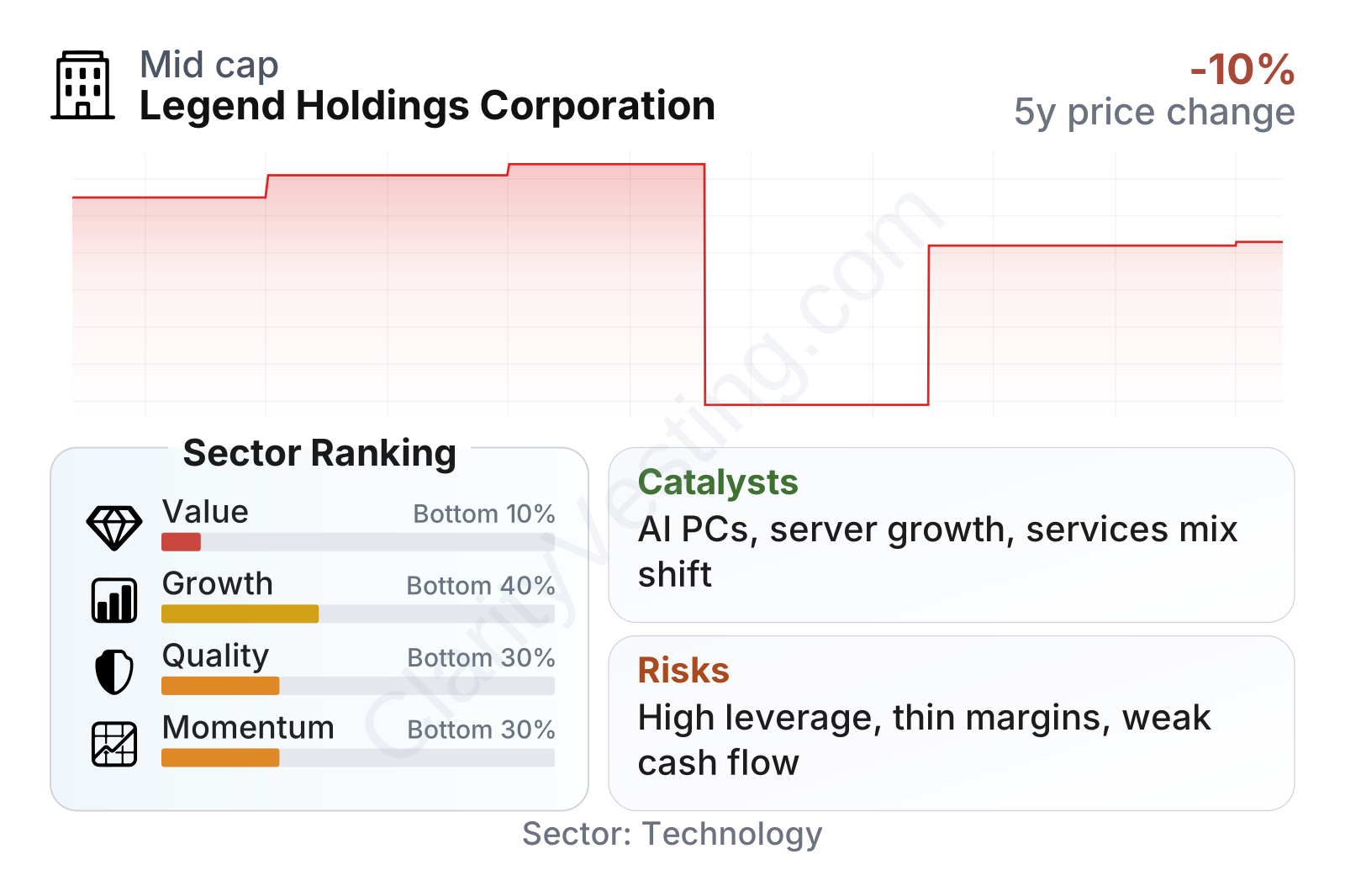
Legend is a mid-sized public company by market value, and its share price volatility has been lower than the broader technology sector, as shown by a beta below 1. The stock history, however, also reflects uneven confidence: after a sharp drop in 2024, the shares partially recovered but still lagged the broader sector over multi-year periods.
The broader metric profile is mixed to weak. On valuation screens, the stock can look statistically cheap, but that signal is heavily distorted by extremely low earnings multiples and negative free cash flow. Growth ranks below the sector median, quality is held back by very high leverage and very low profitability, and recent share-price momentum has also been soft. One brighter point is return on invested capital over the last twelve months, which stands above the sector median, suggesting the operating assets can still generate decent returns when conditions are favorable.
Growth
Legend operates in parts of technology that still matter globally, but not all of them are fast-growing. PCs are a mature market with replacement cycles rather than constant structural expansion. That means long-term growth is less likely to come from simply shipping more traditional computers every year. Instead, the more attractive areas are enterprise infrastructure, IT services, hybrid work tools, AI-enabled devices, and commercial solutions tied to large corporate customers.
That strategic direction makes sense. Lenovo has been pushing beyond PCs into servers, storage, services, and AI-oriented infrastructure. If that shift continues, it could gradually improve the group’s business mix by increasing the share of recurring and enterprise-oriented revenue. Services and solutions are especially important because they usually carry better margins and can make performance less dependent on hardware cycles.
The recent picture is not a straight line. Annual revenue growth is currently negative on a year-over-year basis and trails the sector median by a wide margin, even though the longer revenue trend over five years is still positive. In other words, the company has grown over a full cycle, but the latest snapshot suggests that pace remains inconsistent.
Cash generation is another important point. Free cash flow over the trailing twelve months is negative, which weakens the growth case because expansion is more valuable when it also converts into cash. The company’s recent annual accounts showed a rebound in revenue and operating income in 2025, but that improvement has not fully translated into a stronger trailing cash profile yet.
As for catalysts, the strongest ones are tied to Lenovo’s positioning. A broader enterprise hardware refresh cycle, AI-capable PCs, demand for servers and storage linked to AI workloads, and continued expansion of services could all help. Recent company communications have emphasized AI integration across devices and infrastructure, which is strategically relevant because it gives Lenovo a way to participate in a major industry theme without relying on a single niche product.
Risks
This article is for informational purposes only and does not constitute financial advice. Some content is AI-generated. See Disclaimer


