Stock Analysis · LGI Homes (LGIH)
Overview
LGI Homes is a U.S. homebuilder focused mainly on entry-level and move-up buyers. The company develops communities, acquires land, builds homes, and sells completed houses directly to customers across multiple states. Its model is built around offering move-in ready homes, standardized floor plans, and an in-house sales and marketing approach designed to keep the buying process simple.
Revenue comes primarily from home closings, with a much smaller contribution from financial services tied to the home purchase process. Based on the company’s recent annual reporting structure, the business can be summarized this way:
- Home sales: about 97% to 99% of revenue. This includes revenue from closing newly built homes in the company’s communities.
- Financial services and other: about 1% to 3% of revenue. This generally includes mortgage-related and title-related activities that support the home sale process.
Geographically, LGI Homes is spread across fast-growing Sun Belt and other expansion markets rather than being concentrated in only one region. That gives it exposure to population migration and household formation trends, but it also ties results closely to local affordability, land availability, and mortgage rates.
The long-term business case is fairly easy to understand: LGI buys land, develops lots, builds homes at scale, and earns a profit when those homes are sold. The challenge is that this is a cyclical business. Results can swing sharply when mortgage rates rise, affordability weakens, or incentives are needed to keep sales moving.
The longer-term picture shows a business that was much more profitable during the housing boom of 2021 and 2022 than it is today. Revenue and gross profit have moved down from those peak levels, while operating income and net income have compressed even more, which suggests that pricing power has weakened and the cost of sustaining sales has become heavier.
Key Figures
| Metric | Value | Sector ⓘ |
|---|---|---|
| Date | Sep 12, 2026 | |
| Context | ||
| Sector | Consumer Cyclical | |
| Industry | Residential Construction | |
| Market Cap ⓘ | $1.15B | |
| Beta ⓘ | 1.84 | |
Value (Cheapness) | ||
| P/E Ratio ⓘ | 17.10 | 17.10 |
| FCF Yield ⓘ | 11.40% | 8.53% |
| EBIT / EV ⓘ | 3.23% | 6.46% |
| PEG ⓘ | 0.69 | |
Growth (Business expansion) | ||
| Revenue Growth ⓘ | 5.70% | 5.75% |
| RPS Growth (5Y CAGR) ⓘ | -12.03% | 9.14% |
| EPS Growth (5Y CAGR) ⓘ | -47.97% | -18.21% |
| Margin Growth (5Y Trend) ⓘ | -12.02% | -0.23% |
| FCF Growth (5Y CAGR) ⓘ | N/A | 4.91% |
Quality (Business durability) | ||
| ROIC (Latest) ⓘ | 1.86% | 12.61% |
| ROIC (5Y Median) ⓘ | 6.52% | 10.72% |
| Net Debt / EBIT (Latest) ⓘ | 16.98 | 2.10 |
| Net Debt / EBIT (5Y Median) ⓘ | 5.40 | 2.32 |
| Operating Margin (Latest) ⓘ | 5.80% | 9.25% |
| Operating Margin (5Y Median) ⓘ | 11.75% | 9.64% |
| Debt to Equity (Latest) ⓘ | 74.34% | 75.78% |
| Profit Margin (Latest) ⓘ | 3.93% | 5.33% |
| Free Cash Flow (Latest) ⓘ | $131.01M | |
Momentum (Price trend) | ||
| 3Y Return ⓘ | -57.95% | +14.53% |
| 12M Return (excl. last month) ⓘ | -7.37% | +3.08% |
| 6M Return ⓘ | +20.45% | +0.55% |
| Price vs. 200-Day MA ⓘ | -2.27% | -0.54% |
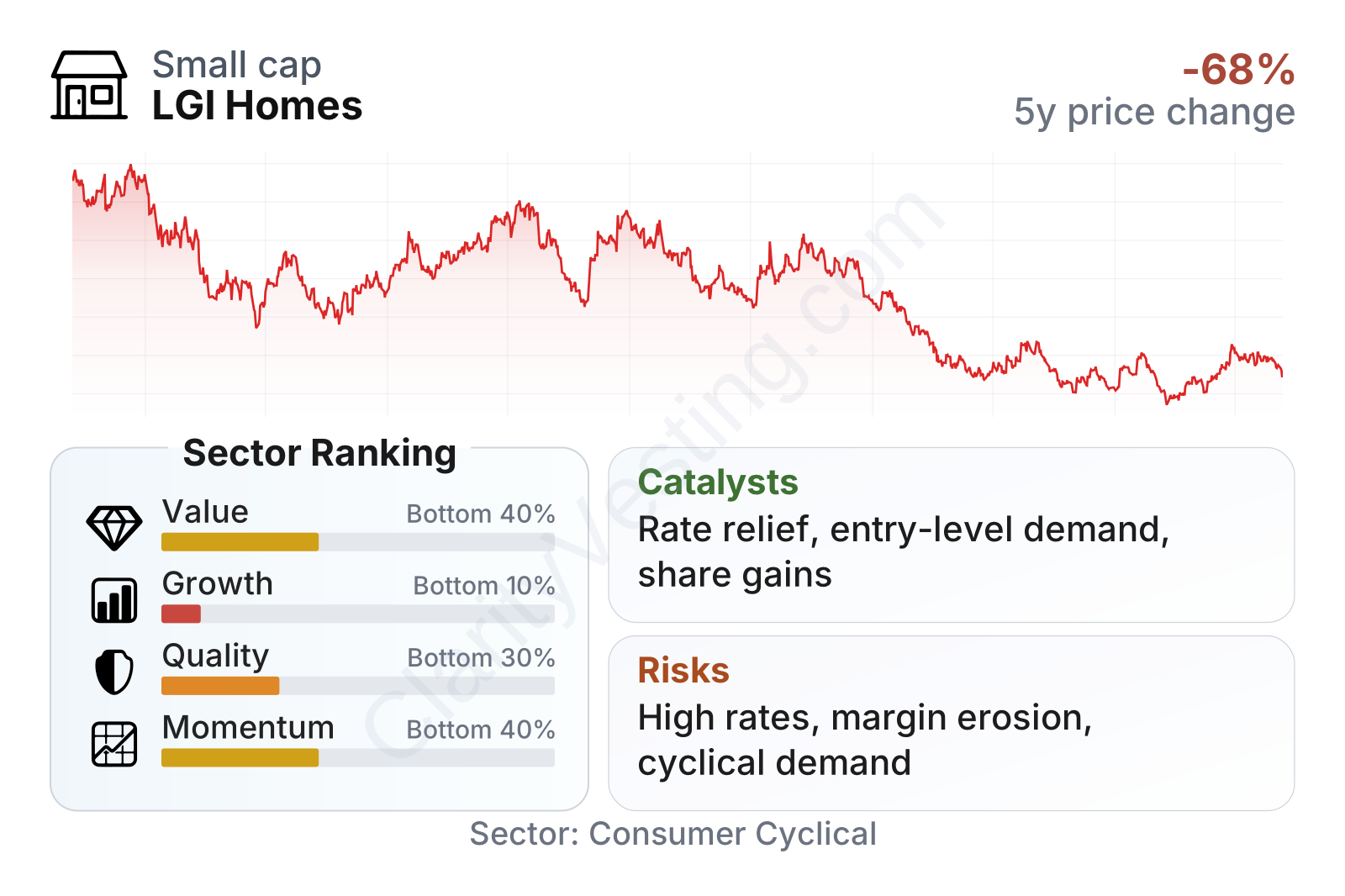
LGI Homes sits in the smaller end of the public homebuilder group and carries a high-beta profile, which helps explain why the stock has been volatile. The overall factor picture is mixed: value metrics are not especially attractive relative to the sector, growth ranks weakly, quality is under pressure because returns on capital and margins have fallen, and momentum has improved somewhat over the past year even after a much weaker three-year share price record.
The stock history reflects that same pattern. Shares are far below the highs reached during the post-pandemic housing surge, showing how strongly sentiment has reset as earnings cooled. Even so, the recent trading pattern suggests the market has become less negative than it was at the deepest part of the downturn.
Growth
Residential construction remains a sector with long-term demand support in the United States. Population growth, household formation, and a structural shortage of housing in many markets still create a real need for new homes. For builders focused on more affordable price points, demand can remain resilient even in a slower market, especially when existing-home supply is tight and buyers need alternatives.
LGI Homes’ strategy still makes sense in that context. The company has historically targeted first-time and affordable buyers, a segment that is large and underserved. Its community-based operating model, standardized construction, and integrated marketing approach can work well when buyers are highly payment-sensitive and want a simpler path to homeownership. If mortgage rates stabilize or ease, that part of the market could respond quickly.
Recent revenue growth has been uneven rather than consistently upward. The company moved from very strong growth during the earlier housing upcycle into several periods of contraction, and only recently returned to modest year-over-year growth. That pattern shows a business that still has demand, but not enough to fully offset affordability pressure and a softer pricing environment.
Cash generation is another area worth watching closely. Free cash flow has been negative for several years, although the outflow has narrowed materially. For a homebuilder, that does not automatically mean the model is broken because land purchases, development, and inventory timing can consume cash before closings occur. Still, long-term improvement here would be important because stronger cash conversion would give the company more flexibility during slower housing periods.
One of the clearest catalysts is any improvement in the mortgage-rate backdrop. A lower or more stable financing environment could help affordability, reduce the need for incentives, and improve absorption rates in LGI’s communities. Another possible growth driver is market share: smaller builders can sometimes expand by staying active in local markets where weaker operators pull back.
Recent company updates have also pointed to continued community count management and efforts to align product and pricing with current demand conditions. That is not an explosive catalyst by itself, but it matters because homebuilders often recover first through better execution before headline growth becomes obvious.
Risks
This article is for informational purposes only and does not constitute financial advice. Some content is AI-generated. See Disclaimer