Stock Analysis · Lagardere SA (LGDDF)
Overview
Lagardère SA is a French media, publishing, and travel retail group. Its business is much easier to understand than the “specialty retail” label may suggest. The company mainly operates airport and railway station stores through Lagardère Travel Retail, and it also owns a major global publishing business through Lagardère Publishing, best known internationally for Hachette. It also has a smaller media activities perimeter, including magazines and licensing-related operations.
The company’s revenue mix is led by travel retail, which has become the clear engine of the group as passenger traffic recovered after the pandemic and concession networks expanded. Based on recent annual reporting, the main sources of revenue are approximately:
- Travel Retail: about 72% to 76% of revenue. This includes duty free, foodservice, convenience stores, bookstores, and specialty retail in airports and train stations.
- Publishing: about 20% to 24% of revenue. This includes books across general literature, education, illustrated works, children’s titles, and distribution activities.
- Other activities, mainly media and corporate items: about 3% to 5% of revenue. This area is much smaller than the two core divisions.
That mix matters because it gives Lagardère two very different profit drivers: a cyclical but large-scale travel retail business tied to passenger flows, and a more stable publishing arm built on catalog depth, authors, and recurring releases. Over the last few years, the group has also become more concentrated around these two pillars, making the business easier to follow than it was in the past.
The long-term financial direction has been positive: revenue and operating income have recovered strongly since 2021, reflecting the rebound in travel retail and a broader normalization of group profitability. Net income remains much smaller than operating profit, however, showing that interest expense and financing structure still absorb an important share of earnings.
Key Figures
| Metric | Value | Sector ⓘ |
|---|---|---|
| Date | Sep 12, 2026 | |
| Context | ||
| Sector | Consumer Cyclical | |
| Industry | Specialty Retail | |
| Market Cap ⓘ | $3.16B | |
| Beta ⓘ | 0.82 | |
Value (Cheapness) | ||
| P/E Ratio ⓘ | 12.95 | 17.10 |
| FCF Yield ⓘ | 62.93% | 8.53% |
| EBIT / EV ⓘ | N/A | 6.46% |
| PEG ⓘ | 2.35 | |
Growth (Business expansion) | ||
| Revenue Growth ⓘ | 1.70% | 5.75% |
| RPS Growth (5Y CAGR) ⓘ | 14.67% | 9.14% |
| EPS Growth (5Y CAGR) ⓘ | N/A | -18.21% |
| Margin Growth (5Y Trend) ⓘ | 5.12% | -0.23% |
| FCF Growth (5Y CAGR) ⓘ | 13.71% | 4.91% |
Quality (Business durability) | ||
| ROIC (Latest) ⓘ | 26.13% | 12.61% |
| ROIC (5Y Median) ⓘ | 9.31% | 10.72% |
| Net Debt / EBIT (Latest) ⓘ | 3.64 | 2.10 |
| Net Debt / EBIT (5Y Median) ⓘ | 9.77 | 2.32 |
| Operating Margin (Latest) ⓘ | 6.46% | 9.25% |
| Operating Margin (5Y Median) ⓘ | 5.36% | 9.64% |
| Debt to Equity (Latest) ⓘ | 572.80% | 75.78% |
| Profit Margin (Latest) ⓘ | 2.21% | 5.33% |
| Free Cash Flow (Latest) ⓘ | $1.99B | |
Momentum (Price trend) | ||
| 3Y Return ⓘ | -3.77% | +14.53% |
| 12M Return (excl. last month) ⓘ | -10.36% | +3.08% |
| 6M Return ⓘ | -5.27% | +0.55% |
| Price vs. 200-Day MA ⓘ | +5.60% | -0.54% |
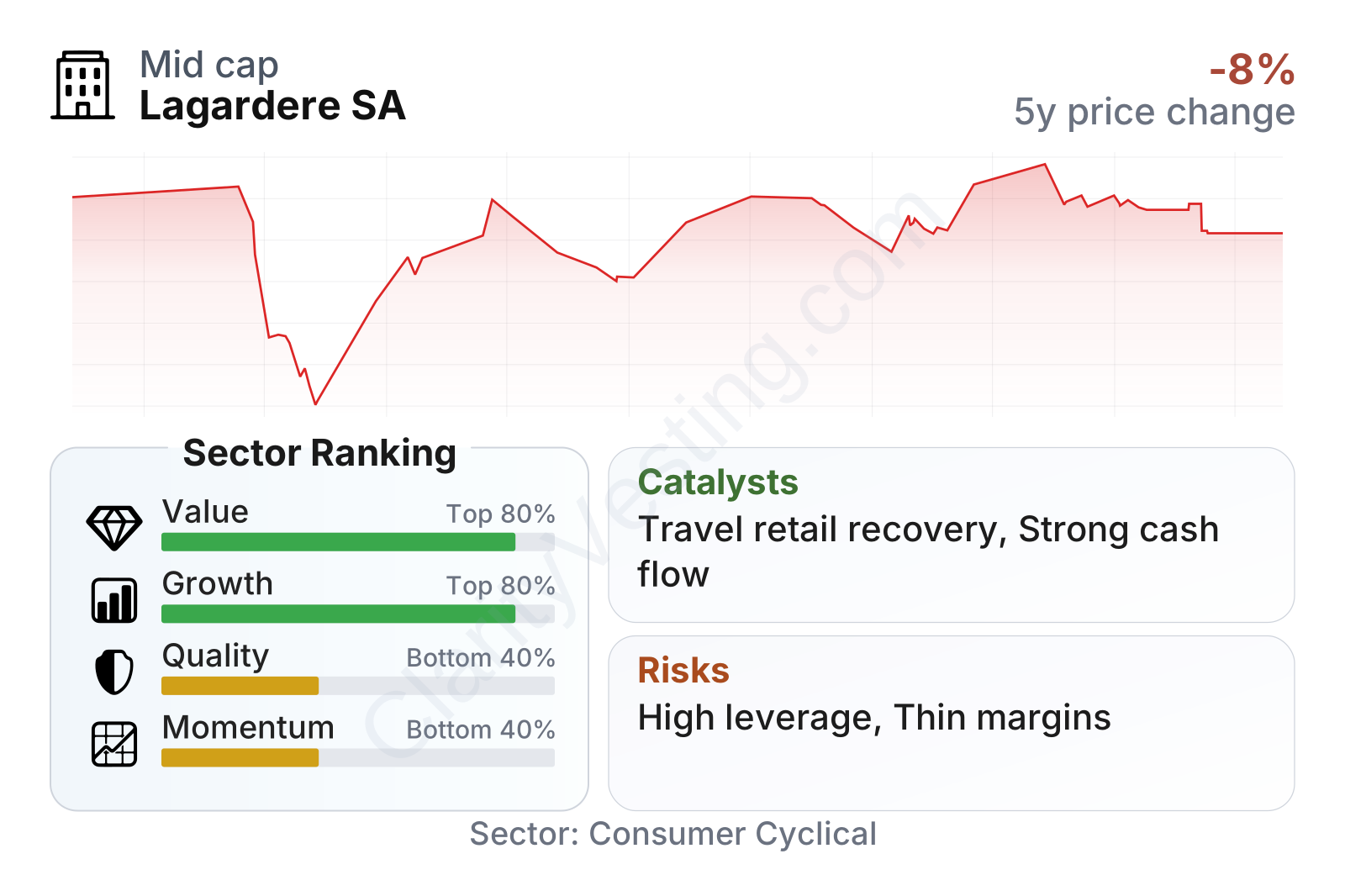
Lagardère is a mid-sized company by market value, and its share price has been relatively flat over a multi-year period despite a significant operational recovery. The metrics table shows a mixed profile. On one side, valuation looks undemanding versus the sector, free cash flow generation is very strong, and five-year growth indicators are better than many peers. On the other side, leverage remains elevated, margins are below the sector median, and market momentum has been weaker than average. In simple terms, the company looks stronger operationally than its stock performance alone would suggest, but the balance sheet still limits how clean the investment profile appears.
Growth
Lagardère operates in two sectors with different growth patterns. Travel retail is supported by long-term increases in air traffic, the expansion of airport commercial space, and rising spending per passenger in major hubs. Publishing is a slower-growth business overall, but it can remain resilient when supported by strong intellectual property, educational titles, and global distribution. This combination gives the group access to one structural growth market and one steadier cash-generating activity.
The company’s strategy broadly makes sense for future growth because it is focused on areas where scale matters. In travel retail, winning concession contracts and operating across many transport hubs can create network effects and supplier advantages. In publishing, owning a large portfolio of imprints and international distribution capabilities helps maintain relevance even when individual title performance varies. Since the strategic reshaping of the group, the business appears less scattered and more centered on segments where it already has established positions.
Recent annual growth is modest, with revenue growth of roughly 2% year over year, below the broader sector median. That said, the longer view is stronger: five-year revenue per share growth and free cash flow growth are well above sector medians, suggesting that the group’s recovery has not been a short one-year rebound but part of a broader rebuilding process.
Cash generation is one of the more attractive parts of the profile. Trailing free cash flow is very high relative to the company’s size, and the five-year trend is strong. For a business with concession exposure and financing needs, this matters because it creates more room to reduce debt, support operations, and manage contract cycles. A strong cash profile also helps offset the fact that accounting profit margins remain thin.
A notable catalyst in recent years has been the normalization of global passenger traffic and the recovery of airport retail economics. Another important element is governance and ownership stability following the rise of Vivendi as controlling shareholder and the later mandatory tender process. That does not automatically create growth, but it does reduce uncertainty around the company’s strategic perimeter and can support longer-term execution. The publishing division also continues to offer optionality through well-known brands and international expansion, particularly in English-language markets.
Risks
This article is for informational purposes only and does not constitute financial advice. Some content is AI-generated. See Disclaimer


