Stock Analysis · Levi Strauss & Co (LEVI)
Overview
Levi Strauss & Co. is a global apparel company best known for denim, especially the Levi’s brand. Its business centers on designing, marketing, and selling jeans, casualwear, tops, outerwear, and related accessories through wholesale partners, company-operated stores, e-commerce, and licensed arrangements. In addition to Levi’s, the group also owns Dockers and Beyond Yoga, giving it exposure to workwear-inspired casual apparel and premium activewear.
The company’s revenue base is still heavily anchored in the Levi’s brand, while management has been working to expand direct-to-consumer sales and women’s, tops, and lifestyle categories to reduce reliance on classic men’s denim. Based on recent annual reporting, the main sources of revenue can be summarized as follows:
- Levi’s brand: approximately 88% to 90% of revenue. This includes men’s and women’s denim, tops, bottoms, outerwear, accessories, and footwear sold globally.
- Dockers: approximately 5% to 7% of revenue. This business focuses on khakis, chinos, tops, and work-to-casual apparel, mainly in wholesale and some direct channels.
- Beyond Yoga and other brands: approximately 3% to 5% of revenue. This includes premium athleisure and adjacent apparel categories.
Looking at channel mix, direct-to-consumer has become a major strategic pillar and now represents roughly 45% to 50% of sales, with the remainder largely coming from wholesale and a small licensed component. Geographically, the Americas remains the largest region at about 55% of revenue, followed by Europe near 30%, and Asia around 15%, though these percentages can shift modestly by year.
The business model has two appealing features for long-term analysis: a globally recognized heritage brand and a margin structure that benefits when more sales move through owned stores and online channels instead of third-party retailers.
Over the last several years, revenue has stayed around the low-to-mid $6 billion range, but profit conversion has been more volatile. Gross profit has remained solid, while operating income and net income have moved around more noticeably, showing how sensitive apparel earnings can be to promotions, operating costs, and brand investment.
Key Figures
| Metric | Value | Sector ⓘ |
|---|---|---|
| Date | Sep 12, 2026 | |
| Context | ||
| Sector | Consumer Cyclical | |
| Industry | Apparel Manufacturing | |
| Market Cap ⓘ | $7.76B | |
| Beta ⓘ | 1.31 | |
Value (Cheapness) | ||
| P/E Ratio ⓘ | 14.40 | 17.10 |
| FCF Yield ⓘ | 7.42% | 8.53% |
| EBIT / EV ⓘ | 8.36% | 6.46% |
| PEG ⓘ | N/A | |
Growth (Business expansion) | ||
| Revenue Growth ⓘ | 8.00% | 5.75% |
| RPS Growth (5Y CAGR) ⓘ | 2.81% | 9.14% |
| EPS Growth (5Y CAGR) ⓘ | -18.24% | -18.21% |
| Margin Growth (5Y Trend) ⓘ | -0.46% | -0.23% |
| FCF Growth (5Y CAGR) ⓘ | -13.16% | 4.91% |
Quality (Business durability) | ||
| ROIC (Latest) ⓘ | 18.16% | 12.61% |
| ROIC (5Y Median) ⓘ | 17.19% | 10.72% |
| Net Debt / EBIT (Latest) ⓘ | 1.91 | 2.10 |
| Net Debt / EBIT (5Y Median) ⓘ | 2.46 | 2.32 |
| Operating Margin (Latest) ⓘ | 11.45% | 9.25% |
| Operating Margin (5Y Median) ⓘ | 10.87% | 9.64% |
| Debt to Equity (Latest) ⓘ | 101.02% | 75.78% |
| Profit Margin (Latest) ⓘ | 9.67% | 5.33% |
| Free Cash Flow (Latest) ⓘ | $575.40M | |
Momentum (Price trend) | ||
| 3Y Return ⓘ | +62.55% | +14.53% |
| 12M Return (excl. last month) ⓘ | +12.11% | +3.08% |
| 6M Return ⓘ | +12.66% | +0.55% |
| Price vs. 200-Day MA ⓘ | -7.16% | -0.54% |
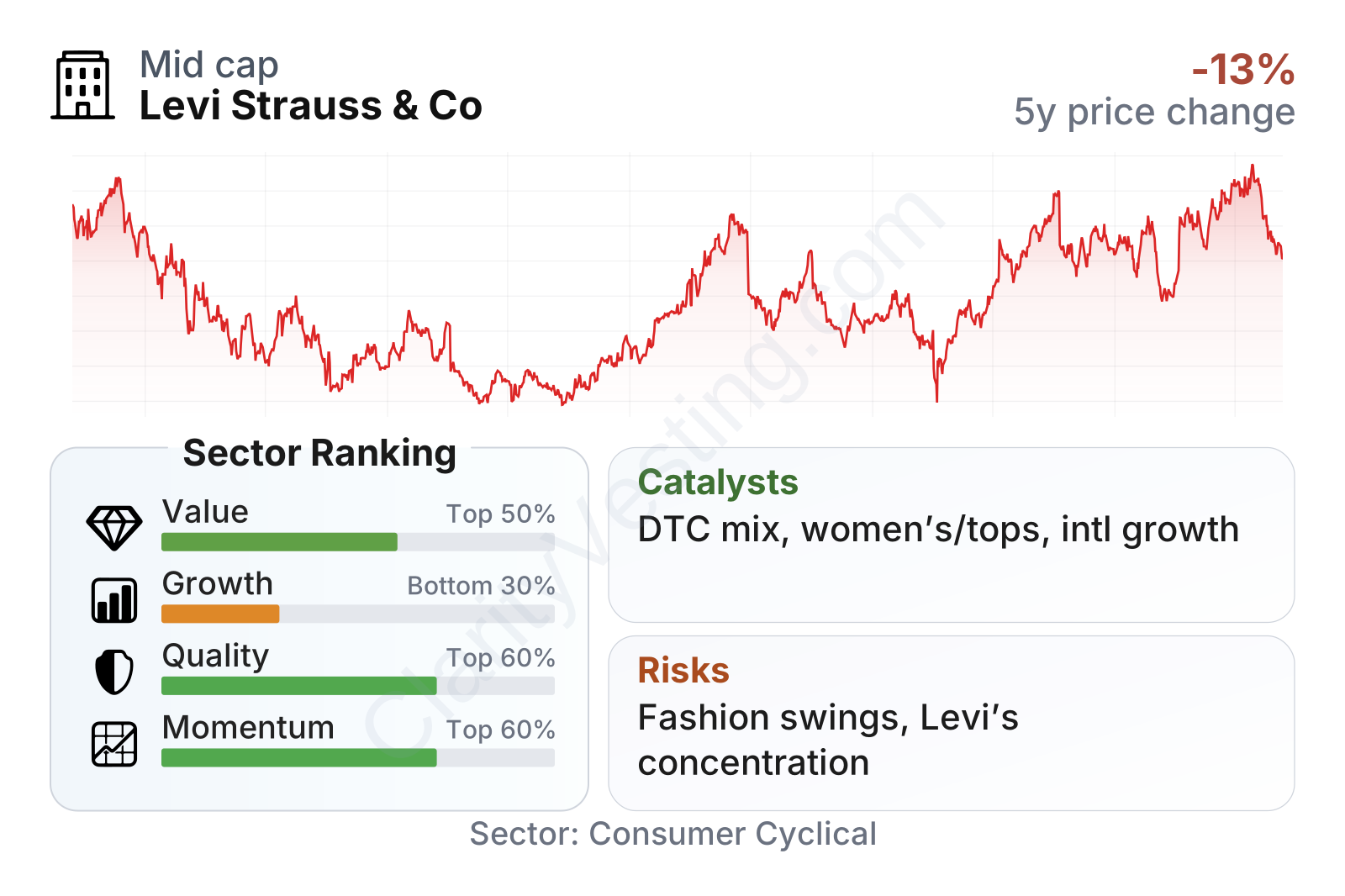
Levi Strauss is a mid-sized public company with a stock that has shown stronger recent momentum than much of the consumer cyclical space. The quality profile is relatively solid: returns on invested capital and operating margins sit above the sector median, and net debt compared with EBIT is currently conservative. Growth, however, looks less impressive over a multi-year period, especially in revenue per share and free cash flow trends. In other words, the company currently looks stronger on profitability and brand economics than on sustained expansion speed.
The stock-price history also reflects that pattern. After a long stretch of weakness from 2021 into 2023, the shares recovered sharply through 2024 and into 2026, suggesting the market has become more confident in execution and earnings normalization.
Growth
Levi Strauss operates in a mature but still attractive global apparel market. This is not a high-growth industry in the way software or semiconductors can be, yet it remains large, international, and resilient because clothing demand is recurring. Within that market, denim and casual lifestyle apparel continue to have durable demand, while premium activewear and direct digital retailing offer additional expansion paths.
The company’s strategy makes sense for future growth because it is focused on areas where brand strength matters most. Management has been emphasizing direct-to-consumer, international expansion, women’s apparel, tops beyond jeans, and newer categories such as activewear through Beyond Yoga. That matters because these categories can increase purchase frequency and reduce dependence on a single product type. A customer who knows Levi’s only for jeans may buy less often than one who also shops tops, dresses, outerwear, and athleisure.
Recent revenue growth has turned positive again, with year-over-year growth around 8% in the latest reading, ahead of the sector median. That is encouraging, especially after the uneven demand environment seen across apparel in prior periods. Still, the longer-term record remains more modest, with five-year revenue-per-share growth well below the sector median. This suggests the company is improving, but it has not yet demonstrated consistently fast expansion.
Cash generation is another important part of the growth picture. Free cash flow has recovered from a negative period in 2023 and is now back around the high hundreds of millions of dollars on a trailing basis. That recovery gives Levi Strauss room to fund store investments, digital capabilities, dividends, and selective brand development without leaning heavily on borrowing.
A meaningful catalyst is the continued shift toward direct-to-consumer. Selling through owned stores and e-commerce usually gives the company better control over pricing, inventory presentation, and customer data. Another catalyst is brand extension: women’s categories, tops, and activewear can expand the addressable market without requiring Levi Strauss to build awareness from scratch. International growth is also relevant, especially in markets where denim remains aspirational and Western lifestyle brands carry pricing power.
Recent company updates have also pointed to continued focus on productivity, margin improvement, and sharper brand allocation. For a business like Levi Strauss, operational discipline can be almost as important as top-line growth because small changes in markdowns, sourcing costs, and channel mix can have a large effect on earnings.
Risks
This article is for informational purposes only and does not constitute financial advice. Some content is AI-generated. See Disclaimer


